Urban Pipeline Digital Transformation: IoT vs Data Silos
How the industry is shifting from engineering construction to "Renovation + Sensing and Operations" amidst policy-driven resilience goals.
Introduction: Safety Resilience Meets Refined Operations
Over the past decade, China's urban water infrastructure construction focused largely on upgrading wastewater treatment plants, remediating black and odorous water bodies, ensuring supply, and improving sewage collection rates. Entering 2024, the industry's focus has noticeably shifted to underground pipelines, drainage and waterlogging prevention, urban resilience, and operational management. The increase in extreme rainfall events, rising waterlogging risks, and concentrated defects in aging pipelines have made the drainage network—an "invisible project"—a priority in urban governance.
Compared to water supply and gas pipelines, urban drainage systems undertake multiple tasks: stormwater discharge, sewage collection, combined sewer overflow control, and waterlogging safety. Data such as liquid level, flow rate, rainfall, waterlogging depth, pump station status, and gate opening are becoming fundamental indicators for assessing pipeline health. Industry competition is also shifting from single equipment procurement to comprehensive capacity building of "sensing devices + data platforms + hydraulic models + O&M services."
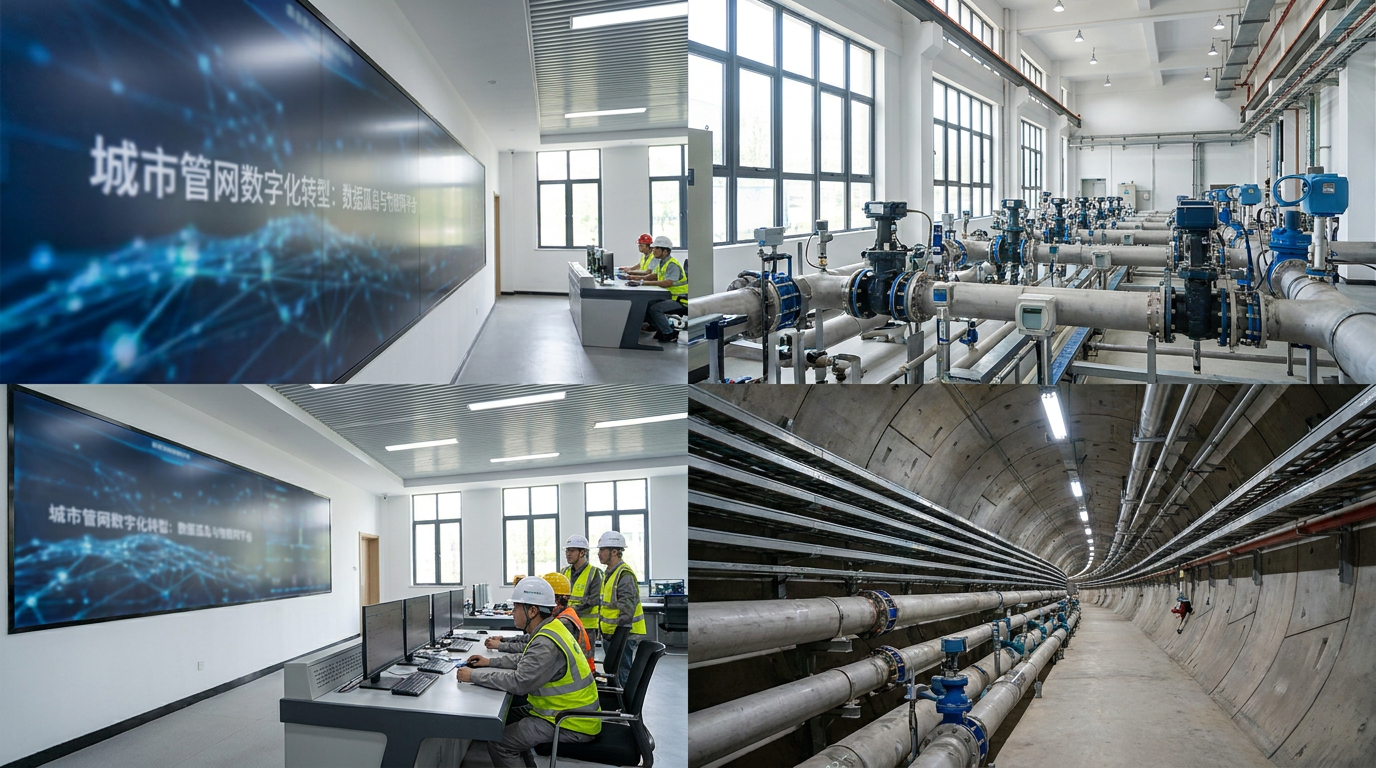
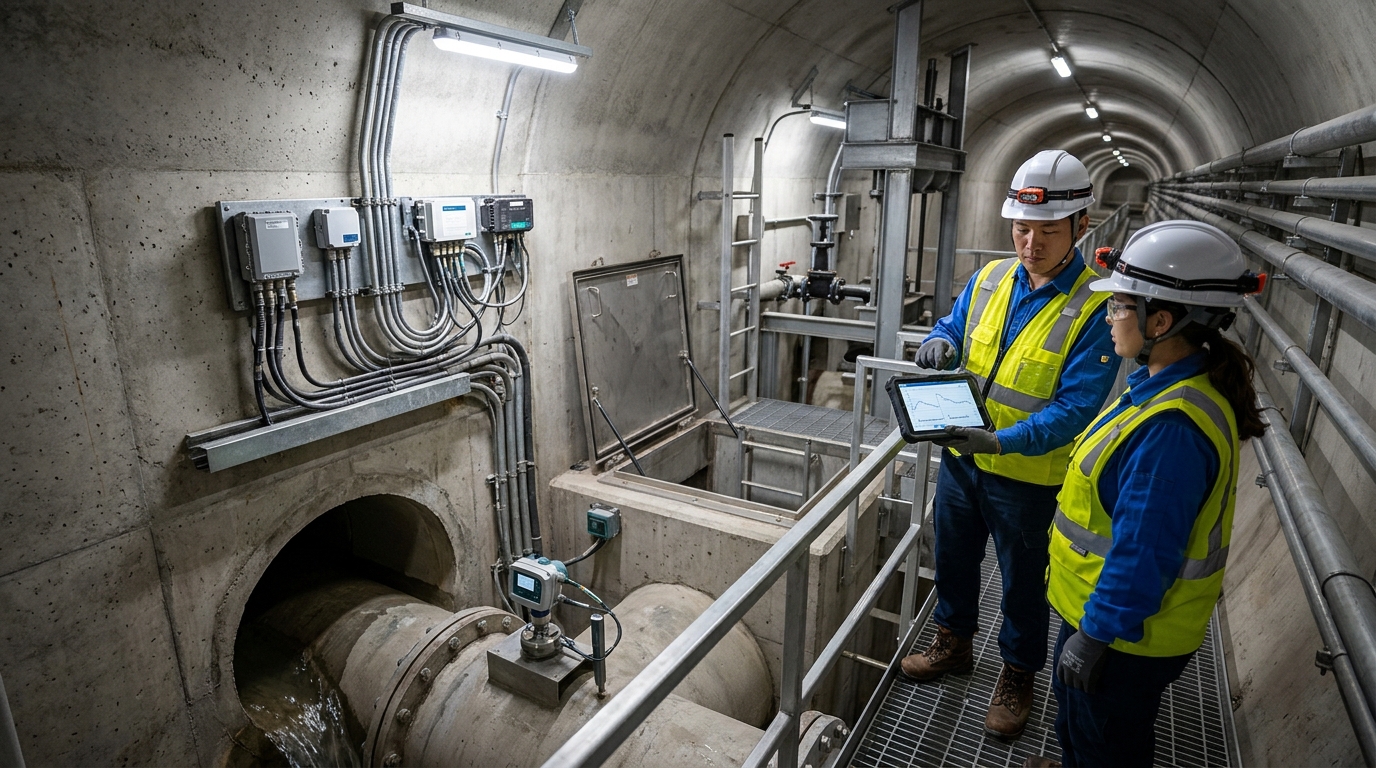
Real-time IoT monitoring transforms invisible underground networks into transparent, manageable assets.
"The urban pipeline network market will present three main themes over the next three to five years: policy-driven scaling, large-scale deployment of sensing facilities, and a shift from empirical judgment to model simulation."
I. Market Trends: Shifting to "Renovation + Sensing"
In terms of market capacity, the industry is transitioning from new construction dominance to a parallel phase of "filling gaps in new construction, updating existing assets, and smart renovation." Public plans indicate that during the "14th Five-Year Plan" period, national investment will maintain a substantial scale, with approximately 80,000 kilometers of new/upgraded sewage pipelines. Unlike the past pursuit of pure treatment capacity, pipeline inspection, cross-connection renovation, and operational monitoring are now high-frequency items in local project portfolios.
- Project Types: Bidding is shifting towards preliminary and operational projects like CCTV inspection, smart platforms, and trenchless rehabilitation.
- Demand Structure: Three converging demands—Safety (waterlogging risk reduction), Environmental Protection (linked monitoring of flow/quality), and Management (unified dispatch platforms).
- Funding Sources: Diversification via ultra-long-term special treasury bonds and local government special bonds is shifting projects from "fragmented renovation" to "packaged implementation and long-term O&M."
II. Policy Impacts: Drivers of Governance & Efficiency
Policy remains the most direct variable. National documents focus on eliminating severe waterlogging risks, reducing pollution, and enhancing underground infrastructure safety. Local policies emphasize census, remediation, and smart supervision.
Waterlogging Governance
Requires a system of "source reduction, pipeline discharge, combined storage, and emergency response." Key cities must verify standards against 20- to 50-year return periods, promoting upgrades to stormwater pipelines and early warning systems.
Sewage Governance
Focus has shifted from "treatment capacity" to "collection efficiency." Indicators like influent BOD concentration and sewage collection rates force authorities to systematically investigate cross-connections and external water infiltration.
Funding and supervision now demand higher maturity. Projects are judged not just by engineering scale but by monitoring capabilities, dispatch mechanisms, and disaster mitigation benefits. The review logic is shifting from "construction volume" to "operational effectiveness."
III. Drainage System Upgrades: Census & Re-evaluation
The first step in upgrading is understanding existing assets. Many pipelines suffer from missing data and complex misconnections. The industry uses QV, CCTV, sonar, and laser scanning to establish archives linked with GIS.
Rain-Sewage Separation: Simply laying new pipes is insufficient. A city in South China adopted a "source area survey + pipeline inspection + verification" approach, reducing sewage overflow frequency by 40% and increasing influent BOD concentration by 15%. This proves effects can be quantified through operational data.
Hydraulic Models: Increasing pipe diameter doesn't always solve waterlogging if backwater effects or insufficient pump capacity exist. The industry increasingly values hydraulic models that integrate rainfall forecasts, surface runoff, and pump station operations to simulate risk distribution under different rainfalls.
IV. Technologies: From Point Monitoring to Model-Based Dispatch
Liquid level and flow rate are the "vital signs" of the drainage network. With decreasing costs, city-wide deployment is becoming standard.
Sensing Equipment Evolution
- Liquid Level Sensors: Radar sensors (26GHz/80GHz) perform stably in narrow manholes compared to ultrasonic sensors, which are sensitive to condensation. Pressure-based sensors suit submerged environments but face drift issues.
- Flow Meters: Traditional full-pipe electromagnetic meters are often unsuitable. Non-full pipe measurement combines liquid level, velocity, and cross-section using Doppler or transit-time ultrasonic solutions.
Data Quality & Governance: Underground environments cause sensor blockages and transmission instability. Modern projects require self-diagnosis and edge calibration. For instance, if liquid levels remain static while rainfall increases, the system should flag sensor blockage rather than generating false alarms.
Closed-Loop Dispatch: Sensing data must enter model loops. 1D-2D coupled models can predict waterlogging areas and depths 15 minutes to 2 hours in advance. Pilots in East China reduced waterlogging disposal time by 30% using "forecast-pre-discharge-pre-storage" mechanisms.
V. Outlook: The "Sensing-Prediction-Dispatch-Review" Loop
Over the next five years, the industry will shift from "engineering project delivery" to "risk governance and operational services." The standard for measuring drainage capacity will move from pipeline mileage to waterlogging risk reduction and emergency response speed.
Opportunities concentrate in four directions: reliable sensing/edge computing, digital twins/AI analysis, trenchless inspection services, and performance-based O&M. As data becomes integrated, urban underground networks will transform from "invisible infrastructure" into a safety foundation that is sensible, predictable, dispatchable, and reviewable.