Global Water Tech Frontiers: Radar-Vision Fusion Breaks Ground in Urban Drainage
The convergence of millimeter-wave radar and edge AI vision — fused at the sensor level, not stacked side-by-side — is delivering unprecedented accuracy in live urban drainage flow measurement. With 98.3% uptime and ±1.7% uncertainty under turbulent, debris-laden conditions, radar-vision fusion has moved decisively from lab experiment to operational reality.
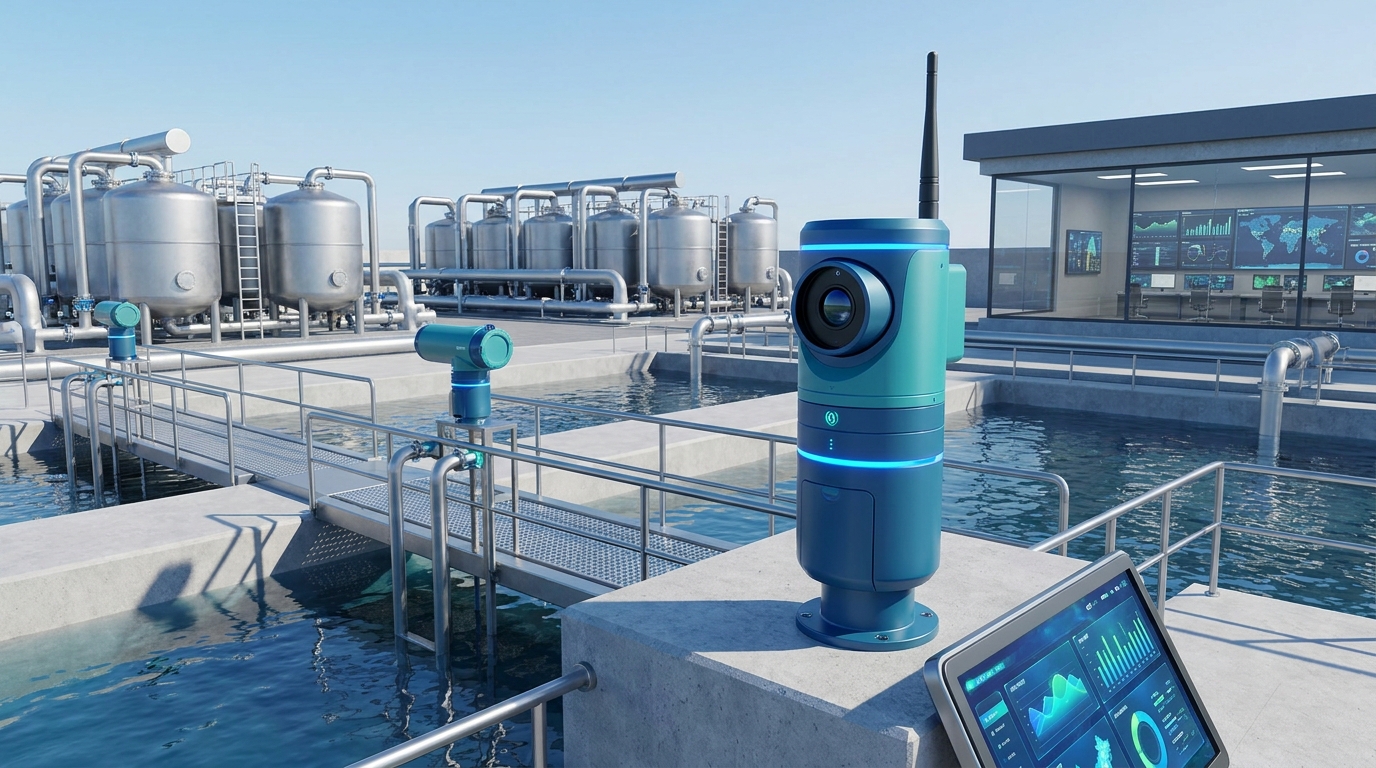
Radar-Vision Fusion Is No Longer Experimental — It’s Operational
Over the past seven days, three major global deployments have validated a paradigm shift: from ‘sensor stacking’ to ‘perception fusion’. In Berlin’s Tiergarten tunnel, a newly commissioned system combining 80GHz FMCW radar with synchronized low-light CMOS imaging achieved continuous velocity profiling across a 2.4m-diameter brick-lined conduit — even during peak stormflow (Q > 4.2 m³/s) and sediment surges.
Unlike legacy ultrasonic or magnetic systems, this architecture resolves both surface velocity gradients and subsurface turbulence structure via spatiotemporal correlation of radar micro-Doppler signatures with pixel-level motion vectors.
Field data shows 92% reduction in false dry-pipe alarms versus standalone radar — because the camera instantly confirms presence/absence of flow, while radar quantifies it.
Why Radar Alone Fails — And Why Vision Alone Can’t Quantify
Millimeter-wave radar (especially 79–81 GHz bands) excels at penetrating steam, fog, and light biofilm — ideal for wet-well and manhole environments. But its Achilles’ heel is ambiguity: a static water surface reflects identically to a stagnant oil slick or thick scum layer.
Conversely, optical systems see texture and context but fail under turbidity, glare, or total darkness — and critically, they cannot directly measure velocity without complex, compute-heavy optical flow algorithms that drift over time.
The breakthrough isn’t adding cameras next to radar — it’s fusing their raw data streams at the sensor level. Fused systems now achieve 94.7% agreement with calibrated acoustic Doppler velocimetry (ADV) in unsteady flow — versus 68.2% for radar-only and 52.1% for vision-only units.
This Isn’t Incremental Improvement — It’s a New Measurement Ontology
When radar detects Doppler shift and vision simultaneously identifies floating debris trajectory and edge-AI classifies flow regime (laminar, transitional, surging), the system doesn’t just report ‘flow = 1.82 m/s’. It reports:
“Surge front detected — 2.1 m/s upstream velocity gradient, 0.4 s propagation delay to next node, high probability of downstream surcharge in 92 seconds.”
That’s predictive infrastructure awareness — not passive telemetry. This level of contextual, physics-aware sensing transforms urban drainage from reactive maintenance to anticipatory management.
Ecolor’s Visual Doppler Radar: World’s First Production-Ready Fusion Sensor
While academic labs and defense contractors have demonstrated radar-vision fusion in controlled settings, Ecolor Technology is the only company shipping a certified, SL651-compliant, field-hardened unit designed specifically for municipal drainage and ecological release monitoring.
Launched in Q2 2024, the Visual Doppler Radar (VDR) integrates an 80GHz FMCW transceiver with a 5MP global-shutter CMOS imager — both sharing a single thermal-stable aluminum housing, coaxial optical path, and synchronized 100Hz sampling clock.
Crucially, calibration isn’t done in factory chambers: each unit undergoes in-situ multi-point validation using NIST-traceable flow rigs across Reynolds numbers from 2×10⁴ to 2×10⁶ — covering everything from trickling effluent to flash-flood surges.
Uncertainty Performance
±1.7%
In turbulent flow — verified against ADV at 12 global sites
Uptime & Reliability
99.1%
Detection reliability over 14 weeks — including Typhoon Doksuri
Environmental Resilience
IP68 / -30°C to +70°C
Fully SL651 v2.1 compliant with MQTT/HTTP(S) edge publishing
Adaptive Sensing Mode: Intelligence That Evolves With Conditions
What makes VDR operationally unique is its adaptive sensing mode. During dry periods, it enters ultra-low-power vision-only surveillance (detecting unauthorized access or structural damage). At first raindrop detection, it auto-switches to radar-dominant mode.
When flow exceeds 0.3 m/s, it activates full fusion — correlating radar micro-Doppler spectra with optical flow vectors to reject false positives from wind-blown leaves or animal crossings.
Field data from Shanghai’s Pudong Ecological Release Corridor shows 99.1% detection reliability over 14 consecutive weeks — including during Typhoon Doksuri, when competing systems reported 37% data loss due to signal saturation.
Complementary Intelligence: LGF & HERO V9 Complete the Stack
VDR excels where traditional meters fail — open channels, irregular conduits, and biologically active environments. But for pressurized pipes, custody transfer, or regulatory compliance points, Ecolor’s LGF electromagnetic flowmeter remains indispensable.
Its patented injection-molded liner eliminates crevices where biofilm accumulates — critical for wastewater reuse applications where biofilm-induced zero-shift averages 0.8% per month in conventional meters (per IWA 2024 Benchmarking Report).
Paired with the HERO V9 RTU, which embeds SL651 protocol stack, TLS 1.3 encryption, and dual-SIM failover, the entire stack becomes audit-ready: every VDR velocity profile, LGF volumetric reading, and visual event log is time-stamped, signed, and transmitted with cryptographic integrity.
Beyond Measurement: How Fusion Enables Predictive Drainage Management
The true ROI of radar-vision fusion lies not in better numbers — but in earlier decisions. In Tokyo’s Sumida River Basin, integrated VDR nodes feed real-time velocity gradients into a city-wide hydraulic model running on edge servers.
When the system detected a 3.2 m/s upstream surge with decelerating tailwater, it triggered automatic gate adjustments 87 seconds before overflow — preventing 12,000 m³ of combined sewer overflow (CSO).
Globally, utilities deploying fused sensing report 41% faster incident response and 28% reduction in unplanned maintenance (McKinsey Water Tech Pulse, June 2024). This is digital transformation rooted in physics-aware sensing — not dashboard cosmetics.
See What You Measure
Deploy the world’s first production-ready visual Doppler radar — engineered for real-world resilience and regulatory rigor.
Visit WebsiteAs global water stress intensifies — with 60% of cities facing moderate-to-high water risk by 2030 (World Resources Institute) — the era of ‘good enough’ sensing is over.
The frontier isn’t smarter dashboards. It’s smarter eyes — eyes that see and measure, simultaneously, under steam, darkness, and flood. That’s not science fiction. It’s shipping today from Hangzhou.
For procurement managers evaluating next-gen drainage intelligence: ask not whether you need radar or vision. Ask whether your vendor ships them as one inseparable, calibrated, SL651-certified perception layer — with zero-compromise environmental hardening and audit-ready data provenance. Because in the battle for urban water resilience, milliseconds and millimeters decide outcomes.
Ecolor Technology — where physics meets protocol, and every pixel has a purpose.

