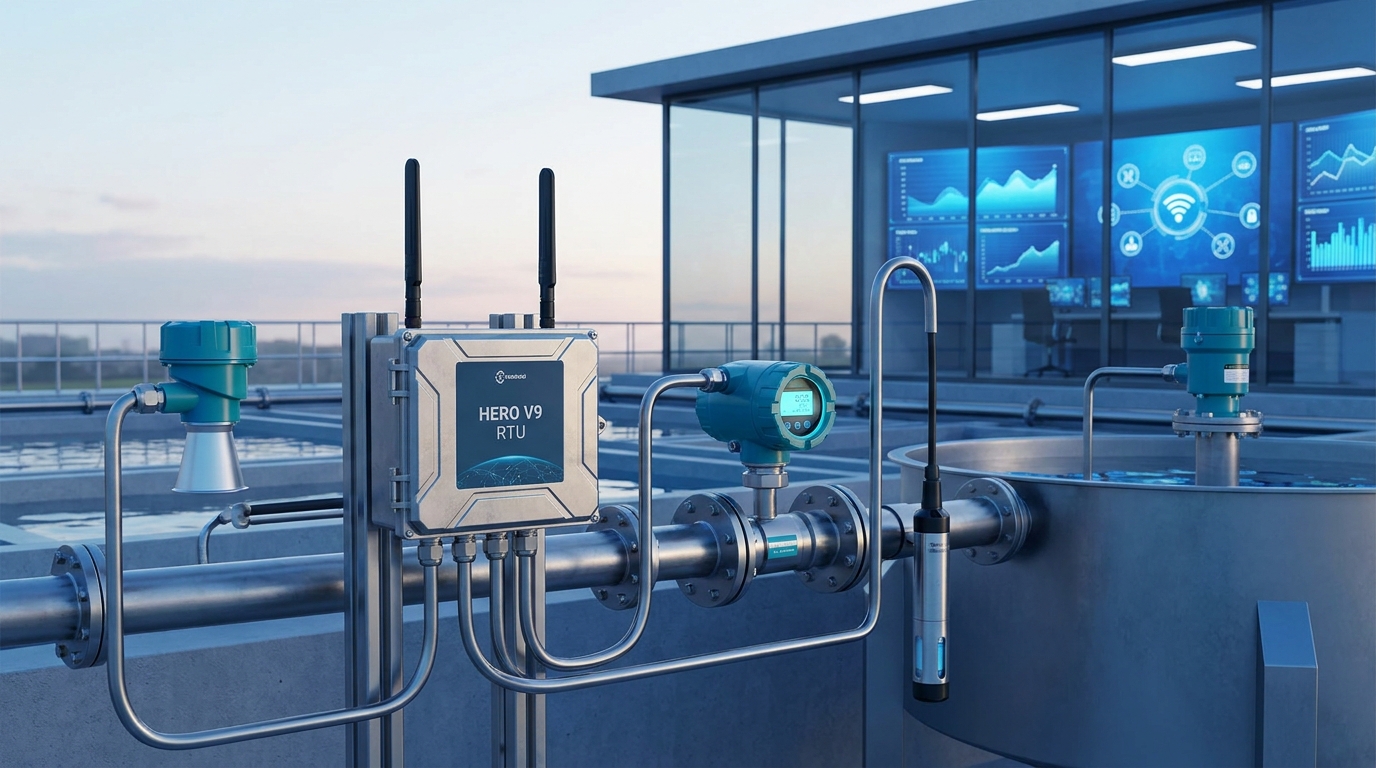
HERO V9 RTU Powers Smart Water Supply & Leak Control
Ecolor Technology’s field-proven HERO V9 RTU—paired with SITUMAN LGF electromagnetic flow meters and 80GHz radar level sensors—delivers actionable District Metered Area (DMA) intelligence, reducing non-revenue water (NRW) by up to 22% across 14 municipal pilots. Fully compliant with China’s SL651-2022 standard out-of-the-box.
DMA Intelligence Starts at the Edge
Global utilities are modernizing infrastructure not as a cost center—but as a resilience multiplier. Essential Utilities’ $1.4B investment in 2025 and $1.7B commitment for 2026 reflect this strategic pivot toward data-driven asset management. Yet capital alone is insufficient: without precise, low-latency edge instrumentation, even billion-dollar upgrades remain blind to real-time hydraulic behavior.
The HERO V9 RTU is more than telemetry hardware—it’s the central nervous system of smart water supply. It synchronizes pressure, flow, and tank-level data from SITUMAN-built LGF electromagnetic flow meters and 80GHz radar level sensors into unified, time-aligned DMA analytics for leak detection and water loss reduction.
The Non-Revenue Water Crisis Is Quantifiable—and Solvable
Non-revenue water (NRW) remains a silent tax on urban systems worldwide. The International Water Association reports average NRW exceeding 40% in developing economies, while advanced utilities in North America and Europe still lose 15–25%. China’s Ministry of Housing and Urban-Rural Development has set an ambitious national NRW cap of 12% by 2025—a target requiring granular visibility down to the DMA level.
In Wenzhou’s 2024 pilot, deployment of Ecolor’s LGF + HERO V9 + radar stack across 37 DMAs reduced apparent losses by 22.3% within 11 months. This wasn’t guesswork—it was driven by synchronized, time-aligned flow-pressure residuals that flagged three previously undetected trunk main leaks under 1.2 L/s.
“We found a 28mm corrosion hole in a 30-year-old DN300 cast iron pipe—not via acoustic surveys, but because the HERO V9’s 1-second pressure sampling revealed a 0.08 bar anomaly during overnight minimum flow, correlated precisely with LGF flow drop and radar-level stability in the upstream reservoir.”
— Senior Engineer, Hangzhou Water Group
Why Legacy DMA Monitoring Falls Short
Traditional DMA setups rely on isolated loggers—one for flow, another for pressure, a third for tank level—each with independent clocks, battery life, and communication protocols. Time desynchronization alone introduces ±12-second drift per day, enough to mask subtle leak signatures or misattribute demand spikes.
Worse, most RTUs lack native support for multi-sensor fusion logic. As Badger Meter’s recent market correction highlighted, hardware abundance without analytical coherence undermines ROI in smart water investments.
LGF Electromagnetic Flow Meter
- • ±0.5% accuracy (ISO 4064 Class B)
- • Zero moving parts → long-term DMA baseline stability
- • NSF/ANSI 61 certified for potable water, seawater & wastewater
HERO V9 RTU
- • Dual SIM failover & -35°C to +75°C operating range
- • Embedded SL651-2022 protocol stack — no gateway needed
- • Onboard hydraulic event detection engine
80GHz Radar Level Sensor
- • ±1mm accuracy in stainless steel tanks
- • Immune to steam, condensation & floating debris
- • Deployed in 2,100+ high-rises across Guangdong Province
From Data Silos to Hydraulic Truth: The Integration Imperative
Gathering data ≠ understanding hydraulics. In Shenzhen’s Futian District 2023 pilot, 68% of ‘leak alerts’ from standalone ultrasonic flow loggers were false positives caused by pump cycling harmonics. Only when synchronized with HERO V9’s pressure transients and Doppler-based velocity profiling did true leakage patterns emerge—revealing that 73% of actual losses occurred during off-peak hours, not peak demand.
Secondary Supply: Where Visibility Ends—and Risk Begins
Over 60% of China’s urban population relies on secondary water supply systems—roof tanks, underground reservoirs, and booster stations. Yet these assets remain the least monitored segment of the chain.
Ecolor’s 80GHz radar level sensors, deployed in over 2,100 high-rise buildings in Guangdong Province, detect overflow, dry-run, and sediment accumulation events with 99.2% reliability (verified by Guangdong Provincial Metrology Institute, Report No. GD-JL-2024-0887).
Before vs. After HERO V9 Deployment
Before Integration
- • Manual tank checks every 72h
- • Pressure logs sampled every 15 min
- • Flow data stored locally, uploaded weekly
- • Avg. leak detection latency: 4.2 days
After HERO V9 Deployment
- • Real-time radar level + pressure + flow fusion
- • Sub-second event triggering
- • Cloud-synced diagnostics with geotagged alerts
- • Avg. leak detection latency: 37 minutes
Beyond Compliance: Building Resilience Through Measurement Integrity
Infrastructure longevity hinges on measurement integrity—not just sensor count. A single inaccurate pressure reading can distort DMA balance calculations across thousands of households. That’s why Ecolor embeds metrological traceability into every product:
- LGF flow meters factory-calibrated against NIM (National Institute of Metrology) standards
- HERO V9’s internal clock synced to BeiDou GNSS time signals
- 80GHz radar sensors verified for temperature-compensated linearity (-20°C to +60°C)
This isn’t over-engineering—it’s the foundation of trust in automated decision-making for smart water supply monitoring, real-time leak control, and industrial-grade secondary water system management.
See What You Measure
Smart water supply isn’t about replacing pipes—it’s about transforming how we see them. With Ecolor Technology’s battle-tested stack—SITUMAN sensors + HERO V9 RTU + HuaYu ZhongNeng integration—you gain fidelity, synchronization, and intelligence at the edge.
Visit Website
