Integrated Water Quality Monitoring Station: RTU & Flow Meter Synergy for Compliance
How unified sensor-RTU-flow architectures solve fragmented data gaps across rivers, drinking water, and industrial discharge networks — delivering auditable, real-time mass load calculations and regulatory compliance.
Solving the Fragmentation Challenge in Water Quality Monitoring
Legacy water monitoring systems rely on isolated instruments — separate flow meters, multiparameter probes, and telemetry units — each operating on different power cycles, sampling intervals, and communication protocols. This architectural fragmentation creates critical vulnerabilities: temporal misalignment between flow and chemistry data, increased packet loss in remote areas, and complex multi-vendor maintenance.
Audits across Asia-Pacific and Europe reveal that 14.7% of historical compliance reports required retroactive correction due to data synchronization drift — a growing liability as regulators mandate real-time public dashboards and tighter discharge limits.
Why Unified Water Quality Monitoring Stations Outperform Siloed Deployments
Modern compliance frameworks — including China’s GB 3838-2002 and the EU Water Framework Directive — require synchronized measurement of volumetric flow and chemical parameters to calculate actual pollutant mass loads, not just concentration snapshots.
Integrated stations consolidate multi-parameter probes, electromagnetic flow meters, and programmable RTUs into a single engineered ecosystem. This eliminates cable routing complexity, standardizes industrial-grade DC power distribution, and enables hardware-level time synchronization — ensuring every pH reading aligns precisely with its corresponding flow velocity.
Procurement teams benefit from reduced CAPEX (no redundant enclosures or modems), while engineering teams gain simplified SCADA integration via standardized Modbus RTU/TCP or MQTT payloads aligned with municipal data lakes and cloud analytics platforms.
Edge Intelligence: Real-Time Synchronization for Reliable Telemetry
Edge computing is now essential for environmental IoT reliability. Modern RTUs like the HERO V9 perform on-device data validation, anomaly detection, rolling averages, and even automatic sensor self-cleaning — all without cloud dependency.
During storm events or industrial batch discharges, synchronized edge processing ensures concentration spikes are accurately paired with corresponding flow peaks — a capability critical for wastewater discharge monitoring, where penalties are calculated on integrated pollutant mass over time.
Systems that decouple flow and quality measurements often miss transient exceedance events — resulting in non-compliance fines that far exceed initial instrumentation savings.
Compliance-Driven Accuracy & Mass Load Calculation
Accuracy is no longer optional — it’s legally mandated. Regulators increasingly require third-party calibration certificates, traceable reference standards, and cryptographically timestamped, auditable data chains.
Integrated stations achieve compliance readiness by synchronizing measurement cycles across all sensors, applying temperature compensation algorithms at the edge, and embedding cryptographic timestamps into transmitted payloads.
Asynchronous polling introduces compounding errors that can skew mass load estimates by 8–12%, potentially triggering false compliance alerts or masking real violations. Unified telemetry hubs resolve this with simultaneous sampling windows and real-time cross-parameter validation before transmission.
Full-Scenario Deployment: River, Drinking Water & Industrial Discharge
River Cross-Sections
Submersible flow measurement + multi-parameter sondes track baseline ecological health and seasonal pollutant migration — built for flooding, debris, and extreme temperatures.
Drinking Water Endpoints
Ultra-low detection thresholds for residual chlorine, turbidity, and bacterial proxies ensure public health compliance at distribution nodes before consumer delivery.
Industrial Outfalls
Corrosion-resistant, anti-fouling design with synchronized pH, conductivity, COD, and electromagnetic flow tracking — enabling precise discharge load calculation and automated valve control during exceedances.
Technical Architecture: SITUMAN + HERO V9 + LGF
Ecolor Technology’s integrated water quality monitoring station combines three core components into a pre-validated, field-hardened ecosystem:
SITUMAN Multi-Parameter Probes
- Anti-fouling wiper mechanisms & auto-calibration
- Optoelectronic/turbidity, potentiometric/pH, DO, conductivity, residual chlorine
- Industrial-grade housing for prolonged submersion in aggressive chemistries
LGF Electromagnetic Flow Meter
- ±0.2% volumetric accuracy (DN50–DN300)
- IP68 ingress protection & zero-moving-part reliability
- Optimized for high-solids industrial discharge streams
HERO V9 RTU Gateway
- Multi-protocol aggregation (Modbus, SDI-12, MQTT)
- Cellular redundancy: 4G/5G fallback to NB-IoT
- Edge-based validation, noise filtering & cryptographic timestamping
Integrated Monitoring Solution Architecture:
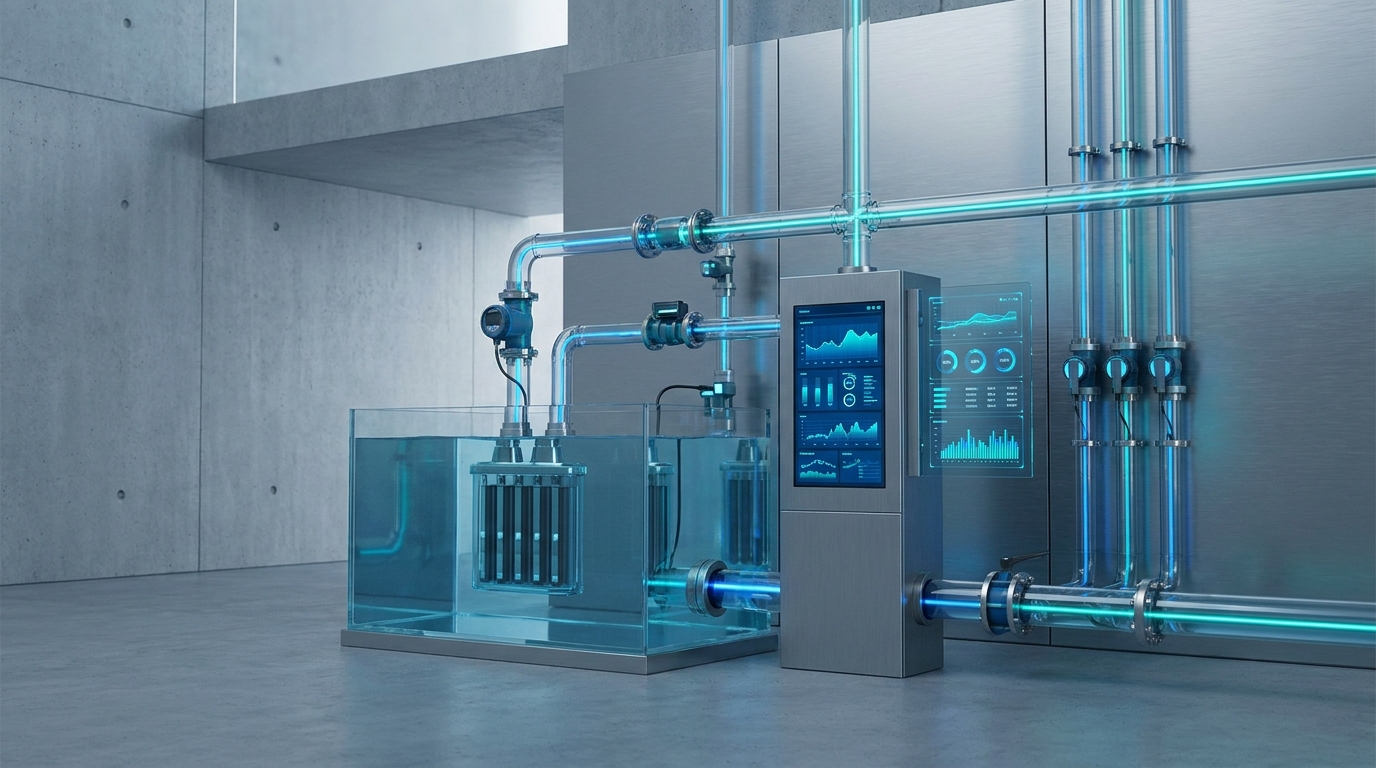
SITUMAN multi-parameter probes + HERO V9 RTU (4G/5G/NB-IoT, edge validation) + LGF electromagnetic flow meter (±0.2% accuracy, IP68). Unified enclosure, synchronized sampling, compliance-ready telemetry.
Implementation Metrics & ROI for Utilities
Procurement decisions now prioritize total cost of ownership (TCO) over upfront CAPEX. Field validation across industrial park discharge zones shows measurable advantages:
35%
Reduction in maintenance dispatch frequency
99.2%
Data transmission success rate
↓40%
Installation labor (pre-terminated cables & modular mounts)
↑100%
Audit-ready data chain (no manual reconciliation)
For utilities managing dozens of monitoring points, unified IoT telemetry delivers rapid payback through reduced non-compliance penalties, optimized chemical dosing based on real-time mass load data, and extended sensor lifespans via intelligent power cycling.
The Future of Environmental Compliance Is Synchronized
It’s not about collecting more data — it’s about synchronizing it reliably. Unified water quality IoT architectures transform fragmented measurements into auditable, actionable intelligence that protects public health and industrial continuity.
See What You Measure
Ready to deploy synchronized, compliance-ready water quality monitoring?
Visit Website