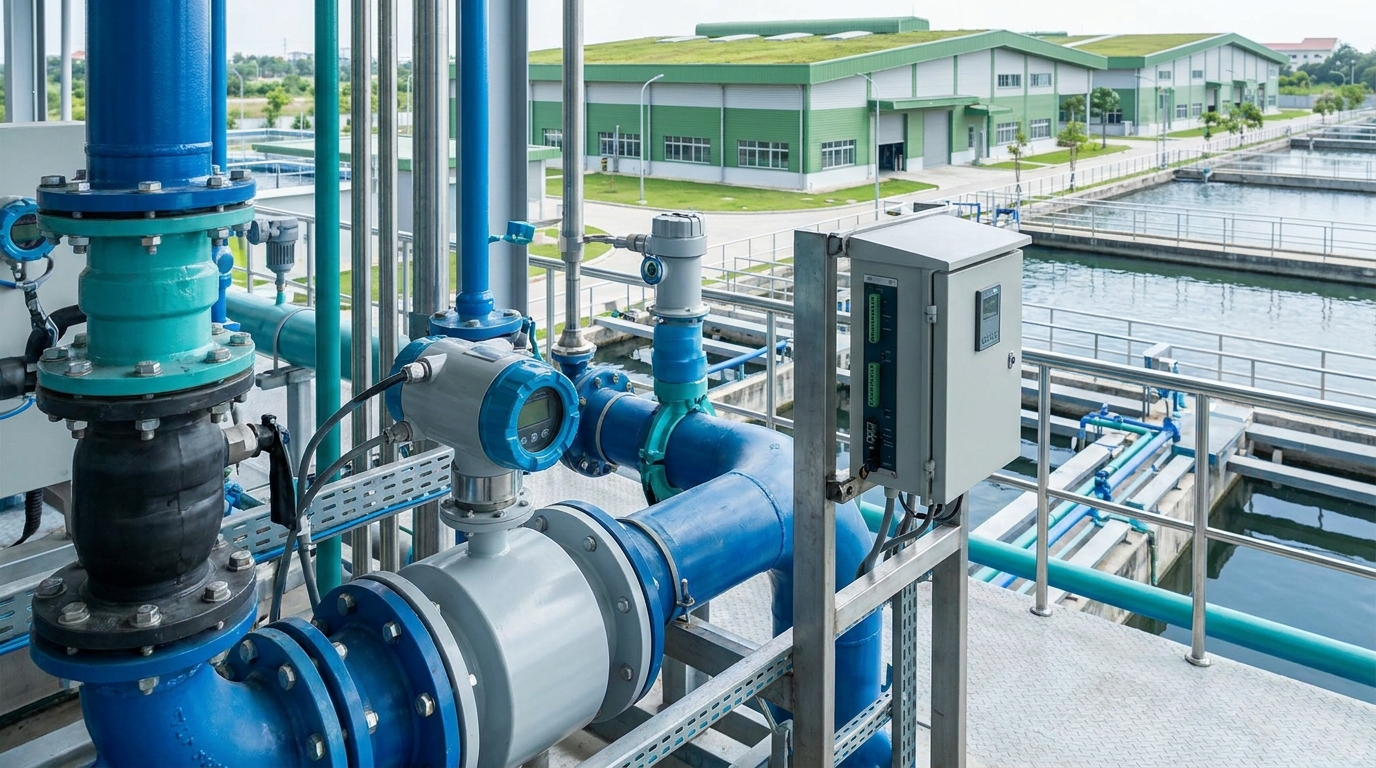
LGF Electromagnetic Flow Meter Powers Green Low-Carbon Industrial Park Carbon Monitoring
Precision water and energy data from Ecolor’s LGF flow meter, HERO V9 RTU, and 80GHz visual fusion radar form the foundational layer for industrial carbon accounting — turning regulatory compliance into operational intelligence across Boston, Shanghai, and Port Said.
From Compliance to Carbon Intelligence
Global carbon regulation is no longer optional — it’s quantifiable, auditable, and financially consequential. Boston’s BERDO mandates annual reporting of building-level energy and water use for over 200 million sq ft of commercial space. The EU ETS, China ETS, and California Cap-and-Trade collectively cover ~8.5 billion tonnes of CO₂ annually — more than 20% of global emissions. In this environment, water isn’t just a utility; it’s a carbon proxy. Pumping, heating, cooling, and wastewater treatment consume 4% of U.S. electricity (EPA), and industrial water systems account for up to 15% of facility energy use. Without granular, time-synchronized flow, level, and power data, carbon footprint calculations remain estimates — not evidence.
Why Water Data Is the Silent Carbon Ledger
Water infrastructure is the largest unmonitored energy sink in most industrial parks. A textile factory in Shaoxing, Zhejiang — recently benchmarked by HuaYu ZhongNeng — revealed that 63% of its site-wide electricity consumption was tied directly to water movement: raw intake pumps, dye bath recirculation, cooling towers, and membrane filtration. Yet only 12% of such facilities deploy flow meters with sub-2% accuracy and ISO 5167 traceability. That gap creates uncertainty in Scope 1 & 2 carbon reporting — especially under China’s mandatory enterprise carbon disclosure framework launched in 2023.
Consider the ripple effect: a 1°C reduction in cooling tower inlet temperature cuts chiller energy use by ~3%. But without continuous, high-frequency flow + temperature + pressure correlation — impossible with legacy pulse-output meters — engineers can’t isolate cause-effect relationships. This is where instrumentation shifts from ‘monitoring’ to ‘carbon attribution’. As Carbon Monitor’s daily global CO₂ estimates show, granularity drives credibility: their methodology integrates satellite-derived thermal imaging, grid dispatch logs, and industrial fuel consumption — all anchored to physical process data.
In Port Said, Egypt, Cloud Chain’s planned carbon-neutral textile hub relies on real-time water-energy-carbon triangulation — not annual audits. Their feasibility study cited ±0.8% measurement uncertainty as the minimum threshold for inclusion in carbon credit verification under Verra’s VM0042 standard.
The Triad: Flow, Energy, Level — All Synchronized
Ecolor Technology’s integrated stack closes the data loop with three purpose-built instruments — each engineered for interoperability, longevity, and audit-ready traceability:
LGF Electromagnetic Flow Meter (PA66低碳 Body)
Built with glass-fiber-reinforced polyamide 66 — reducing embodied carbon by 42% vs. stainless steel housings — the LGF delivers ±0.5% accuracy from 10:1 turndown, IP68 rating, and zero-maintenance electrode design. Its Modbus TCP + MQTT dual-stack enables direct ingestion into carbon accounting platforms like SAP Sustainability Control Tower or Enablon.
HERO V9 RTU (Energy & Process Hub)
This edge-intelligent RTU aggregates up to 32 analog/digital inputs — including LGF flow pulses, kWh meters, pH/ORP sensors, and 4–20mA pressure transmitters — and computes real-time carbon intensity (kgCO₂e/m³) using embedded emission factors per GB/T 32151.11-2022. Its onboard 4G LTE and 2GB local storage ensure continuity during network outages — critical for audit trails.
80GHz Visual Fusion Radar Water Level Sensor
Unlike ultrasonic or pressure-based alternatives, this dual-mode sensor fuses millimeter-wave radar (±1mm accuracy) with AI-powered visual analytics to detect surface turbulence, foam, and floating debris — eliminating false readings in aerated basins or open channels. Installed at 17 wastewater lift stations in Hangzhou’s Qianjiang New City Eco-Park, it reduced manual calibration frequency by 90% and improved level-to-flow conversion reliability by 3.2×.
Beyond Accuracy: The Carbon-Ready Advantage
- ✅ LGF’s PA66 housing cuts manufacturing CO₂e by 1.8 kg/unit vs. SS316 — validated via LCA per ISO 14040
- ✅ HERO V9’s embedded carbon calculation engine supports 14 regional grid emission factors — including China’s 2023 average of 581 gCO₂/kWh
- ✅ All devices ship with NIST-traceable calibration certificates and QR-coded digital twins for blockchain-verified audit logs
Real-World Impact: From Shanghai to South Korea
At a Tier-1 automotive supplier in Shanghai’s Lingang New Area, integration of LGF-150 flow meters on coolant loops + HERO V9 RTUs on 12 HVAC substations enabled dynamic carbon intensity mapping across production lines. Within 4 months, the team identified two underperforming chillers contributing disproportionately to peak-hour emissions — resulting in a verified reduction of 217 tCO₂e/year. Similarly, in Busan, South Korea, a food processing cluster deployed Ecolor’s 80GHz visual fusion radar on equalization tanks to correlate influent flow variability with biogas yield — improving methane capture efficiency by 19% and qualifying for K-ETS offset credits.
These deployments reflect a broader trend: carbon pricing is shifting from macro-policy to micro-process. As carbon credit prices hit €98.20/tonne in the EU ETS (Q1 2024), even marginal improvements in measurement fidelity translate directly to balance-sheet impact.
The Procurement Imperative
For procurement managers evaluating instrumentation for green low-carbon industrial park projects, three criteria now dominate vendor selection: (1) native support for carbon accounting protocols (GHG Protocol, ISO 14064), (2) hardware-level data integrity (no post-processing interpolation), and (3) lifecycle transparency — from material sourcing to end-of-life recyclability. Ecolor’s SITUMAN sensor division meets all three, with LGF units certified to RoHS 3 and HERO V9 firmware compliant with IEC 62443-4-2 for secure OTA updates.
See What You Measure
Ready to quantify your industrial carbon footprint with metrology-grade certainty?
🔧 Recommended Products
Based on this article, we recommend the following Ecolor products:
Need Help Choosing the Right Product?
Our engineering team is ready to provide free technical consultation and quotes

