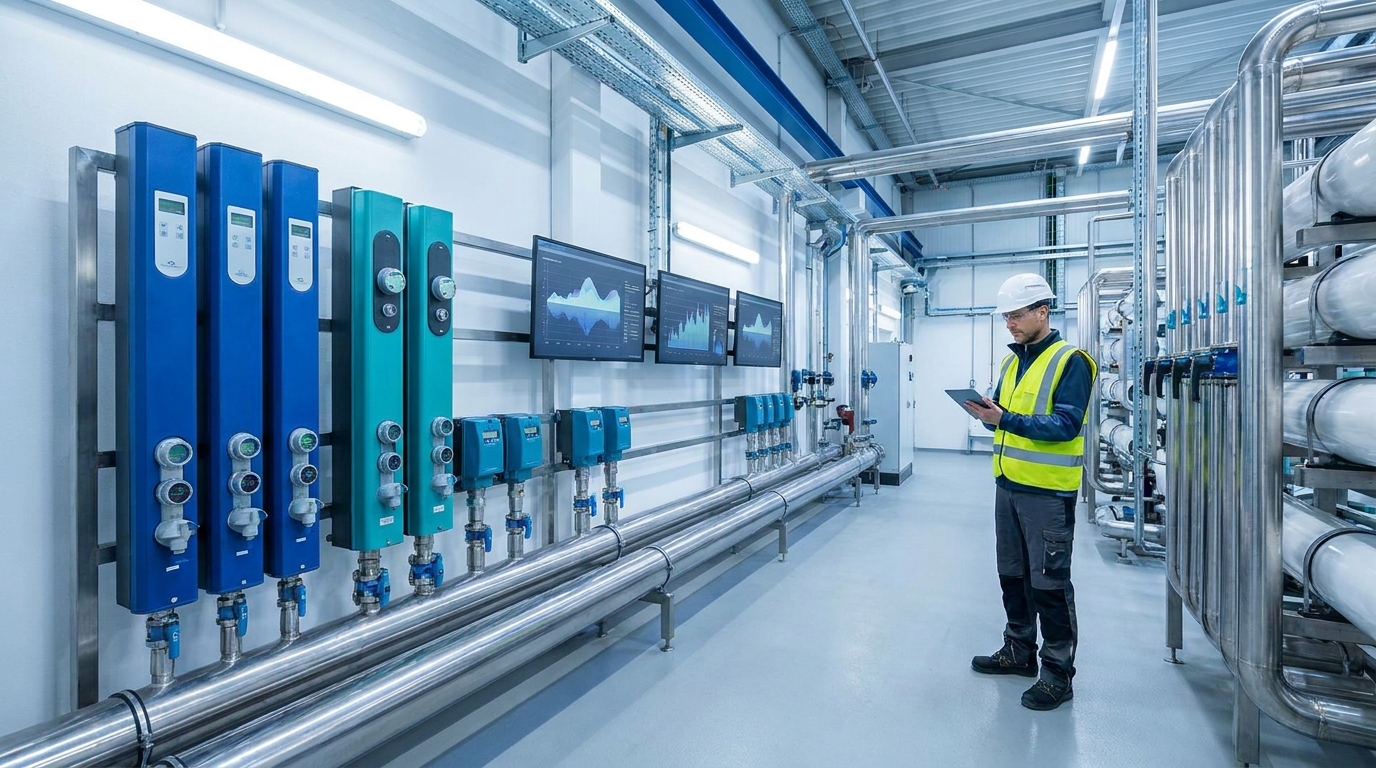
Next-Gen Flow Meter & RTU Integration for PFAS Compliance and AI Water Networks
As global water infrastructure confronts emerging contaminants and AI-driven operational demands, precision sensing and edge telemetry have become the critical bridge between breakthrough filtration and real-world compliance.
The 2026 Water Tech Paradigm: AI, PFAS, and Decentralized Sensing
The global water sector is undergoing a structural shift. Recent breakthroughs in zero-waste desalination and nano-cage PFAS filtration promise unprecedented purification capabilities, yet their commercial viability hinges entirely on dynamic, real-time flow and pressure telemetry. Procurement leaders and municipal engineers must now prioritize data fidelity at the edge to unlock the full potential of AI digital twins and automated treatment systems.
The 2026 Water Tech Paradigm: AI, PFAS, and Decentralized Sensing
The global water technology landscape in 2026 is defined by a dual mandate: eliminating legacy contaminants and achieving autonomous operational efficiency. At WEFTEC 2026, industry leaders are converging on a shared realization—hardware innovation alone cannot solve systemic water challenges. The true bottleneck lies in data acquisition. Advanced treatment processes, whether they involve zero-waste desalination or targeted PFAS adsorption, require continuous, high-fidelity telemetry to optimize chemical dosing, manage hydraulic loads, and maintain regulatory compliance. Without robust water IoT infrastructure, these laboratory breakthroughs remain isolated experiments rather than scalable municipal solutions.
For procurement managers and system integrators, this paradigm shift demands a reevaluation of capital expenditure strategies. The focus is moving from isolated instrumentation to interconnected, protocol-compliant sensing networks capable of feeding AI models with clean, time-stamped data. The integration of smart water technology with decentralized edge computing is no longer optional; it is the foundational layer for next-generation utility resilience.
Beyond Desalination: Zero-Waste Innovation & The Data Imperative
Recent research from the University of Rochester highlights a novel desalination approach that eliminates traditional brine discharge, achieving near-zero waste through advanced membrane cycling and pressure optimization. While the chemistry is revolutionary, the operational reality is stark: zero-waste systems operate within extremely narrow hydraulic margins. A ±2% variance in feedwater flow or pressure can compromise membrane integrity, trigger premature fouling, or disrupt the delicate balance required for continuous recycling.
The PFAS Breakthrough: Why Real-Time Monitoring is the New Compliance Frontier
Simultaneously, breakthroughs in contaminant removal are accelerating. Scientists have developed nano-cage filtration media capable of capturing 98% of toxic PFAS compounds, including notoriously difficult short-chain variants. However, adsorption kinetics are highly dependent on flow velocity, contact time, and water temperature. Static monitoring cannot adapt to diurnal demand fluctuations or sudden stormwater influxes. To maintain compliance with tightening EPA and global PFAS standards, utilities must deploy instrumentation that provides continuous, millisecond-level telemetry to automated control valves and dosing pumps.
"Advanced filtration technologies are only as reliable as the data feeding them. Without precise, real-time flow and pressure monitoring, even the most innovative treatment media will underperform or fail prematurely in dynamic municipal environments."
Bridging the Gap: How Edge Sensing Powers Digital Twins
The MIT Technology Review's 2026 outlook emphasizes that AI-driven water management requires high-resolution, low-latency data streams. Digital twins are rapidly transitioning from conceptual models to operational command centers. Yet, their predictive accuracy collapses when fed by outdated, uncalibrated, or fragmented sensor networks. This is where water digital transformation meets hardware engineering.
Ecolor Technology's LGF Electromagnetic Flowmeter addresses this exact challenge. Engineered for complex, conductive wastewater and potable applications, the LGF delivers ±0.5% measurement accuracy across a wide dynamic range. Its fully welded, IP68-rated construction eliminates gasket failures in submerged or high-humidity environments, ensuring uninterrupted data continuity. When paired with the HERO V9 RTU, which natively supports the SL651 hydrological telemetry protocol, utilities gain a standardized, secure data pipeline from the pipe to the cloud.
LGF Flowmeter
±0.5% accuracy, zero moving parts
HERO V9 RTU
SL651 protocol, edge validation, cellular
Integration
DMA, treatment plant, PFAS compliance
Visual Fusion Radar & Doppler: Seeing What Traditional Sensors Miss
Urban drainage and ecological discharge channels present a different set of monitoring challenges. Traditional ultrasonic or contact sensors frequently fail due to foam, debris, or rapidly changing cross-sectional profiles. The industry's shift toward non-contact, AI-verified sensing is accelerating, driven by the need for maintenance-free, audit-ready data.
Urban Drainage & Ecological Release: The World's First Visual Doppler Solution
Ecolor Technology's Visual Fusion Radar Level Gauge (80GHz + Camera) and the Visual Doppler Flow Radar represent a fundamental leap in open-channel monitoring. Operating at an 80GHz frequency band, the radar penetrates heavy rain, fog, and surface turbulence with minimal beam divergence. The integrated high-definition camera provides visual verification, allowing operators to cross-reference radar readings with actual flow conditions, debris accumulation, or illegal discharge events.
The Visual Doppler Flow Radar, currently recognized as a globally unique solution for urban drainage and ecological release monitoring, combines microwave velocity profiling with AI-driven surface flow analysis. By eliminating physical installation in the wetted section, it drastically reduces biofouling risks and maintenance cycles. For project managers overseeing combined sewer overflow (CSO) mitigation or environmental compliance programs, this technology transforms subjective inspections into quantifiable, court-admissible data streams.
80GHz Visual Fusion Radar
Millimeter-level precision, camera diagnostics
Visual Doppler Flow Radar
Non-contact, AI velocity profiling
Applications
Ecological release, drainage, flood warning
Procurement & Engineering Strategy: Building Resilient, Compliant Networks
As municipalities transition from reactive maintenance to predictive operations, procurement strategies must prioritize total cost of ownership (TCO) over initial hardware pricing. The integration of smart water technology requires a holistic view of sensor durability, protocol standardization, and data interoperability. Below is a strategic comparison for engineering teams evaluating next-generation monitoring deployments:
Traditional Monitoring
- ❌ Contact sensors prone to biofouling
- ❌ Proprietary protocols causing data silos
- ❌ Reactive maintenance cycles
- ❌ Limited audit trail for compliance
AI-Ready Edge Sensing
- ✅ Non-contact radar & Doppler profiling
- ✅ SL651 & open API integration
- ✅ Visual verification & predictive alerts
- ✅ Immutable, timestamped compliance data
For HuaYu ZhongNeng system integrators and municipal engineering teams, the path forward involves deploying modular, protocol-compliant architectures. By leveraging the HERO V9 RTU's edge computing capabilities alongside high-precision flow and level instrumentation, utilities can reduce false alarms by over 40%, optimize chemical dosing in real-time, and generate automated compliance reports that satisfy stringent environmental regulations. The convergence of advanced filtration chemistry, AI modeling, and robust water IoT infrastructure is no longer a theoretical roadmap—it is the operational baseline for 2026 and beyond.
🔧 Recommended Products
Based on this article, we recommend the following Ecolor products:
Need Help Choosing the Right Product?
Our engineering team is ready to provide free technical consultation and quotes

