SCADA Market Surge Puts RTU Telemetry Front and Center
A recent report by SNS Insider projects the global SCADA market will surpass USD 30.66 billion by 2035, fuelled by industrial automation mandates, smart grid investments and critical infrastructure modernization. Within this ecosystem, Remote Terminal Units (RTUs) held the largest component share of over 32% in 2025, confirming their role as the primary data-acquisition and control nodes for wide-area topologies—oil wells, pipeline control stations, electrical substations and, crucially, water reservoir pump stations. At the same time, PLCs are forecast to grow at a CAGR of 10.89%, driven by smart manufacturing and process control modernization. For water utility engineers and procurement managers, the message is clear: the RTU remains the indispensable edge device, and its selection must be governed by reliability, security, and rigorous hydrological compliance.
Job descriptions across the sector reinforce this reality. When a UK water recruiter like Lanesra seeks an Electrical Project Engineer, they list hands-on experience with “Remote Terminal Unit, instrumentation, control systems, systems integration (SCADA/Telemetry)” right alongside pumps, valves and switchgear. The RTU is no longer a ‘black box’ to be procured as an afterthought; it is the linchpin that determines whether a monitoring network delivers secure, actionable data—or becomes a liability.
? Ecolor HERO V9 RTU – Extreme Telemetry & Compliance Hub
Built on an ARM Cortex-A7 core, the HERO V9 natively speaks SL651 and SL180 hydrological protocols. It delivers 4G/NB-IoT encrypted communications, solar-ready power management, explosion-proof certification, IP68 submersion protection, and operates from -40°C to +85°C. RS485/4-20mA interfaces welcome any legacy sensor. No protocol converters, no extra boxes—just turnkey compliance for water and wastewater projects. Explore HERO V9
Hydrological Compliance: Why Native Protocols like SL651 Are a Non-Negotiable
Water management projects—especially those involving river monitoring, ecological flow release from hydropower stations, and urban drainage networks—must pass acceptance tests against national hydrological standards. In China, the SL651 protocol (Water Resources Data Transmission) and SL180 (Hydrological Monitoring) define the language of telemetry. A classic pitfall is to deploy a generic RTU and then bolt on an external protocol converter. This approach introduces latency, single points of failure, and complex debugging during the critical 72-hour compliance trial. Enterprise SCADA tips from Inductive Automation underscore that standardization is the foundation for security and scalability. An RTU that natively encodes SL651/SL180 eliminates translation errors and ensures every water-level, flow-rate, and rainfall datum arrives at the monitoring center in the format regulators expect.
This is where Ecolor Technology’s design philosophy stands out. The HERO V9 RTU is purpose-built for hydrological compliance. Its firmware embeds the full SL651 and SL180 protocol stacks, allowing direct configuration through a web interface. When a water authority wants to verify data integrity, the RTU can demonstrate compliant heartbeat messages, error-check routines, and time-synchronization fields out of the box. For project managers, this translates to one stress-free acceptance.
OT Security Realities: When an RTU Must Be a Fortress, Not a Fragile Node
Industrial cybersecurity expert Erdal Ozkaya reminds us of a hard truth: “In OT, sending active scanning packets to a Programmable Logic Controller (PLC) or a Remote Terminal Unit (RTU) can cause the device to crash, freeze, or behave unexpectedly. I have heard of active scanning triggering emergency shutdowns in industrial environments.” This is not a theoretical risk for water infrastructure. An RTU installed at a remote sewer lift station or a reservoir gate becomes a prime target if it is network-accessible. The EPA’s cybersecurity guidance for water and wastewater systems, and best practices from Water & Wastewater magazine, are unanimous: proper network segmentation and encrypted control traffic reduce the blast radius of any intrusion and make recovery practical.
“Segmentation is not optional for modern wastewater SCADA; it is the baseline control you must build before layering monitoring and incident response on top.” — Water & Wastewater SCADA Best Practices
The HERO V9 RTU is engineered with these OT realities in mind. It supports IPsec VPN and TLS-encrypted 4G/NB-IoT tunnels, so data in transit is shielded even on public carrier networks. Internally, its ARM Cortex-A7 edge processor handles protocol parsing, data logging, and local alarm logic without choking on network noise. The device can operate in a “report-by-exception” mode, minimizing unnecessary traffic and reducing the attack surface. Combined with role-based access and configuration snapshots—exactly the “CMDB fields for top 20 critical devices” sprint recommended by Water & Wastewater—engineers can build a resilient, secure telemetry backbone with confidence.
Built for the Inhospitable: IP68, Wide-Temp, Solar & Explosion-Proof
Water infrastructure lives outdoors—often in places where electronics should not survive. Sewer manholes flood, irrigation canals bake under 50°C sun, northern hydropower stations freeze to -40°C, and pump stations accumulate combustible gases. A standard industrial RTU wrapped in a fiberglass box will fail in these conditions, leaving SCADA operators blind. Ecolor’s HERO V9 answers with a full stack of environmental certifications: IP68 rated for continuous submersion, an operating temperature range of -40°C to +85°C, and explosion-proof certification (ATEX/IECEx zones) for hazardous gas environments. Integrated MPPT solar charger and ultra-low-power design let the RTU run indefinitely on a small photovoltaic panel and battery, making it ideal for unattended field stations where grid power is a distant dream.
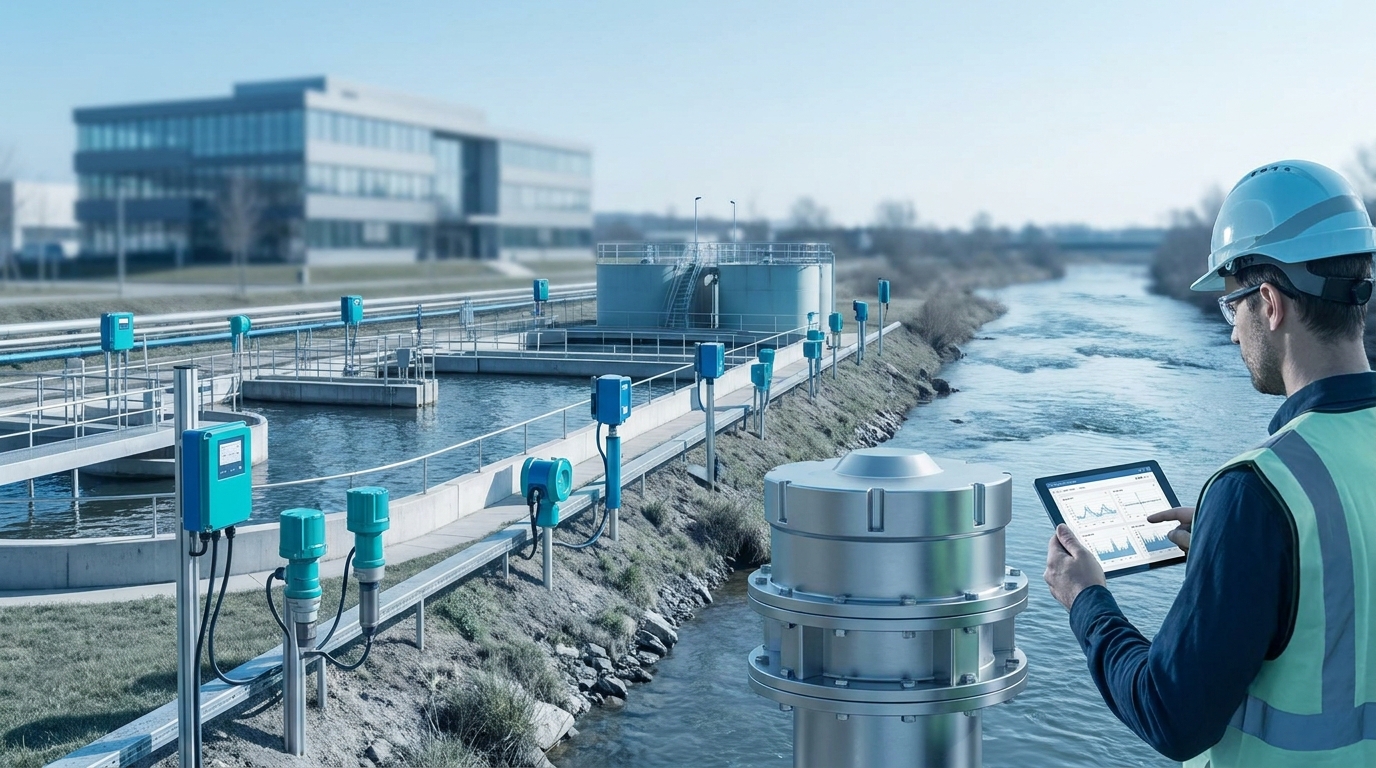
The same rugged DNA flows into Ecolor’s sensor portfolio. The SITUMAN multi-band Doppler radar flowmeter pushes non-contact measurement into the world’s toughest niches—specifically, urban drainage manholes. Its motorized radar angle adjustment and IP68-rated housing mean no confined-space entry, no fouling from sanitary debris, and zero sensor drift caused by grease or silt. This is the only globally proven solution that allows a crew to mount the instrument on a pole with expansion bolts and walk away, while the flowmeter streams level, velocity, and total flow under any condition.
? SITUMAN 3-in-1 Radar Flowmeter – Non-Contact for Underground & Open Channel
Integrated level, flow and camera in one IP68 instrument. Motorized beam angle compensates for installation tilt. No contact with sewage—ideal for urban drainage, ecological flow (hydropower release) and smart irrigation. External water quality sensors plug in for a complete flow+water quality station, and remote camera diagnostics eliminate site visits. Complies with SL651 when paired with HERO V9 RTU. Learn more at cssoc.com
The Double Guarantee: Reliability + Compliance for Flawless Project Acceptance
Every water project manager knows the pain of a field station that generates data but fails the regulatory audition. With Ecolor’s combination of a native-protocol RTU and an environment-immune radar flowmeter, two barriers dissolve: the compliance barrier and the reliability barrier. The HERO V9 encodes every measurement in SL651 or SL180 format, time-stamped and checksum-verified, feeding the SCADA historian without middleware. The radar sensor captures flow even when a manhole surcharges or an irrigation flume freezes. Solar power and explosion-proof construction allow placement in ATEX-classified pumping stations or remote ecological flow cross-sections without secondary enclosures. This dual guarantee dramatically shortens commissioning and delivers the steady 99.9% data availability that utilities demand.
Real-world deployment scenarios include:
- ✅ Urban underground pipe network monitoring – non-contact radar mounted in manholes, RTU in explosion-proof housing, 4G to cloud.
- ✅ Ecological flow compliance at hydropower stations – radar measures turbine release; RTU reports in SL180 to provincial water bureau.
- ✅ Smart agriculture irrigation – radar + water quality sensors, solar RTU, precision flow logging for water-use permits.
- ✅ Flood-prone river reaches – IP68 radar and RTU survive complete submersion, solar keeps cameras live for remote diagnosis.
Your Next Step Towards Secure, Compliant Telemetry
The SCADA market’s double-digit growth and the rising tide of cybersecurity mandates mean that water utilities cannot afford to gamble on unverified RTUs or sensors that falter in the field. Ecolor Technology, through its SITUMAN and HuaYu ZhongNeng sub-brands, has engineered the HERO V9 family to meet the extreme margins of water monitoring head-on. Whether you are a procurement manager seeking mass-deployable smart water stations or an engineer designing a zero-entry confined-space solution, the native SL651/SL180 compliance, IP68 durability and solar-powered edge intelligence of the HERO V9 provide a future-ready platform.
Request a configuration proposal or arrange a pilot deployment. Explore the full HERO V9 range and the SITUMAN radar portfolio at www.cssoc.com or contact the engineering team at sales@cssoc.com.
See What You Measure
Ecolor Technology | Hangzhou, China | www.cssoc.com
Sources:
1. SCADA Market Size to Surpass USD 30.66 Billion by 2035 – GlobeNewswire
2. SCADA Best Practices for Wastewater Plants – Water & Wastewater
3. 10 Enterprise SCADA Tips to Secure, Standardize & Scale Systems – Inductive Automation
4. OT vs IT Security: Why Industrial Environments Need Different Rules – Erdal Ozkaya
5. Electrical Project Engineer Job Requirement – Lanesra Technical Recruitment
Recommended Products
Ecolor Technology provides professional instruments for smart water, environmental monitoring & industrial automation: