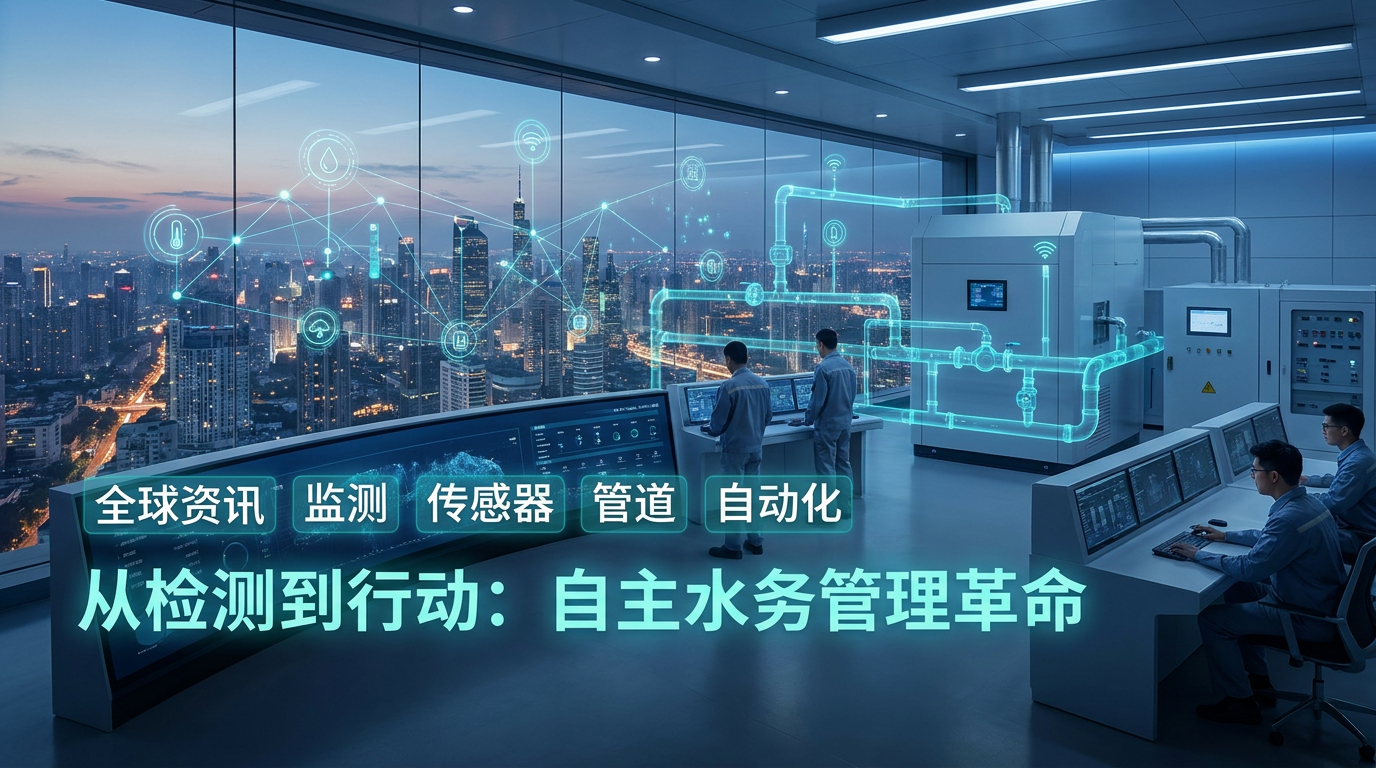
The Smart Water Revolution: How IoT Sensors and AI Are Rewriting Utility Operations
The global water industry stands at a pivotal inflection point. According to recent market analysis, the digital water sector is projected to grow from approximately USD 7.18 billion in 2025 to nearly USD 22.02 billion by 2035—a trajectory that reflects not merely incremental improvement but a fundamental reimagining of how water utilities monitor, manage, and maintain their infrastructure. At the heart of this transformation lies the convergence of Internet of Things (IoT) sensor networks, artificial intelligence, and edge computing devices that are turning vast, aging pipe networks into intelligent, self-diagnostic systems.
From Reactive Repairs to Predictive Infrastructure
Traditional water management operated on a fundamentally reactive model: detect a leak, dispatch a crew, excavate the site, and repair the damage. This approach, while familiar, carries hidden costs that compound across aging infrastructure networks. The average water utility loses 20-30% of treated water to leaks and管网漏损, with repair costs, water loss, and infrastructure degradation creating a cascade of financial and operational burdens.
The emergence of smart water management solutions is rewriting this paradigm. Modern IoT-enabled sensor networks now provide continuous, real-time monitoring of flow rates, pressure differentials, water quality parameters, and acoustic signatures that precede catastrophic failures. As industry analysis confirms, AI-powered predictive analytics combined with these sensor networks are enabling utilities to shift from emergency response to prescient maintenance—identifying potential failures weeks or months before they manifest as burst pipes or contamination events.
The Technology Stack Driving Water Intelligence
Three technological pillars underpin the smart water transformation. First, advanced sensor technology has matured beyond simple point measurements to provide comprehensive, multi-parameter monitoring. Modern electromagnetic flowmeters, such as the LGF series offered by Ecolor Technology, deliver precision measurement with minimal pressure loss, enabling accurate billing, leak detection, and demand forecasting across municipal and industrial applications.
Second, radar-based level and flow measurement has evolved rapidly. The latest 80GHz radar level sensors provide millimeter-accuracy tank and reservoir monitoring, while multi-band Doppler flow radars represent a breakthrough in non-invasive pipe monitoring. Notably, Ecolor Technology's multi-band Doppler flow radar stands as the world's only solution capable of underground pipe monitoring with integrated camera functionality—a capability that transforms blind pipe sections into transparent, inspectable assets.
Third, edge computing and remote terminal units (RTUs) have become the nervous system of smart water networks. Devices like the HERO V9 RTU aggregate sensor data, perform local analytics, and communicate with central management systems—enabling real-time decision-making even across geographically dispersed utility networks.
Consumer and Industrial Applications Converging
Perhaps surprisingly, the smart water revolution is unfolding simultaneously at both ends of the consumption spectrum. Consumer-oriented solutions, exemplified by products like the GoveeLife Wi-Fi Water Leak Detector with its 105dB alerts and dual sensor probes, demonstrate how homeowners can now access the same leak detection technology previously reserved for industrial facilities. These consumer devices represent the leading edge of water awareness—creating a population of informed water users who understand their consumption patterns and can respond immediately to anomalies.
At the industrial and municipal level, automatic shut-off valves integrated with smart valve controllers represent the next evolution in leak response automation. These systems continuously scan water lines for temperature, pressure, and flow irregularities, automatically closing valves upon major leak detection and sending immediate notifications to facility managers. The integration of MicroLeak technology enables detection of even minor weeping that would previously go unnoticed for months.
Regulatory Tailwinds and Smart City Integration
Regulatory pressure is accelerating adoption across all market segments. As global water quality regulations tighten—particularly in 2026 and beyond—the integration of IoT technology with high-precision optical sensors has shifted from competitive advantage to operational necessity for industrial facilities, aquaculture operations, and municipal water systems alike. Smart city initiatives worldwide are incorporating water management into broader infrastructure modernization programs, creating interconnected systems where water, energy, and transportation networks optimize collectively.
Market Dynamics and Growth Projections
The Smart Water Management Market is expected to experience sustained growth through 2031, driven by continuous technological advancement and intensifying global water challenges. Market analysts identify several catalysts: aging infrastructure requiring systematic replacement, increasing urbanization placing pressure on existing water systems, climate variability affecting supply reliability, and tightening environmental regulations around wastewater discharge and water quality.
Regional variation in adoption patterns reflects different infrastructure ages, regulatory environments, and economic conditions. However, the universal driver remains the same: the economics of water loss and infrastructure failure increasingly favor smart monitoring over traditional operational approaches.
The Path Forward: Integration and Interoperability
As the digital water market expands toward its projected USD 22.02 billion horizon, success will depend increasingly on integration capabilities. The sensors, RTUs, flow meters, and analytics platforms of tomorrow must communicate seamlessly—sharing data across vendor boundaries and operational silos. Utilities that invest in interoperable platforms today will position themselves to leverage tomorrow's AI capabilities without costly system replacements.
Chinese technology providers like Ecolor Technology are emerging as significant players in this global transformation, offering precision instrumentation including electromagnetic flowmeters, radar level sensors, and advanced RTU platforms that meet international quality standards while providing competitive value. As water utilities worldwide seek to modernize infrastructure, the availability of high-quality, affordable smart water components from multiple global suppliers will accelerate adoption and improve project economics.
The water industry that emerges from this technological transition will look fundamentally different from its predecessor. Utilities will operate as data-driven organizations, continuously optimizing based on real-time feedback from thousands of sensors. Customers—residential, commercial, and industrial—will gain unprecedented visibility into their water usage and quality. And infrastructure managers will shift from reacting to failures to preventing them, transforming water systems from cost centers into models of operational excellence. The smart water revolution is no longer approaching—it is already underway.
Sources
- GoveeLife Smart Water Leak Detector with Wifi Gateway
- Global Smart Water Management Market Set to Transform Utilities and Industrial Operations by 2031
- Digital Water Market Trends, Companies, and Regional Insights by 2035
- The Future of Industrial Water Management: The Convergence of IoT and High-Precision Optical Sensors in 2026
- Best Automatic Water Shut-Off Valves: 10 Tested Picks (2026)
Recommended Products
Ecolor Technology provides professional instruments for smart water, environmental monitoring & industrial automation: