Urban Pipeline Network Development Opportunities in 2026 Against the Backdrop of the Dual Carbon Goals
Introduction: Urban Pipe Networks Shift from “End-of-Pipe Drainage” to “Citywide Risk Governance”
In recent years, the combination of extreme heavy rainfall, urban waterlogging, aging pipe networks, and underground-space risks has made urban drainage and waterlogging prevention no longer a single municipal engineering issue, but a core topic in urban safe operation, emergency management, and public services. In the past, urban pipe networks were largely seen as infrastructure hidden beneath roads, communities, and underground spaces. Today, as ponding risk points, flood-prone areas, pump and sluice stations, stormwater pipe networks, and meteorological sensing data are incorporated into unified monitoring, pipe networks are transforming from “terminal drainage systems” into a key component of the “urban resilient water network.”
Amid this change, ponding monitoring, short-term nowcasting warnings, radar sensing, and flood-prevention linkage have become new industry keywords. The growth logic of the urban pipe-network industry is also shifting from “expansion of construction scale” to “improved risk identification, higher operational efficiency, and closed-loop governance.” For industry observers, future competition in urban drainage and waterlogging prevention is not only about pipe length, number of pump stations, or investment scale, but about data acquisition, model simulation, warning response, and cross-departmental coordination.
1. Market Trends: Extreme Rainfall and Aging Pipe Networks Combine to Create Demand for a “Resilient Water Network”
Changes in the urban pipe-network market first stem from the combined influence of external rainfall risk and internal facility conditions. Public data show that, by the end of 2023, China’s urbanization rate of permanent residents had exceeded 66%, and the urban built-up area continued to expand. Roads, plazas, underground spaces, rail transit, residential communities, and industrial parks together form a highly complex urban drainage system. At the same time, the total length of urban drainage pipe networks nationwide has exceeded one million kilometers, much of it built in earlier decades. Some areas suffer from rainwater-sewage cross-connections, undersized pipes, sediment accumulation and damage, blocked outfalls, and low system standards.
Shift in Investment Priorities
From a market-structure perspective, the urban pipe-network industry is moving from “new construction-centric” development to a balanced emphasis on new construction, renovation, operation and maintenance, and digitalization.
- Past Focus: Laying drainage pipelines, extending stormwater networks, supporting wastewater treatment.
- Future Focus: Pipe-network surveys, remediation of flood-prone points, pump-station renovation, smart monitoring, ponding warnings, flood-prevention dispatching.
It is worth noting that market demand for urban waterlogging control exhibits a clear “front-loaded risk management” characteristic. Traditional municipal projects often responded passively after ponding occurred, whereas the current market places greater emphasis on full-process management before, during, and after rainfall. Management authorities need to identify risk areas before rainfall, obtain real-time information on ponding, water levels, flow rates, and pump-station operating conditions during rainfall, and conduct rapid post-event reviews and produce retrofit lists after rainfall. As a result, the market no longer purchases only pipes, gates, and pump stations; it also begins to purchase sensing devices, data platforms, model services, warning systems, and O&M solutions.
From the perspective of funding entities, in addition to local governments and municipal departments, water-affairs groups, urban investment companies, park operators, rail-transit management units, expressway operators, and property-management companies of large residential communities have all become important demand-side stakeholders in the digital governance of urban pipe networks. Especially in cities under heavy flood-prevention pressure, drainage and waterlogging-prevention capacity has become one of the baseline indicators of urban safety. Market growth no longer depends solely on single construction projects, but is driven jointly by risk governance, operations and maintenance, and data services.
2. Technical Directions: Radar Sensing, Ponding Warnings, and Pipe-Network Models Are Converging
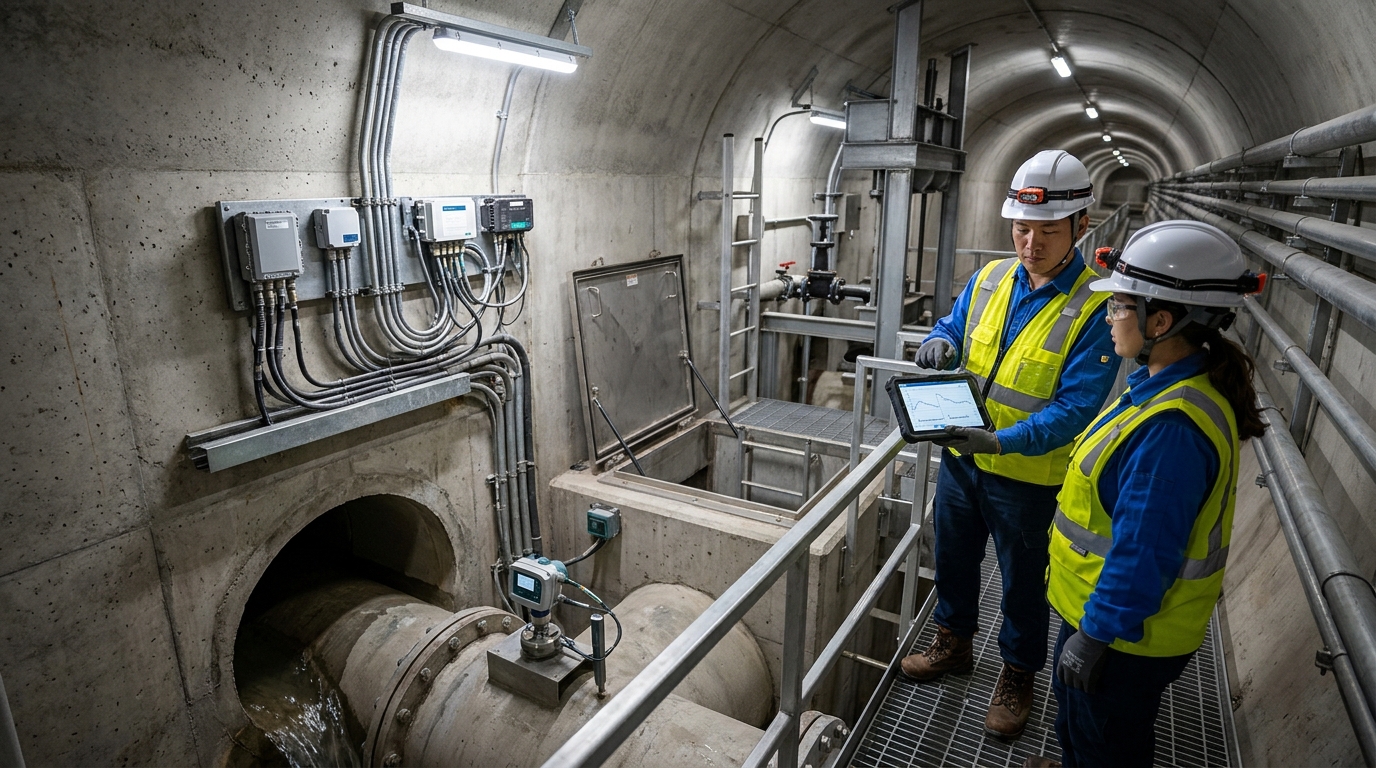
At the technical level, urban pipe networks are forming a closed loop of “meteorological sensing—surface monitoring—pipe-network sensing—model simulation—warning and dispatching.” Radar technology is a key part of this loop. Meteorological radar can provide rainfall distribution, changes in rainfall intensity, and short-term precipitation trends, creating lead time for urban flood prevention. Pipe-network radar level gauges and radar water-level gauges are used to monitor water-level changes in manholes, storage and retention basins, rivers, and key nodes. Road video combined with AI recognition can automatically assess ponding extent, ponding depth, and traffic-disruption risk. The combination of multiple radar-based sensing methods shifts urban water risk from “post-event reporting” to “pre-event prediction and in-event dispatching.”
Short-term nowcasting rainfall warnings typically focus on rainfall changes within the next 30 minutes to 2 hours, with spatial resolution reaching kilometer-level or finer and temporal resolution reaching 6-minute-level or shorter.
In terms of parameters, for pipe-network level monitoring, radar level gauges, pressure water-level gauges, and ultrasonic level gauges differ in accuracy, installation conditions, and maintenance cost. General monitoring at urban flood-prone points requires level errors controlled to the centimeter level and stable data transmission during rainstorms. For road-ponding recognition, video AI can help identify ponding boundaries and vehicle-wading conditions, but it usually needs cross-validation with level sensors, rainfall data, and pipe-network models to reduce false alarms.
Drainage pipe-network modeling is another core capability. Based on data from rainfall, topography, pipe networks, pump stations, sluices and dams, rivers, and storage facilities, commonly used industry models can simulate rainwater flow, overflow, ponding, and backflow in pipe networks. Through model simulation, management authorities can determine which road segments may experience ponding within 30 minutes after rainfall, which pump stations should be started in advance, and which nodes are at risk of backflow. The value of models lies not only in visualization, but in supporting flood-prevention decisions. In the future, models will move from offline analysis to online computation, and from static design verification to dynamic dispatch support.
Digital twins and IoT platforms are becoming important carriers of the urban pipe-network technology system. A digital twin is not merely simple 3D visualization; it integrates pipe-network spatial data, real-time monitoring data, rainfall forecast data, pump-station operating data, and historical waterlogging events to form a computable, simulable, and reviewable urban water system. For flood-prevention scenarios, the core capabilities of a digital twin include ponding-risk prediction, emergency-resource dispatch, drainage-path simulation, and event post-review assessment. In the future, competition in urban pipe-network technology will shift from “whether data exists” to “whether data can generate usable warnings,” and from “whether models exist” to “whether models can be embedded into business processes.”
3. Policy Impact: Higher Waterlogging-Control Standards Push Pipe Networks from Engineering-Centric to System-Oriented
The policy environment has a direct impact on the urban pipe-network industry. At the national level, urban waterlogging control, sponge city construction, urban safety development, and urban lifeline safety projects continue to require urban drainage and waterlogging-prevention facilities to move from “local remediation” to “systematic governance.” Relevant policies explicitly state that, by 2025, an urban drainage and waterlogging-prevention facility system should be basically established, and by 2035, urban waterlogging under rainfall conditions within prevention and control standards should be generally eliminated. This goal means that urban pipe-network construction cannot remain limited to pipe laying and pump-station capacity expansion; it must establish a comprehensive governance system covering source reduction, pipe-network conveyance, combined storage and drainage, and emergency response to rainfall exceeding design standards.
Cross-Departmental Coordination
Local flood-prevention responsibility systems require clear identification of risk points, responsible persons, monitoring and warning, emergency response, and handling procedures. Municipal drainage, meteorology, water affairs, emergency management, transportation, and housing departments must share data and handle issues jointly.
Tiered Warning Standards
On general roads, ponding of 15-20 cm affects vehicle safety; >30 cm increases stalling/trapping risks. Warning systems must provide tiered alerts combining road segment, traffic flow, underpasses, and pump-station capacity.
Standards are also being improved in parallel. Drainage pipe-network surveys, flood-prone-point assessments, ponding-warning thresholds, pump-station operation monitoring, rainwater-sewage separation retrofits, and waterlogging risk-map compilation all require more unified technical specifications. Policy is pushing urban pipe-network investment from “emphasis on construction” to “emphasis on performance.” Local fiscal funds, special bonds, urban renewal funds, and resilient-city construction funds increasingly focus on whether projects create actual risk-reduction capability.
For example, after a district is renovated, has the number of flood-prone points decreased? Has ponding duration been shortened? Has warning response time improved? These indicators will determine project acceptance, O&M evaluation, and subsequent investment arrangements. Under policy influence, the industry must shift from “delivering facilities” to “delivering quantifiable governance capability.”
4. Typical Cases: From Ponding Handling to Warning Linkage, Urban Pipe-Network Governance Is Forming a Closed Loop
From industry practice, many cities have already begun building comprehensive drainage and waterlogging-prevention systems centered on ponding risk. A major eastern coastal city, during recent flood-season governance, deployed level-monitoring devices, road-video recognition devices, and rainfall-sensing data interfaces around flood-prone points, underpasses, low-lying road sections, pump-station forebays, and key stormwater pipe-network nodes. It also coupled meteorological radar short-term rainfall forecasts with pipe-network models. Project evaluation showed that, after the system was put into operation, the average lead time of ponding warnings in key areas increased from about a dozen minutes to about 50 minutes.
In another typical scenario, a central city carried out pipe-network surveys, flood-prone-point remediation, and smart-monitoring system construction to address mixed rainwater-sewage connections, pipe-network sediment accumulation, and low drainage standards in its old districts. By reviewing monitoring data and historical rainfall events, management authorities identified multiple high-risk locations that were “prone to ponding within 30 minutes after rainfall and likely to cause traffic disruption within one hour,” and implemented targeted pipe-diameter retrofits, dredging and repair, pump-station capacity expansion, and underpass warning linkage.
Industrial park and transportation scenarios also reflect a similar trend. An urban expressway underpass section used video AI to recognize ponding, radar level monitoring, and traffic-signal linkage to automatically push warning information when ponding exceeded a threshold, and to coordinate speed-limit alerts, lane closures, and drainage-pump startup. Such cases show that urban pipe-network governance is moving from single-point projects to scenario-based closed loops.
The common feature of these practices is that ponding is no longer merely an event handled after discovery, but a risk that can be identified in advance through radar, monitoring, models, and warnings.
5. Industry Pain Points: Data Silos, O&M Costs, and Model Implementation Remain Key Bottlenecks
Data Silos
Urban drainage systems involve multiple departments (housing, water affairs, emergency management, meteorology, etc.). Data sources are dispersed and standards are not unified. Without a unified data foundation, warning systems find it difficult to form accurate judgments, and flood-prevention dispatching tends to remain at the manual-aggregation stage.
Equipment O&M and Sensor Stability
The urban pipe-network environment is complex. Manholes, stormwater inlets, rivers, and pump-station sites face risks such as humidity, corrosion, sediment accumulation, floating debris, lightning, and communication interruptions. After initial deployment, data quality can decline rapidly if regular calibration, dredging maintenance, and network assurance are lacking.
Model Localization and Business Embedding
If drainage pipe-network models remain only at the research or design stage, they can hardly serve flood-prevention dispatch directly. Models need to be connected to real-time data to form dynamic predictions. If model results cannot be embedded into duty, patrol, dispatch, and review processes, they easily become “visually attractive but unusable” display systems.
Investment-Return Evaluation
Benefits of digital urban pipe-network governance appear in risk reduction and improved emergency efficiency, but these are not easily monetized directly. Smart drainage projects require ongoing investment in O&M, communications, data governance, and algorithm optimization. Establishing long-term O&M mechanisms and sustainable business models remains a challenge.
6. Forward-Looking Assessment: Urban Pipe Networks Will Evolve into Computable, Dispatchable, and Reviewable Resilient Infrastructure
Over the next 5 to 10 years, the urban pipe-network industry will show several clear trends. First, urban drainage and waterlogging prevention will move from “upgrading engineering standards” to “building a risk-management system.” Cities need to establish a comprehensive management system based on ponding risk, rainfall forecasts, pipe-network capacity, storage and retention space, and emergency resources.
Second, radar sensing will develop toward multi-source fusion. Meteorological radar provides rainfall trends, pipe-network radar level gauges provide node water levels, road video provides ponding status, and flow meters provide changes in drainage capacity. Future warning systems will place greater emphasis on data consistency, spatial matching, and dynamic calibration.
Third, AI and digital twins will move from the presentation layer to the decision-making layer. The industry will gradually form a closed loop of “prediction—warning—dispatch—handling—review—retrofit.” Urban pipe-network governance will shift from experience-driven to data-driven, helping management personnel make decisions faster and more accurately.
Fourth, urban pipe networks will be deeply integrated with urban lifelines, emergency management, and public safety systems. Ponding warnings will link to traffic control, metro suspension, underground-space closure, community evacuation, and insurance claims.
Fifth, business models will extend from engineering construction to “construction + operations + data services + risk performance.” Enterprises able to provide long-term O&M, risk assessment, and closed-loop governance services will build competitive barriers. The key capability is not only “being able to build,” but “managing clearly, reporting accurately, dispatching effectively, and retrofitting precisely.”
7. Conclusion: Ponding, Warnings, Radar, and Flood Prevention Jointly Define the Next-Generation Urban Water Network
The urban pipe-network industry is standing at a critical node of transformation from traditional municipal infrastructure to urban safety infrastructure. In the past, urban drainage systems paid more attention to pipes, pump stations, wastewater treatment plants, and river management. In the future, urban water networks will pay more attention to risk perception, ponding warnings, radar monitoring, model simulation, and flood-prevention dispatch.
Ponding is no longer only an outcome after heavy rain; it is a risk that can be identified in advance and managed by tier. Warnings are no longer only information dissemination; they are decision entry points connecting monitoring, models, dispatch, and emergency response. Radar is no longer only a single sensing device; it is an important sensing means integrating meteorology, pipe networks, roads, and water conservancy scenarios. Flood prevention is no longer only temporary emergency response; it is a long-term mechanism embedded in daily urban operations and infrastructure governance.
For urban managers, the core objective of pipe-network governance is not to eliminate all rainfall risk, but to maintain basic urban operations under extreme rainfall, ensure personnel safety, reduce property losses, and enhance recovery capacity. For industry participants, the real focus is on making urban water networks perceivable, predictable, dispatchable, and reviewable.