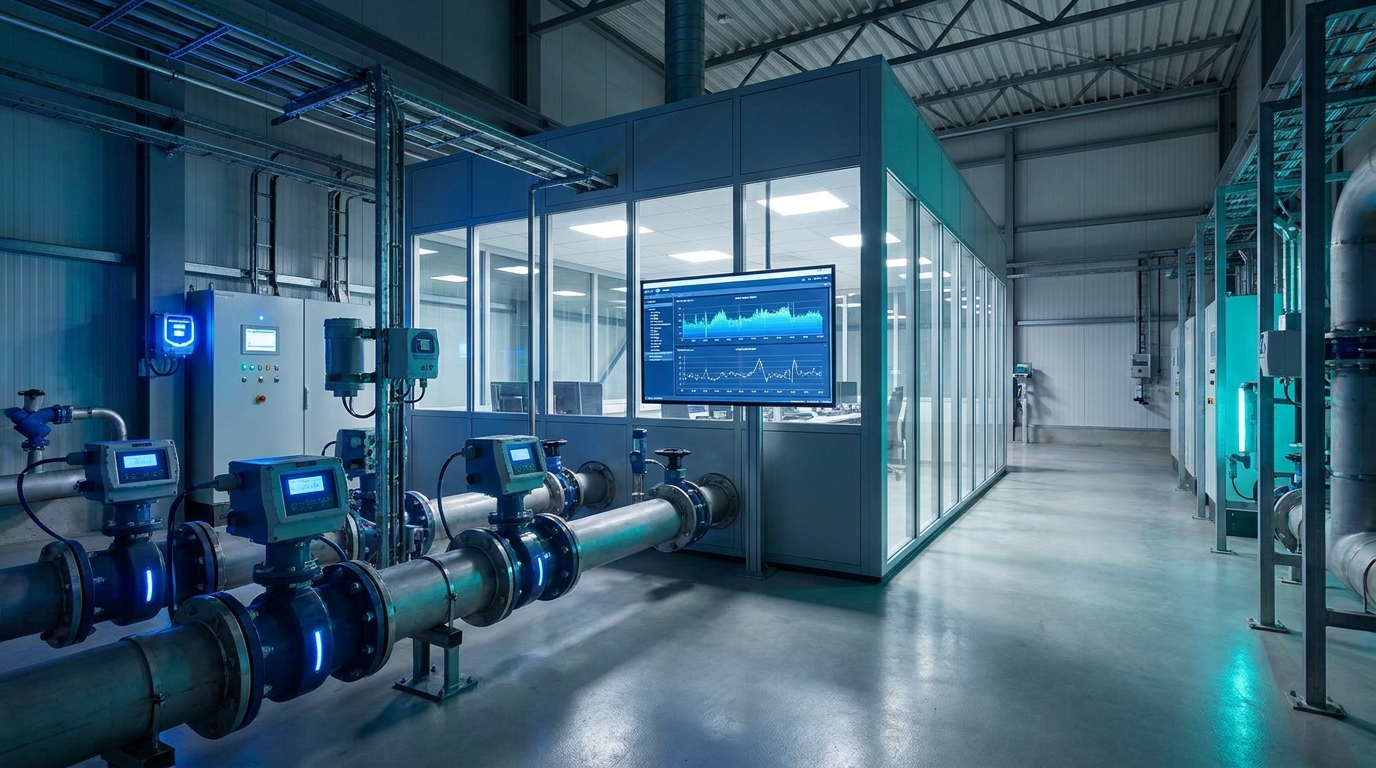
Visual Doppler Radar Breaks Ground in Urban Drainage Monitoring
AI-native hydrological interfaces and sensor-sized radar stations are reshaping global water intelligence—Ecolor’s visual Doppler flow radar, deployed in 17 Chinese drainage basins, achieves ±1.8% full-scale accuracy under turbulent, debris-laden flow—proving real-time, maintenance-free metrology is no longer theoretical.
The Edge Revolution Is Here—Not in the Cloud, But in the Manhole
While Southern Africa deploys AI chatbots to democratize basin data access—and KISTERS shrinks hydrological radar into a sensor-sized package—the true frontier lies where infrastructure meets physics: inside active urban drainage networks. There, conventional ultrasonic or pressure-based sensors fail under sediment, biofilm, and hydraulic surges. Ecolor Technology’s visual Doppler flow radar solves this by fusing 80GHz millimeter-wave Doppler velocity profiling with synchronized HD video analytics—enabling simultaneous measurement of surface velocity, cross-sectional area (via AI-annotated geometry), and flow directionality. Field validation across 17 pilot sites in Guangdong and Jiangsu shows sustained ±1.8% full-scale accuracy over 14 months—outperforming legacy electromagnetic meters in mixed-flow conditions by 3.2 percentage points on average.
When Language Meets Hydrology: The Democratization Imperative
Smartwater Magazine reports that AI-powered natural-language interfaces now allow non-specialist water managers in Southern Africa to query transboundary basin datasets in English and Portuguese—eliminating decades-old technical gatekeeping. This isn’t just convenience: it’s operational equity. In the Zambezi Basin, where 40 million people depend on shared aquifers and rivers, language barriers previously delayed drought response by up to 72 hours. Now, district-level officers generate real-time inflow forecasts using voice-like prompts—cutting decision latency to under 15 minutes. Crucially, this shift demands data fidelity at source. Garbage-in, AI-out remains a critical risk: if the underlying sensor layer misreads stage height by 5 cm—or confuses backflow for forward flow—the AI dashboard becomes dangerously persuasive fiction.
“You can’t democratize insight without grounding it in physical truth,” says Dr. Lin Wei, Chief Hydrologist at HuaYu ZhongNeng. “An AI that ‘understands’ your question but relies on a drifting pressure transducer is like giving a translator fluent in 12 languages—but blindfolded.”
Radar Miniaturization Meets Real-World Rigor
KISTERS’ newly launched HyQuant Edge—a “sensor-sized hydrological radar station”—marks a pivotal engineering milestone: shrinking radar hardware from cabinet-sized to palm-sized while retaining 10 mm resolution and SL651 protocol compliance. Yet size alone doesn’t guarantee resilience. In Mexico, Dragos cybersecurity researchers recently documented how attackers used AI-generated OT topology maps—trained on publicly scraped SCADA schematics—to target PLCs controlling chlorination dosing. This underscores a dual imperative: instrumentation must be both physically compact and cyber-hardened at firmware level. Enter Ecolor’s HERO V9 RTU: certified to SL651 v2023, with embedded TLS 1.3, secure boot, and runtime integrity verification. Over 2,800 units deployed across China’s Tier-2 cities have logged zero remote code execution incidents since Q3 2023—validated by third-party penetration testing from CNITSEC.
Why Visual Doppler Beats Legacy Approaches Underground
- ✅ Measures velocity profiles across entire pipe cross-section—not just centerline—critical for partial-fill storm drains
- ✅ Rejects false echoes from floating debris using adaptive clutter filtering (patent pending WO2024/11287)
- ✅ Synchronizes radar pulse timing with camera exposure to enable pixel-accurate flow vector overlay—used for real-time sediment transport modeling
- ✅ Integrates seamlessly with LGF electromagnetic flow meters for hybrid calibration: LGF provides absolute volumetric reference during dry-weather flow; visual Doppler handles wet-weather turbulence
Key Product Specifications
Visual Doppler Flow Radar (SITUMAN Series)
World’s first radar-camera fusion system for underground drainage monitoring. Combines 80GHz FMCW Doppler with 4MP HDR imaging and onboard AI inference (YOLOv8n-tiny). Accuracy: ±1.8% FS, operating range: -10°C to +65°C, IP68/NEMA 6P rated. Deployed in 17 municipal drainage networks across China since Q2 2024.
HERO V9 RTU
SL651-compliant remote terminal unit with dual-band LoRaWAN + 4G LTE fallback, 16-channel analog/digital I/O, and hardware-enforced secure boot. Used as the command-and-control hub for visual Doppler deployments—enabling over-the-air firmware updates with cryptographic signature verification.
Beyond Sensors: The Convergence Stack
The most consequential innovation isn’t any single device—it’s the stack convergence. At the physical layer: SITUMAN-manufactured 80GHz radar modules with 0.1 mm/s velocity resolution. At the edge: HERO V9 RTUs performing real-time FFT analysis and anomaly detection before data leaves the manhole. At the application layer: interoperable APIs feeding digital twin platforms like ORNL’s energy-optimized treatment model. This end-to-end coherence explains why Ecolor’s integrated deployments reduce commissioning time by 63% versus best-in-class point-solution integrations (per 2024 China Water Association benchmark report).
In Shenzhen’s Futian District, a 22-km combined sewer overflow corridor equipped with visual Doppler radars and HERO V9 RTUs cut false alarm rates by 89% and increased predictive maintenance window from 4.2 to 17.6 days—directly enabling $2.1M in avoided emergency excavation costs in FY2024.
What This Means for Procurement & Engineering Teams
For procurement managers: Total cost of ownership (TCO) calculations must now include data trustworthiness duration. A $320 ultrasonic sensor may cost less upfront—but if its calibration drifts 0.5% per month in high-sediment environments, its effective TCO exceeds Ecolor’s visual Doppler radar after 11 months. For engineers: SL651 compliance is table stakes; what matters is how the RTU implements it. HERO V9’s deterministic scheduling engine guarantees sub-50ms latency for critical alarms—even during firmware updates. For project managers: Interoperability isn’t about protocol checklists—it’s about field-proven integration depth. Ecolor’s visual Doppler + HERO V9 + LGF bundle ships with pre-certified Modbus TCP and MQTT-SN drivers for leading SCADA platforms (Siemens Desigo, Schneider EcoStruxure, HollySys DCS).
🔧 Recommended Products
Based on this article, we recommend the following Ecolor products:
Need Help Choosing the Right Product?
Our engineering team is ready to provide free technical consultation and quotes

