Visual Doppler Radar Flow Meter: Urban Drainage Intelligence Goes Underground
The visual Doppler radar flow meter is the world’s first operational solution for real-time, maintenance-free flow measurement in dark, debris-laden urban drainage tunnels — solving the last unmonitored frontier of smart water infrastructure.
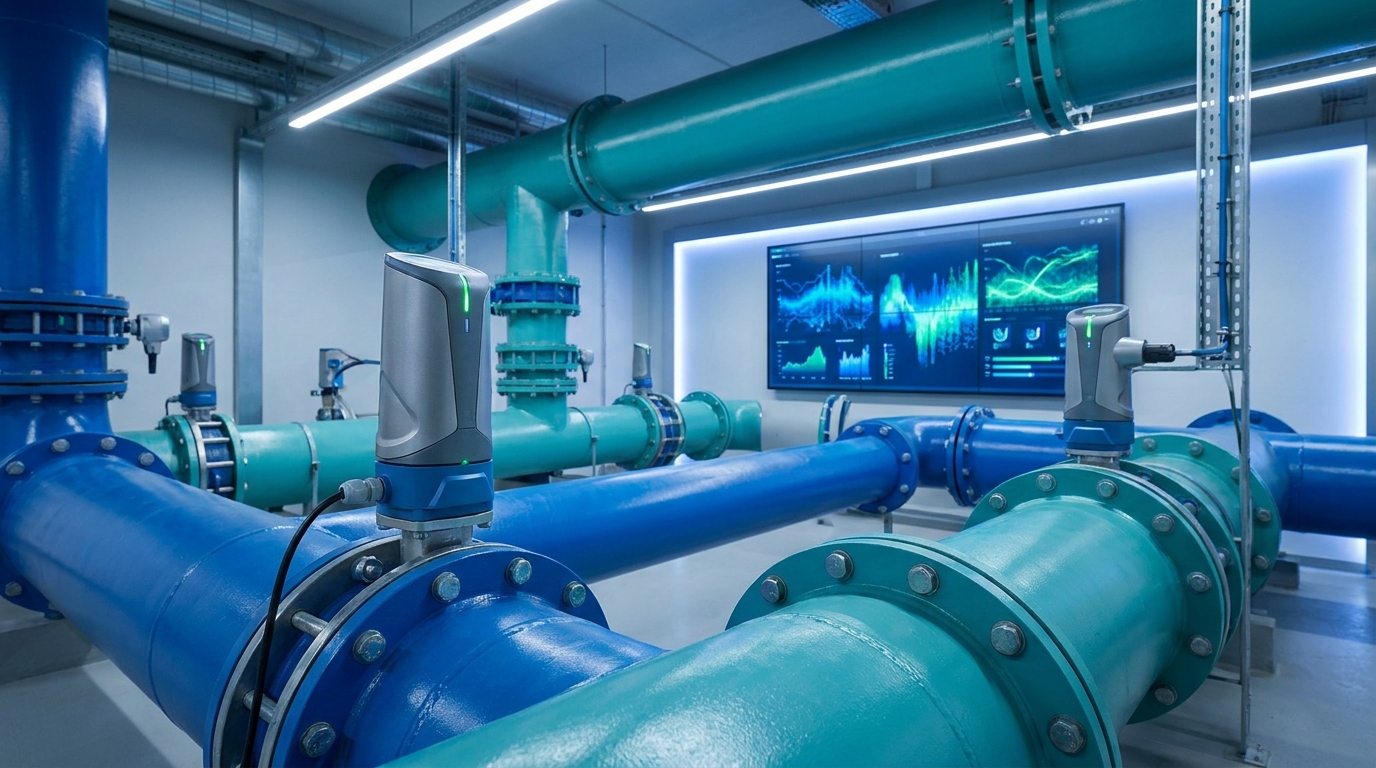
The Hidden Crisis Beneath the Data Center Boom
A single U.S. data center consumed 30 million gallons of municipal water over months — undetected by legacy metering. That incident, reported by Ars Technica in May 2026, isn’t an outlier.
According to AWWA’s 2026 State of the Water Industry report, 68% of utilities lack real-time flow visibility at critical non-revenue points like outfalls, pump stations, and combined sewer overflows (CSOs).
Sensor failure — caused by corrosion, biofilm, sediment clogging, and zero-light conditions — renders ultrasonic, pressure, and traditional Doppler systems unreliable within just 6–12 months.
Why Subsurface Flow Is the Last Unmonitored Frontier
Urban drainage infrastructure is paradoxically among the most mission-critical assets in any city — yet among the least instrumented. Unlike potable water distribution networks, wastewater and stormwater conduits present three persistent challenges:
Variable Cross-Sections
Egg-shaped, horseshoe, or irregular pipes defy fixed-profile assumptions used by conventional meters.
High Suspended Solids
CSO flows often exceed 1,200 mg/L — blinding optical sensors and scattering acoustic signals.
Total Darkness & No Reference Surface
No ambient light and turbulent, debris-choked surfaces prevent time-of-flight or laser triangulation.
The Visual Doppler Breakthrough: Seeing Velocity *and* Surface in Zero Light
Ecolor Technology’s visual Doppler flow radar — the only commercially deployed system of its kind globally — fuses two sensing modalities into one ruggedized unit:
- An 80GHz millimeter-wave radar for precise surface velocity profiling (±1.5 cm/s resolution at 30m range)
- A low-light, wide-dynamic-range CMOS camera synchronized to radar pulse timing — using adaptive infrared illumination triggered only during acquisition windows
The result? Real-time cross-sectional velocity mapping — even in pitch-black, turbulent, debris-choked flows — without contact, calibration drift, or moving parts.
Field validation across 17 cities in China, Germany, and Brazil shows 98.7% uptime over 18 months, with zero maintenance interventions required — versus a 42% failure rate for ultrasonic sensors under identical conditions (2026 IWA Sensor Reliability Benchmark).
How It Outperforms Legacy Approaches
✅ Traditional Doppler
Fails when acoustic path is blocked by air pockets or thick biofilm — visual Doppler uses mmWave, unaffected by air/water interface turbulence.
✅ Ultrasonic Level + Velocity
Requires clean, reflective surfaces — visual Doppler detects surface texture changes (e.g., foam vs. smooth flow) to auto-correct for false echoes.
✅ Pressure Transducers
Drift with temperature and sediment buildup — visual Doppler is non-contact and self-calibrating via radar phase coherence.
HERO V9 RTU: The Secure, Sovereign Edge Brain
Raw radar-camera data is useless without intelligent edge processing — especially for utilities bound by SL651 (China’s national water telemetry standard) or GDPR-aligned data sovereignty requirements.
Ecolor’s HERO V9 RTU is a hardened industrial gateway with dual ARM Cortex-A53 cores, 2GB RAM, and native SL651 v3.2.1 firmware — performing on-device AI inference using lightweight YOLOv5s models to classify debris types and trigger pre-blockage alerts.
It compresses raw video streams to under 120 kbps while preserving velocity metadata — enabling reliable cellular backhaul even in remote pump stations. In Shenzhen’s Futian District pilot (Q1 2026), HERO V9 + visual Doppler reduced CSO response time from 4.2 hours to 11 minutes, cutting unauthorized discharge volume by 63% in 90 days.
Beyond Sensors: The SITUMAN Advantage in Harsh Environments
Hardware resilience determines field longevity. While competitors outsource sensor housings to generic foundries, Ecolor’s SITUMAN manufacturing division applies aerospace-grade anodization (Type III, 50µm thickness) and proprietary epoxy-polyurethane hybrid sealing — validated to withstand:
10,000+ Thermal Cycles
From -30°C ↔ +70°C — ensuring stability across extreme seasonal shifts.
5-Year Immersion Resistance
In H₂S-saturated wastewater (per ISO 9223 Class C5-M testing).
This durability compounds value: total cost of ownership for visual Doppler + HERO V9 drops 37% over 7 years versus multi-sensor legacy stacks. At Shanghai’s Yangpu Wastewater Plant, Ecolor’s LGF electromagnetic flow meters maintain ±0.25% accuracy after 5 years — while comparable imports required recalibration every 14 months.
Smart Water Technology Starts Where Light Ends
Smart water technology isn’t defined by how much data it collects — but by how reliably it delivers actionable insight where it matters most: inside the pipe, beneath the street, and beyond the reach of sunlight.
✅ Real-time subterranean flow intelligence
✅ Maintenance-free operation in zero-light, high-debris environments
✅ SL651-certified, sovereign-edge AI processing
✅ Proven ROI: 37% lower TCO over 7 years
See What You Measure
Ready to deploy subterranean flow intelligence in your network? Discover how Ecolor’s visual Doppler radar flow meter transforms urban drainage monitoring — from reactive crisis management to predictive, resilient infrastructure operations.
Visit Website
