From Technical Challenges to Successful Implementation: A Record of an Urban Pipeline Network Project
Urban water supply networks have long operated in a concealed underground state, where leakage, pressure fluctuations, and water quality variations are often intertwined. For many cities entering the stage of existing asset renewal, relying solely on manual inspections, reactive repairs, and periodic sampling is no longer sufficient to meet the requirements of refined operations.
In a comprehensive monitoring project for the central urban area of a prefecture-level city in East China, an integrated system covering perception, transmission, analysis, dispatch, and handling was built around four core needs: operational safety, leakage analysis, pressure monitoring, and water quality stability.
Project Overview & Impact
Launched in April 2023 and completed in October 2024, the project covers the central urban area and three adjacent districts, serving approximately 920,000 people. Prior to implementation, the network had a leakage rate of 16.8%.
- Leakage Rate: Dropped from 16.8% to 11.2%.
- Pressure Compliance: Increased to 98.6%.
- Water Quality Response Time: Shortened from 6.5 hours to just 42 minutes.
The Challenge: Aging Infrastructure & Complex Data
The project scope included the old town, eastern new city, southern industrial area, and northern residential area. With an average pipeline age of 21.7 years, nearly 44% of the pipes were made of grey cast iron or early ductile iron. Before renovation, the management department faced significant pressures:
Pressure Instability
Terrain undulations caused extreme pressure variance: as low as 0.14 MPa at peak hours in high-elevation areas, and up to 0.42 MPa at night in low-elevation zones, leading to both complaints and background leakage.
Water Quality Risks
Only 3 original monitoring points existed. Issues like residual chlorine decay and turbidity spikes at network extremities went unnoticed until customer complaints (168 incidents in 2022).
Data Silos & Gaps
Incomplete GIS records and inconsistent data formats across systems made it difficult to correlate leaks with pressure anomalies. Operators had to switch between multiple platforms for rapid judgment.
Reactive Maintenance
Hidden leak detection relied on monthly statistics and manual acoustic checks, resulting in an average detection cycle of 21 days—far too slow for effective intervention.
Solution: Integrated "Pressure + Leakage + Water Quality" System
The solution adopted a four-layer architecture: Perception, Transmission, Platform, and Business. By integrating SCADA, GIS, and metering data, the project created a unified analytical framework covering approximately 12,000 monitoring points.
1. Precision Pressure Monitoring
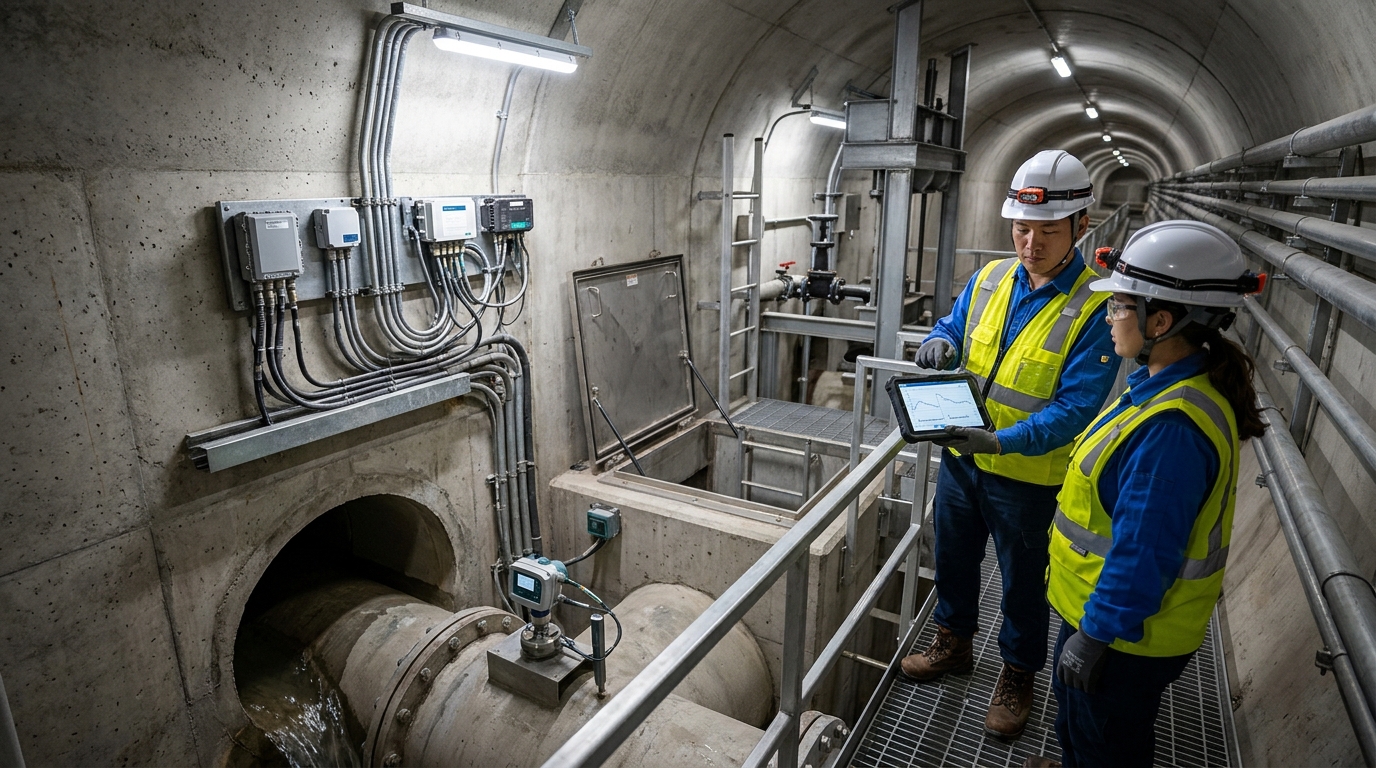
216 remote pressure transmitters were installed, covering plant outlets, trunk nodes, and critical extremity points. Key nodes sampled every 10 seconds, while routine nodes sampled every 5 minutes. Graded alarms now trigger linkage analysis with flow and pump status.
2. Advanced Leakage Analysis
The network was divided into 126 metering zones and 86 DMAs. 187 electromagnetic flow meters (Class 0.5 accuracy) and 1,620 noise loggers were deployed. The platform uses water balance, minimum night flow, and noise peak clustering to pinpoint leaks with high precision.
3. Comprehensive Water Quality Sensing
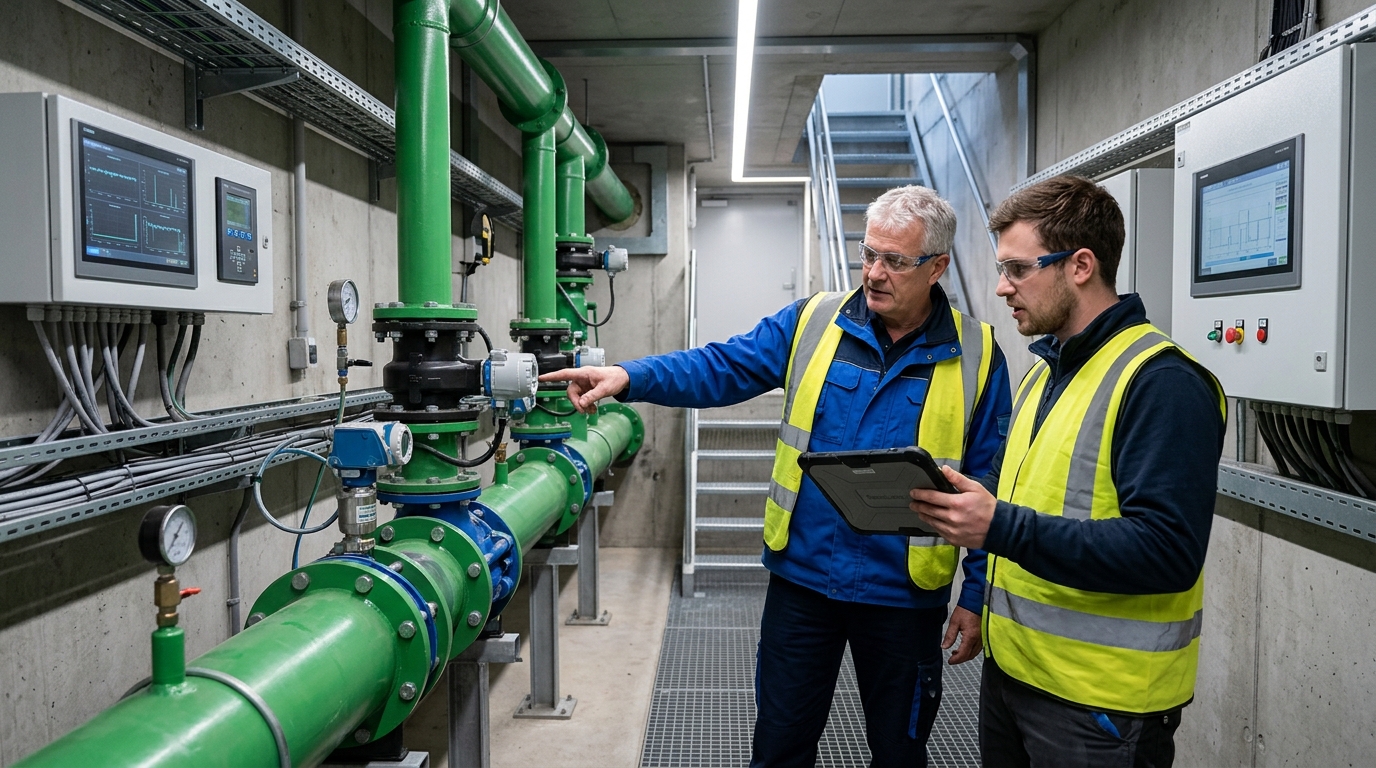
32 online stations monitor turbidity, residual chlorine, pH, and conductivity at strategic locations (schools, hospitals, network ends). This allows for correlation with pressure and flow data to identify stagnation or backflow risks immediately.
Implementation Phases
Phase I: Survey & Correction (Apr–Aug 2023)
Corrected 3,214 pipe node records and verified 1,872 valve chambers to establish accurate GIS topology.
Phase II: Installation & Debugging (Sep 2023–Feb 2024)
Installed all sensors using low-power and solar solutions where grid power was unavailable. Achieved 99.2% data validity.
Phase III: Optimization & Closed-Loop (Mar–Oct 2024)
Trained AI models for leak prediction. Established a closed-loop process: Platform Alarm → Field Positioning → Repair → Re-inspection.
Key Success Cases
Case: Eastern DMA-17 Zone Leak Detection
In April 2024, the platform detected a rise in minimum night flow (14.2 to 38.6 m³/h) and a pressure drop. Noise correlation identified a joint leak on a DN400 grey cast iron pipe. Excavation confirmed a 0.65m crack. Post-repair, flow normalized within 24 hours, proving the efficacy of multi-parameter fusion over manual detection.
Case: Southern DMA-32 Water Quality Anomaly
In July 2024, a simultaneous drop in residual chlorine and rise in turbidity triggered an alert. Correlation with valve maintenance records revealed flow direction changes causing stagnation. Targeted flushing resolved the issue within 24 hours, preventing potential health risks.
Operational Results & Future Outlook
(Down from 16.8%)
(Up from 93.4%)
Response Time
The project saved approximately 14.87 million RMB annually in water loss costs and reduced pump station energy consumption by 8.4%. More importantly, it shifted the paradigm from "reactive repair" to "proactive early warning."
Looking ahead, the project will expand into full-domain sensing, predictive maintenance, and risk simulation. As algorithmic models mature, urban water supply systems will move further from merely detecting anomalies to predicting and preventing them, ensuring safer, more efficient, and refined management for growing cities.