Comprehensive Guide to Installation and Commissioning of Water Distribution Network Monitoring
Including FAQs & Practical Implementation Strategies
In urban water supply systems, the pipeline network connects water plants to users and is the most concentrated area for risks of leakage, low pressure, secondary pollution, and pipe bursts. In the past, many water supply utilities relied on manual inspections and reactive repairs, meaning problems were often only discovered after complaints or water outages occurred. With the widespread adoption of pressure monitoring, flow metering, online water quality analysis, and district metering methods, water supply network management is shifting from "visible" to "precisely managed." However, the equipment itself cannot automatically generate value; it is the layout of monitoring points, installation quality, commissioning standards, and maintenance frequency that determine whether the data can be used for dispatch and decision-making.
From the perspective of Yicai Technology's water industry observations, this article compiles a practical guide for water supply network monitoring, covering installation steps, commissioning methods, daily maintenance, and common fault troubleshooting. It also provides executable parameters in conjunction with keywords such as water supply networks, leakage analysis, pressure monitoring, and water quality. It must be emphasized that network monitoring is not a one-time project, but a closed loop of "installation—commissioning—analysis—handling—review." Only by meticulously executing on-site work can monitoring data support the goals of reducing leakage, stabilizing pressure, and ensuring water quality.
I. Monitoring Point Layout: Determining Locations Around Leakage, Pressure, and Water Quality
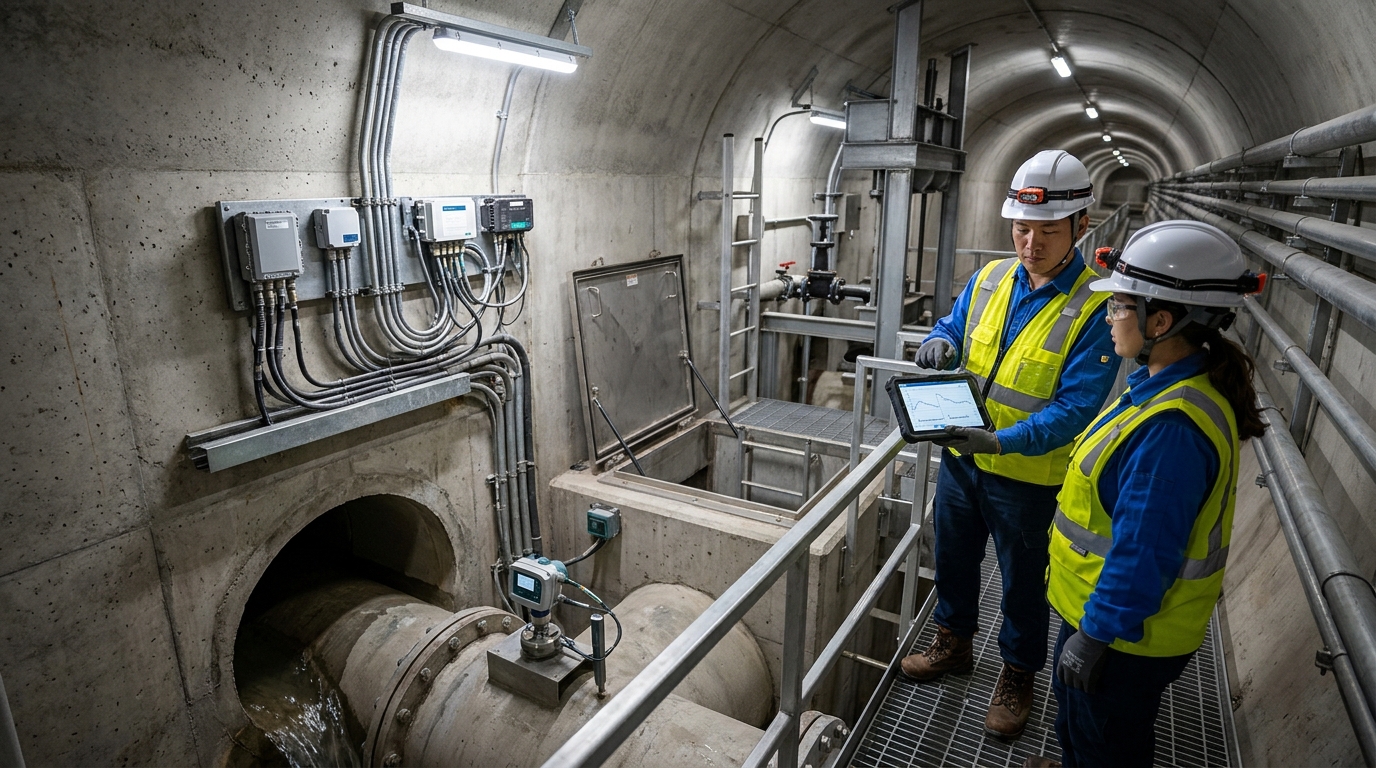
Before laying out monitoring points, objectives should be clearly defined. If the primary goal is leakage control, priority should be given to deploying flow and pressure points at the boundaries of District Metered Areas (DMAs), entrances to old residential communities, long-distance transmission and distribution pipeline sections, and pipeline segments with high pressure or frequent bursts. If the focus is on pressure assurance, attention should be paid to the ends of the network, areas with significant topographical elevation differences, before and after secondary water supply, and areas with concentrated complaints about low pressure during peak hours. If water quality safety is the priority, focus should be placed on water plant outlets, network extremities, areas with old cast-iron pipes, and near key users such as schools and hospitals.
Example Parameters for an 80 km² Urban Area
- DMA Division: Divide into DMAs of 2–5 km² each (approx. 30–40 metering districts).
- Instrumentation: Flow meters and pressure transmitters at DMA entrances; residual chlorine and turbidity monitoring at key nodes.
- Trunk Pipes (>DN300): Set up one pressure monitoring point every 1–2 kilometers.
- Branch Pipes (DN100–DN200): Lay out sampling points based on historical complaints and leakage data.
- Pressure Range: 0–1.0 MPa or 0–1.6 MPa, accuracy class ≥ 0.5.
- Protection Rating: Outdoor equipment recommended ≥ IP68.
II. Installation Steps: From Site Survey to Fixing, Wiring, and Protection
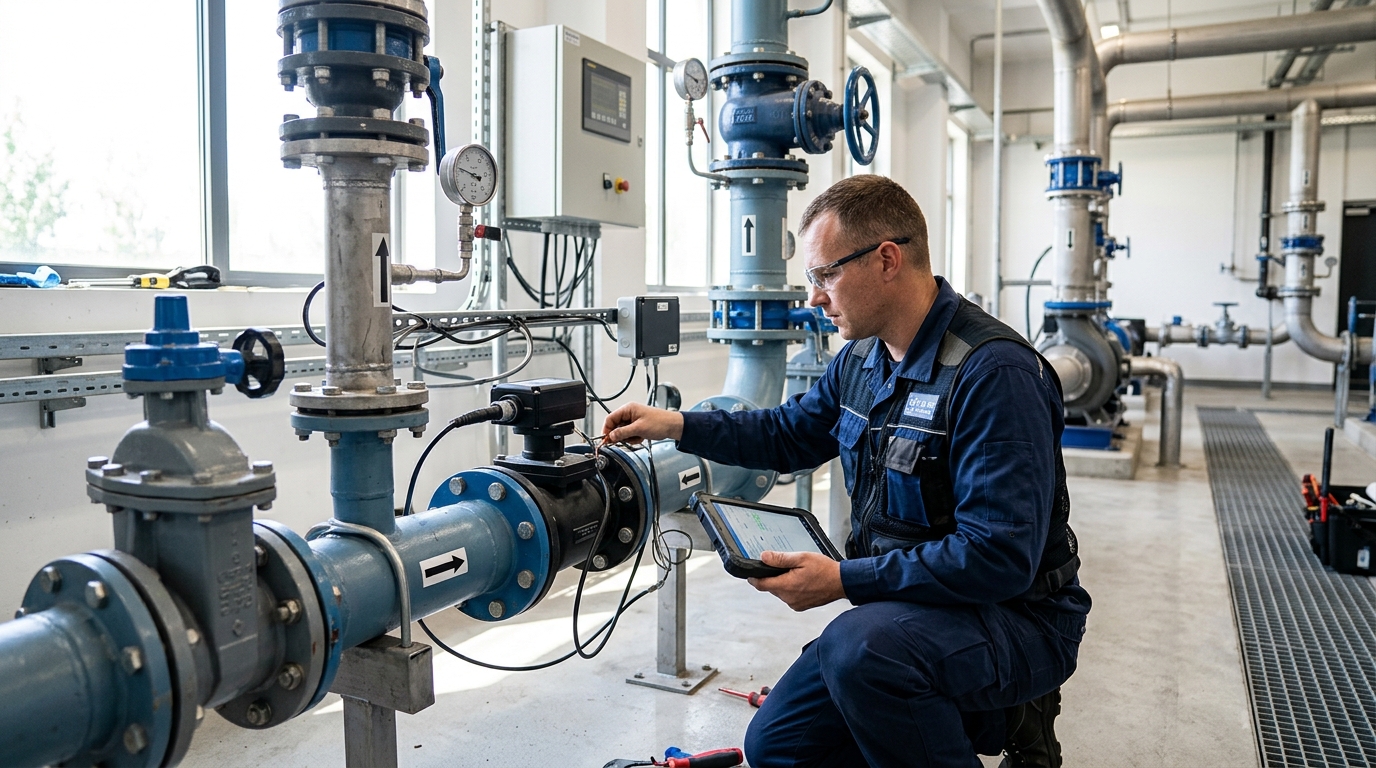
A site survey must be completed before installation, covering pipe material, pipe diameter, burial depth, valve chamber locations, power supply conditions, communication signals, waterlogging risks, and traffic impact. Pressure tapping points should preferably be selected at the top or side of the pipe, avoiding the sediment zone at the bottom and locations with significant flow disturbance such as valves, elbows, and pump station outlets. A ball valve or needle valve should be installed between the tapping point and the main pipe to facilitate future maintenance. Electromagnetic flow meters must ensure an upstream straight pipe section of no less than 5 times the pipe diameter and a downstream straight pipe section of no less than 3 times the pipe diameter; when conditions permit, arrange them with 10D upstream and 5D downstream, avoiding the turbulent flow zone after the pump.
Installation Checklist: Verify equipment model → Confirm shutoff/live-line plan → Drill/install tee → Install valves/transmitters → Fix enclosure (≥0.3m from ground) → Complete wiring → Restore site & record ID/coordinates.
Taking a pressure monitoring point on a DN800 transmission and distribution pipe in a certain city as an example, a 30-minute pressure retention test is conducted after construction; water flow is only allowed to resume if the pressure drop does not exceed 0.01 MPa and there is no leakage at the joints.
III. Commissioning Methods: Calibration, Communication, Thresholds, and Joint Debugging
Equipment cannot be put into operation directly after installation; commissioning must be completed. Pressure transmitters should undergo zero-point and span calibration, which can be compared using a standard pressure pump or a portable pressure gauge, recording deviations at points such as 0 MPa, 0.3 MPa, 0.6 MPa, and 0.9 MPa. If the error exceeds 0.5% of the full scale, recalibration or replacement is required. Battery-powered devices should be checked for static power consumption and reporting current to avoid premature battery depletion caused by frequent reconnections of the communication module. Flow meters should verify empty pipe alarms, forward and reverse flow, and cumulative flow to ensure consistency with the actual flow direction.
Communication Standards
- Signal strength (4G): ≥ -85 dBm
- Data integrity rate: > 98%
- Observation period: ≥ 72 hours
- Clock sync error: ≤ 1 minute
Threshold Settings
- Normal Service Pressure: 0.20 – 0.45 MPa
- Low-Pressure Alarm: < 0.18 MPa (15 min)
- High-Pressure Alarm: > 0.55 MPa (10 min)
- Sudden Drop: > 0.05 MPa (5 min)
IV. Leakage Analysis: Locating Suspected Leak Points Using Minimum Night Flow
Leakage analysis is one of the most valuable applications of water supply network monitoring. Common methods include the minimum night flow method, water balance analysis, pressure-flow correlation analysis, and acoustic leak detection verification. The minimum night flow is usually selected between 2:00 AM and 4:00 AM, when residential water consumption is low and industrial water use is stable. If the night flow in a certain DMA remains significantly higher than the normal level, there may be background leakage or visible leaks. For residential-dominated DMAs, the minimum night flow can use 0.5 to 1.5 cubic meters per kilometer of pipe per hour as a preliminary reference; if it reaches over 5 cubic meters per hour, priority investigation should be conducted.
During analysis, one cannot only look at flow; pressure must also be considered. If pressure rises at night in a certain area while flow increases synchronously, it often indicates the presence of a leak; if both pressure and flow decrease, it may be due to upstream valve closure or pipe blockage; if pressure is stable but flow increases abnormally, new water usage, firefighting water use, or metering errors should be verified.
Case Study: East China City
A 1,240-kilometer pipeline network was divided into 32 DMAs with 176 pressure points, 58 flow meters, and 24 water quality stations. After 6 months, the system identified 11 areas with abnormal minimum night flow. Correlators and acoustic detection confirmed 9 hidden leaks. Post-repair, the regional leakage rate dropped from 11.7% to 8.9%.
V. Operational Key Points for Pressure and Water Quality Monitoring
The focus of daily operation for pressure monitoring is trend stability. Operation and maintenance personnel should review pressure curves daily, paying attention to changes at the same monitoring point under similar water consumption conditions. If the daytime pressure at a certain point is consistently below 0.20 MPa and drops significantly during peak hours, the upstream valve opening, whether the pipe diameter is too small, the presence of local blockages, or increased water load should be checked. If the night pressure at a certain point is consistently above 0.55 MPa, an assessment should be made on whether pressure reduction is needed, as excessive pressure increases the risk of pipe bursts and joint leakage.
The key to water quality monitoring is ensuring sample representativeness and sensor cleanliness. Residual chlorine sensors are easily affected by membrane fouling, bubbles, and insufficient flow velocity. After installation, continuous flow of the water sample should be ensured, with the flow rate generally controlled at 0.2 to 0.5 liters per minute. Turbidity sensors should have their optical windows cleaned regularly to avoid the attachment of biofilms and sediment.
VI. Daily Maintenance: Establishing Schedules and Ledgers
Water supply network monitoring equipment operates long-term in humid, vibrating, temperature-fluctuating, and underground well environments. Without a maintenance plan, data quality will decline rapidly. It is recommended to establish a five-tier maintenance system: daily, weekly, monthly, quarterly, and yearly.
| Frequency | Key Tasks |
|---|---|
| Daily | Platform inspection, data integrity check, offline device alert, battery voltage check. |
| Weekly | Spot-check key points, verify reasonableness of pressure/flow/water quality curves. |
| Monthly | On-site inspection, manhole cover check, antenna fixation, enclosure sealing, sensor cleaning. |
| Quarterly | Standard comparison, battery capacity test, communication restart, parameter backup. |
| Annual | Comprehensive calibration, protection rating check, spare part replacement, ledger update. |
Regarding specific parameters, pressure transmitters are recommended to undergo on-site calibration every 6 months (3 months for critical points). Electromagnetic flow meters require annual zero-point checks. Residual chlorine sensor membranes/electrolyte should be replaced every 1–3 months. Battery-powered devices should trigger low-voltage alarms when lithium battery voltage drops below 3.3 volts.
VII. Common Fault Troubleshooting and Future Prospects
Common faults can be divided into four categories: no data, data drift, abnormal alarms, and on-site equipment damage. When there is no data, troubleshooting should follow the sequence of "power supply—communication—platform": first check battery voltage, solar charging, and wiring terminals; then check the SIM card, signal strength, and antenna connection; and finally confirm the platform access address, port, and acquisition protocol. When data drifts, pressure equipment should be prioritized for on-site comparison; if adjacent points are normal while a single point continuously deviates, it is mostly due to sensor zero-point drift, tapping pipe blockage, or joint leakage.
Looking ahead, water supply network monitoring will further develop towards multi-source data fusion and intelligent early warning. Pressure, flow, water quality, noise, work orders, geographic information, and user complaint data will be cross-analyzed on the same platform, and leakage analysis will shift from manual empirical judgment to model-assisted localization. However, no matter how technology evolves, on-site installation quality, basic ledgers, calibration records, and maintenance closed loops remain the key to determining system effectiveness. For water supply enterprises, only by properly installing, accurately calibrating, and thoroughly maintaining every monitoring point can water supply network monitoring truly serve the goals of safe water supply, energy conservation, consumption reduction, and refined management.