Complete Guide to Installation and Commissioning of Water Supply Network Monitoring Systems
Including Common Problems, Maintenance Strategies, and Troubleshooting
As urban water supply systems expand and the age of pipe networks increases, leakage control, pressure safety, and water quality stability in water distribution networks have become critical issues in water utility operations and maintenance (O&M). In industry practice, many urban water supply enterprises have deployed pressure monitoring, flow monitoring, online water quality monitoring, and district metered area (DMA) systems, gradually shifting from traditional “reactive repair” to “proactive early warning.”
However, whether monitoring systems can deliver value depends not only on equipment parameters, but more on standardized on-site installation, sufficient commissioning, closed-loop routine maintenance, and rule-based troubleshooting. From a practical perspective, this article outlines the installation steps, commissioning methods, routine maintenance, and common troubleshooting for water distribution network monitoring, covering typical scenarios such as leakage analysis, pressure monitoring, and water quality monitoring, to provide actionable guidance for water utility O&M personnel, installation crews, and dispatch management personnel.
1. Monitoring Point Planning and Equipment Selection
The first step in water distribution network monitoring is not equipment procurement, but point planning. Pressure monitoring points are usually prioritized at pump station outlets, main pipe nodes, network ends, large-diameter intersections, downstream of pressure-reducing valves, inlets of secondary water supply pump houses, and areas with historical pipe bursts. It is generally recommended to install at least 1 to 2 pressure monitoring points in each independent pressure control zone, with redundant points at important nodes. Flow monitoring points should be installed at DMA boundaries, DMA inlet/outlet, large-diameter mains, inlets of concentrated user areas, and finished-water metering points. Water quality monitoring points should cover finished water, mid- and end-of-network locations, secondary water supply tanks or pump houses, areas with concentrated customer complaints, and network ends with low residual chlorine.
Equipment Selection Criteria
- Pressure Transmitters: Common ranges are 0–1.0 MPa, 0–1.6 MPa, or 0–2.5 MPa. Accuracy should be 0.5 class or 0.25 class. Output options include 4–20 mA, RS485 Modbus, or wireless protocols.
- Flow Meters: Electromagnetic meters suit full-pipe clean water (DN50–DN2000, ±0.5% to ±2% accuracy). Ultrasonic meters (clamp-on or insertion) require specific straight pipe lengths (upstream 10D, downstream 5D).
- Water Quality Sensors: Cover residual chlorine (0–5 mg/L), turbidity (0–100 NTU), pH (0–14), conductivity (0–5000 μS/cm), and temperature.
- Communication & Power: Use 4G/NB-IoT/Fiber for urban areas with mains power; solar + wireless for suburban/valve wells. Protection rating must be IP66 or higher.
2. On-Site Installation Steps
Pressure Monitoring Points
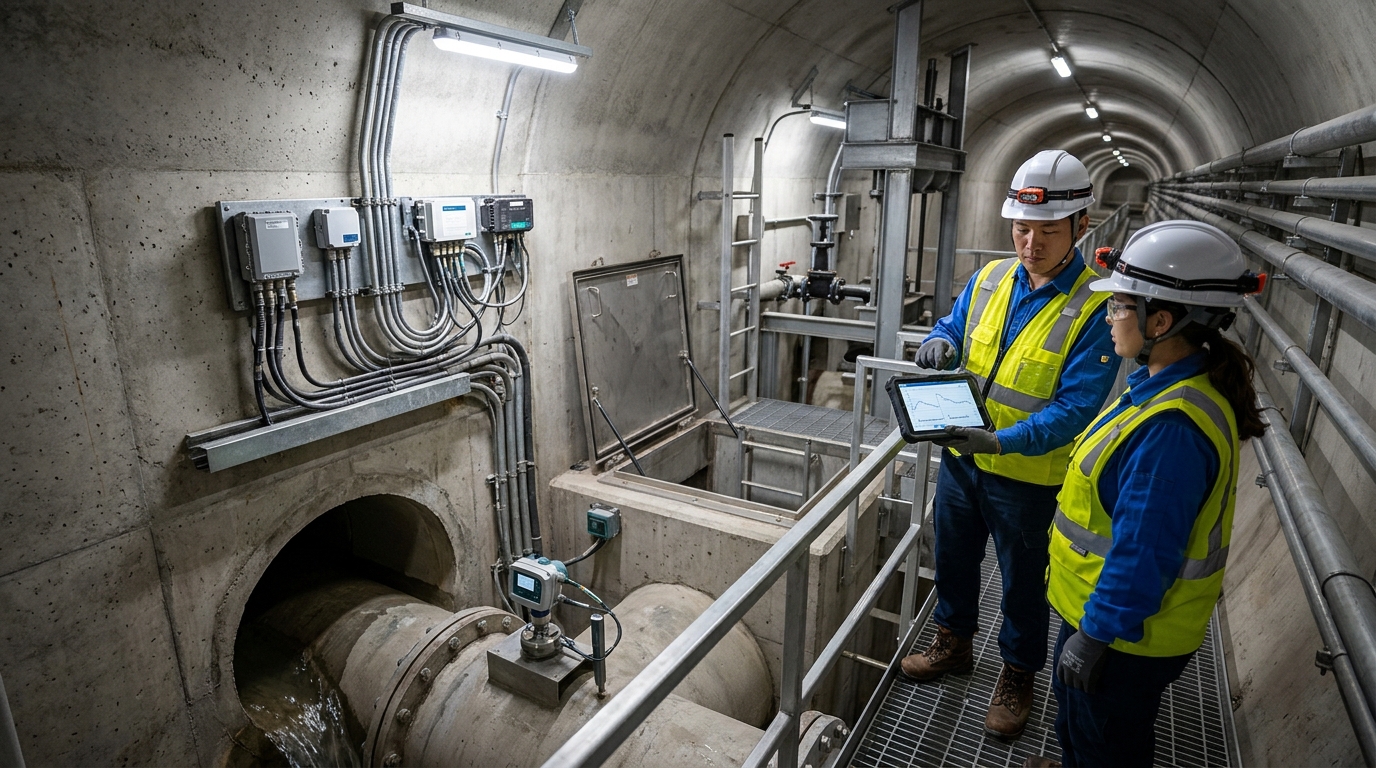
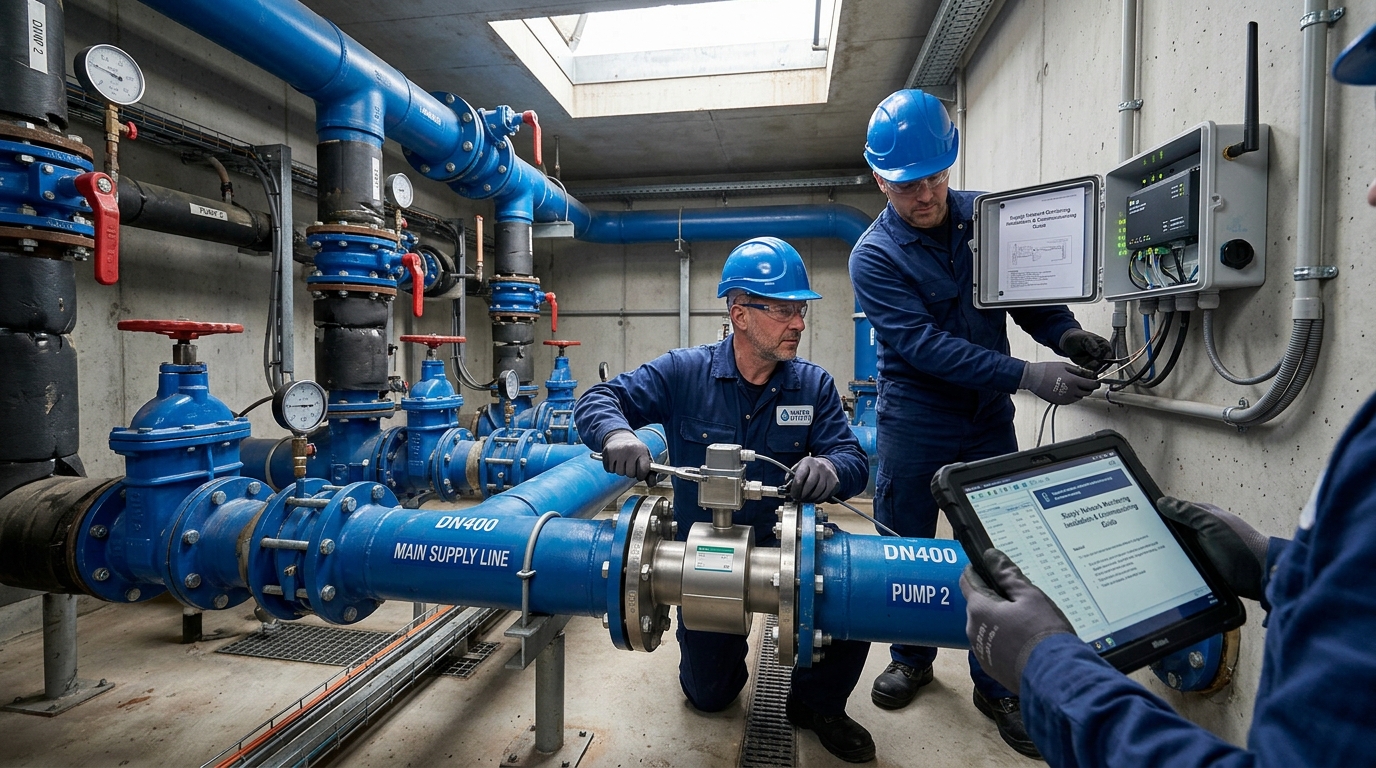
Follow principles of “safe isolation, low-loss pressure tapping, reliable grounding, and waterproof/dustproof protection.” Confirm shutdown/depressurization plans before work. For DN100+ pipes, use welded tees or clamp-ons. Ensure diaphragm orientation avoids sediment deposition. Ground shields at one end only (<4 Ω resistance) and leave 1–2 m cable slack to prevent pulling damage.
Flow Meter Installation
Electromagnetic: Avoid high points/gas pockets. Gasket ID must not be smaller than pipe ID.
Insertion Type: Check wall corrosion/scaling; avoid welds/bolt holes.
Clamp-on Ultrasonic: Grind pipe surface to expose metal/stable wall. Apply coupling gel. Signal quality should exceed 60%. Protect transducers from sun/rain.
Note on Water Quality: Use bypass sampling pipelines to ensure continuous flow. Residual chlorine probes need flow cells to avoid bubbles/sunlight. Turbidity probes require regular backwashing. Keep pH/conductivity electrodes wet. Place main units outside wells in dry locations to avoid immersion.
3. Commissioning Methods
The objective is to confirm accurate measurements, stable data links, and available alarm logic. Before powering on, check voltage, polarity, addresses, SIM status, and protection.
- Pressure Calibration: Use standard bench or field tee valve with gauge. Three-point calibration (e.g., 0, 0.6, 1.2 MPa). Error within 0.5% FS (0.25% for critical points). Perform step tests to check response time.
- Flow Verification: Compare electromagnetic readings with portable instruments. For ultrasonic, repeat comparisons three times; deviation should be ≤±2%. Check straight pipe length and lining parameters if deviations occur.
- Water Quality Calibration: Use standard solutions (e.g., 0.2/1.0 mg/L for Cl₂, 1/10 NTU for turbidity, pH buffers 4.00/6.86/9.18). Record lot numbers and results.
- Platform Integration: Verify IDs, coordinates, ranges, units, and protocols. Set alarms based on operating conditions (e.g., Low Pressure Alarm at 0.25 MPa if normal is 0.35–0.60 MPa). Test breakpoint resume and clock synchronization.
Prepare an acceptance report including photos, wiring diagrams, calibration records, threshold settings, and outstanding issue lists.
4. Practical Leakage Analysis
DMA-based metering establishes water balance: Input = Legitimate Consumption + Unmetered + Error + Leakage. The Night Minimum Flow (NMF) method (02:00–04:00) is widely used. If NMF rises significantly above baseline (e.g., 32 m³/h to 45 m³/h) for >3 days without new users/fire usage, initiate investigation.
Case Study: A DMA serving 23,000 people detected abnormal NMF. Valve closure tests localized a DN150 branch. Acoustic detection revealed crack leakage in sandy soil. Repair reduced NMF from 32 to 18 m³/h, lowering leakage rate from 12.4% to 8.1%, saving ~123,000 m³/year.
Pressure Correlation: Leakage volume approximates proportional to $P^n$ ($n \approx 1.15–2$). Reducing nighttime pressure (e.g., 0.52 to 0.47 MPa) can reduce NMF by ~8%. However, pressure reduction must consider fire safety and end-user demand.
Typical Investigation Process
- Confirm abnormal area via platform data review.
- Eliminate data anomalies (sensor faults, comms interruptions).
- Conduct district valve closure tests to narrow range.
- Use acoustic detectors/correlators for nighttime localization.
- Excavate, repair, and record leak details.
5. Routine Maintenance Cycle
Data credibility depends on maintenance quality. Establish a five-level mechanism:
Daily & Weekly
- Daily: Check completeness (>95%), alarms, online rate, battery, signal.
- Weekly: Inspect solar panels, loose wiring, well water accumulation, locks. Clean water quality filters/probes.
Monthly & Quarterly
- Monthly: Zero-point checks for pressure, portable comparison for flow, standard solution calibration for water quality.
- Quarterly: Check mechanical reliability (valves, tees, brackets, grounding, lightning modules, antennas, conduits). Clean well silt.
Annual & Seasonal: Conduct metrological verification and sensor replacement assessments (pressure every 2–4 years; probes every 6–18 months). In winter, insulate pipelines/boxes, install heat tracing, and drain accumulated water to prevent freeze cracking.
6. Common Troubleshooting
Pressure Issues
Drift/Abnormal Readings: Check zero point, range settings, and diaphragm scaling. Fluctuations: Investigate water hammer, half-open valves, pump cycling, or gas pockets. Interruptions: Check power, terminals, address, and protocol. Use multimeter for 4–20mA loop current. For RS485, verify A/B line polarity and termination resistance.
Flow Anomalies
Electromagnetic: Empty-pipe alarms or jumps caused by non-full pipe, bubbles, electrode contamination, or bad grounding. Ultrasonic: Weak signals/high gain due to corrosion, dried gel, position offset, or wrong pipe parameters. Re-grind pipe surface, adjust transducers, or change location. Check firmware/battery for long-idle devices.
Water Quality Faults
Follow sequence: Sampling Conditions → Probe Cleanliness → Calibration/Electrode Life.
- Low Residual Chlorine: Long sampling lines, sunlight, high temp, contaminated flow cell, expired reagent.
- High Residual Chlorine: Electrode aging, bubbles, expired standards, diaphragm contamination.
- Turbidity Drift: Scaling, algae, bubbles, flow disturbance.
- pH Drift: Glass membrane contamination, reference clogging, dry storage.
Conclusion and Outlook
Water distribution network monitoring is evolving from single-point collection to systematic intelligence. Future integration will combine pressure, flow, water quality, noise, GIS, and hydraulic models. By accumulating historical data (NMF, pressure changes, burst locations, soil conditions), utilities can build leakage probability models for predictive O&M. Digital twins will enhance dispatching by predicting pressure propagation and stagnation risks during planned interventions.
Ultimately, the value of monitoring lies not in device quantity, but in reasonable point planning, standardized installation, credible data, closed-loop maintenance, and procedural fault handling. Only then can “visible data” transform into “manageable networks.”