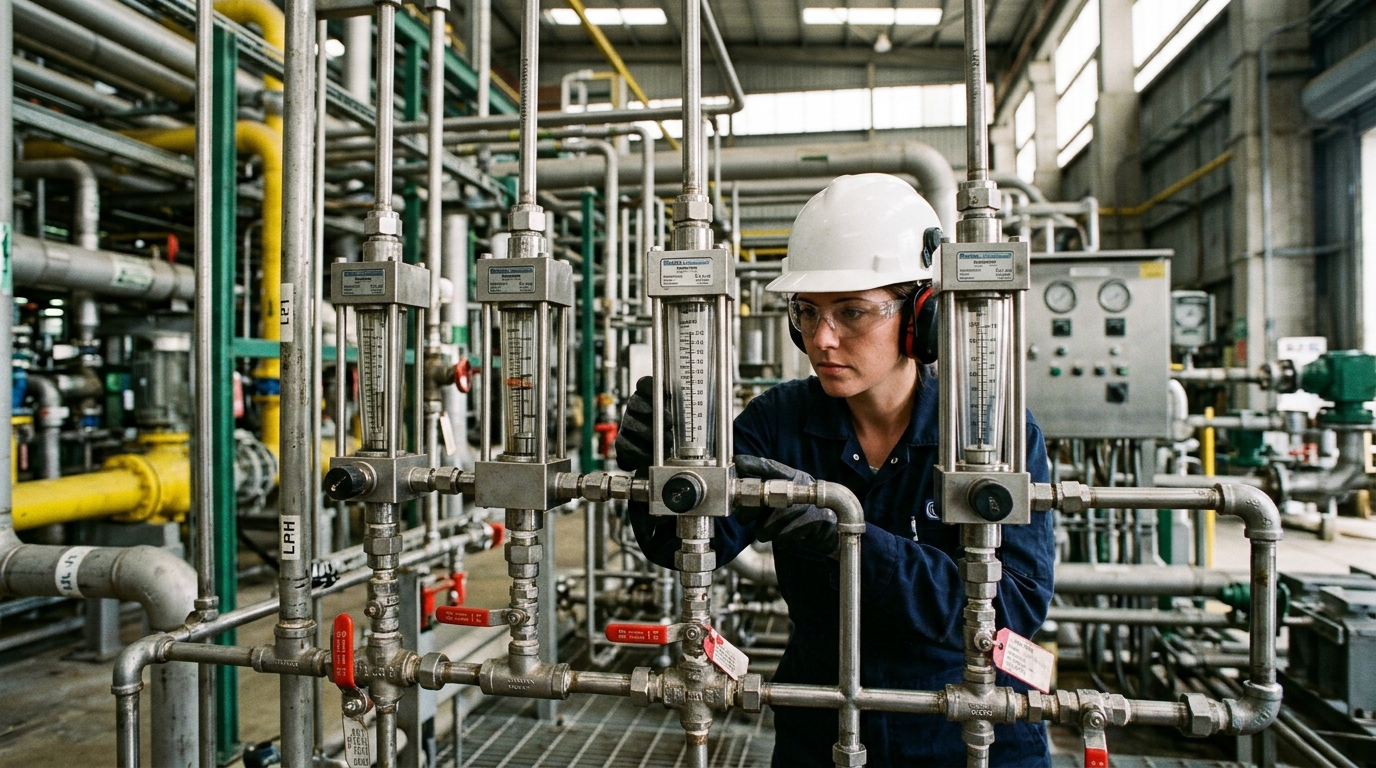
Metal Tube Rotameter Solution for Small-Flow Metering of Chemical Process Media
Targeting the difficulties of metering small flows of liquids, gases and corrosive media in chemical plants — insufficient turndown of differential-pressure meters and fragile signals at micro-flow rates — this solution uses metal tube variable area flow meters (rotameters) as the primary sensing element, combined with magnetic-coupled local indication, 4-20mA/HART remote transmission and flow alarm switches, covering dosing, purging, sampling and seal-flush duties with 1.5-class accuracy over a 10:1 turndown and RTU/DCS networking for centralized monitoring and trend analysis.
Overview
Summary
Targeting the difficulties of metering small flows of liquids, gases and corrosive media in chemical plants — insufficient turndown of differential-pressure meters and fragile signals at micro-flow rates — this solution uses metal tube variable area flow meters (rotameters) as the primary sensing element, combined with magnetic-coupled local indication, 4-20mA/HART remote transmission and flow alarm switches, covering dosing, purging, sampling and seal-flush duties with 1.5-class accuracy over a 10:1 turndown and RTU/DCS networking for centralized monitoring and trend analysis.
Key Advantages
Challenges
- Dosing, purging and sampling points operate as low as a few liters per hour; differential-pressure and velocity meters drift at low Reynolds numbers with insufficient turndown, causing chronic metering errors
- Corrosive acids, alkalis and solvents impose severe material demands — plain carbon steel or 304 bodies corrode and leak, while lined meters face conflicting pressure and temperature limits
- Micro-flow signals are disturbed by pump pulsation, gas-liquid two-phase flow and installation stress, producing unstable indications that operators cannot trust
- Small-flow points are numerous and scattered; reliance on manual rounds for readings leaves serious data gaps, so material-balance accounting and leak investigation lack quantitative basis
- Loss of seal-flush or carrier-gas purge flow often goes undetected; without interlocks this damages pump seals or analyzers, causing costly unplanned shutdowns
Results
- The variable area principle is inherently suited to small flows with 10:1 turndown; normal flow positioned at 60%-80% of scale delivers stable 1.5-class system accuracy
- 316L / Hastelloy / PTFE-PFA lined wetted materials selected per medium withstand 16 MPa class and 300 °C service, eliminating corrosion-leak incidents
- Leak-tight magnetic coupling plus damping configuration suppress pulsation; local indication is steady and readable, and the 4-20 mA/HART signal matches DCS display
- Small-flow points networked via RTU provide point lists, historical trends and shift reports; manual reading is abolished and material accounting gains continuous data support
- High/low alarm switches wired into interlocks give second-level annunciation of flow loss or over-flow, markedly reducing unplanned shutdowns of seal-flush and analyzer carrier loops
Solution Details
Metal Tube Rotameter Solution for Small-Flow Metering of Chemical Process Media
In chemical, petrochemical and fine-chemical plants, dosing, sampling, purging, seal flushing and analyzer carrier-gas loops routinely operate at small flow rates of a few to a few hundred liters per hour. These points feature low flow, small line sizes and aggressive media: orifice plates and vortex meters lose discharge-coefficient stability at low Reynolds numbers and lack sufficient turndown, so the flow is measurable but not trustworthy. Metal tube rotameters are based on the variable area principle — float position corresponds almost linearly to volumetric flow — making them inherently suited to small flows, low velocities and wide turndown, independent of medium conductivity, and a classic choice for chemical small-flow metering.
This solution adopts all-metal construction rotameters: measuring tube and float materials are selected per medium corrosion aggressiveness from 304, 316L, Hastelloy or PTFE/PFA-lined variants, with pressure ratings up to 16 MPa class and temperatures above 300 °C (high-temperature versions available), meeting sealing-safety requirements for flammable, explosive and toxic media. Magnetic coupling transmits float position leak-tight to the indicator head, supporting on-site pointer and LCD display with 4-20 mA output overlaid with HART digital communication for DCS/RTU integration. Optional low/high flow alarm switches and totalization provide interlock protection against dosing interruption or purge-flow loss. For complete plants, multiple rotameters are networked via signal isolators and RTUs, turning scattered small-flow points into a managed point list with historical trend analysis supporting material-balance accounting and process optimization.
Implementation follows a closed loop of selection, installation, calibration, commissioning and maintenance: standard water/air scales are converted to actual process conditions using medium density and viscosity, ensuring the normal flow falls within 60%-80% of scale; installation guarantees verticality and upstream/downstream straight runs with block and bypass valves for online maintenance; factory wet calibration combined with field verification and periodic calibration records keeps measurement traceable over the long term.
Key Features of the Metal Tube Rotameter for Chemical Small-Flow Metering
- Variable area measuring principle: float position is nearly linear with volumetric flow, highly sensitive at small flows with 10:1 turndown, and local indication needs no external power
- All-metal safe construction: measuring tube in 304/316L/Hastelloy or PTFE/PFA-lined versions per medium, 16 MPa class and above 300 °C, suitable for flammable, explosive and toxic media
- Leak-tight magnetic coupling: float position transmitted to the indicator head through a magnetic system with zero dynamic-seal leakage, meeting hazardous-media sealing safety
- Versatile signal outputs: pointer plus LCD local display, 4-20 mA overlaid with HART, optional RS485 (Modbus RTU), compatible with DCS/PLC/RTU networking
- Alarm and interlock integration: optional high/low flow alarm switches and totalization provide second-level interlock protection against dosing interruption and purge-flow loss
- Process conversion and wet calibration: water/air scales corrected for medium density and viscosity; every unit wet-calibrated at the factory for traceable measurement
Technical Specifications at a Glance
10:1
Turndown Ratio
16 MPa
Pressure Rating Class
>300 °C
Temperature Capability
4-20 mA
Output with HART
60%-80%
Normal Flow Within Scale
304/316L
Hastelloy / PTFE/PFA Lined
Applications and Implementation of the Metal Tube Rotameter
The metal tube rotameter is engineered for small-flow metering across chemical, petrochemical and fine-chemical processes. Typical application points include dosing, sampling, purging, seal flushing and analyzer carrier-gas loops, where reliable low-flow measurement is critical for process integrity and safety.
Implementation follows a closed loop of selection, installation, calibration, commissioning and maintenance. Standard water/air scales are converted to actual process conditions using medium density and viscosity, ensuring the normal flow falls within 60%-80% of scale. Installation guarantees verticality and upstream/downstream straight runs with block and bypass valves for online maintenance. Factory wet calibration combined with field verification and periodic calibration records keeps measurement traceable over the long term.
? References
- Variable area flow measurement principle and low-Reynolds-number behavior of orifice plates and vortex meters
- All-metal rotameter construction, material selection and pressure/temperature ratings for aggressive media
- Magnetic coupling transmission, 4-20 mA/HART output and DCS/RTU integration practices
- Process conversion, wet calibration and installation requirements for small-flow metering loops
Approach
How we implement intelligence into your infrastructure step by step.
Process survey and point inventory
Map all small-flow loops — dosing, purging, sampling, seal flushing, carrier gas; record medium, density, viscosity, working pressure/temperature and normal/min/max flows; build a point list with metering and interlock classifications.
Sizing calculation and material selection
Convert actual flows to equivalent standard water/air scale flows; select bore sizes so normal flow falls within 60%-80% of scale; determine wetted materials and lining per corrosion, temperature and pressure; specify indication, remote transmission and alarm configurations.
Installation and piping accessories
Guarantee vertical installation (deviation ≤2°) and required upstream/downstream straight runs; fit block and bypass valves for online maintenance; add filters for solids-laden media and trace heating for crystallizing media.
Calibration, configuration and commissioning
Verify factory wet-calibration certificates; configure zero point and damping on site to suppress pump pulsation; route 4-20 mA/HART to DCS or via signal isolators into RTUs; set alarm switch thresholds, wire interlocks and complete loop checks.
Data networking and periodic maintenance
Upload small-flow point data via RTU to the monitoring platform; build trend analysis, shift reports and material-balance templates; schedule periodic cleaning of floats and tubes, magnetic-transmission checks and recalibration to keep measurement trustworthy long term.
Recommended Hardware
Essential components for this solution.
❓ Related FAQs
Related Solutions
Split-Type Electromagnetic Flow Meter Solution for Pump Stations with High Humidity and Heavy Vibration
Inline Ultrasonic Flow Meter Solution for Pump Station Discharge Metering and Pump Efficiency Testing
Doppler Ultrasonic Flow Meter Solution for Flow Monitoring in Partially Filled Municipal Drainage Conduits

Ready to Optimize Your Business?
Contact us, and our professional team will provide customized solutions to help your business achieve digital transformation.
Get In Touch