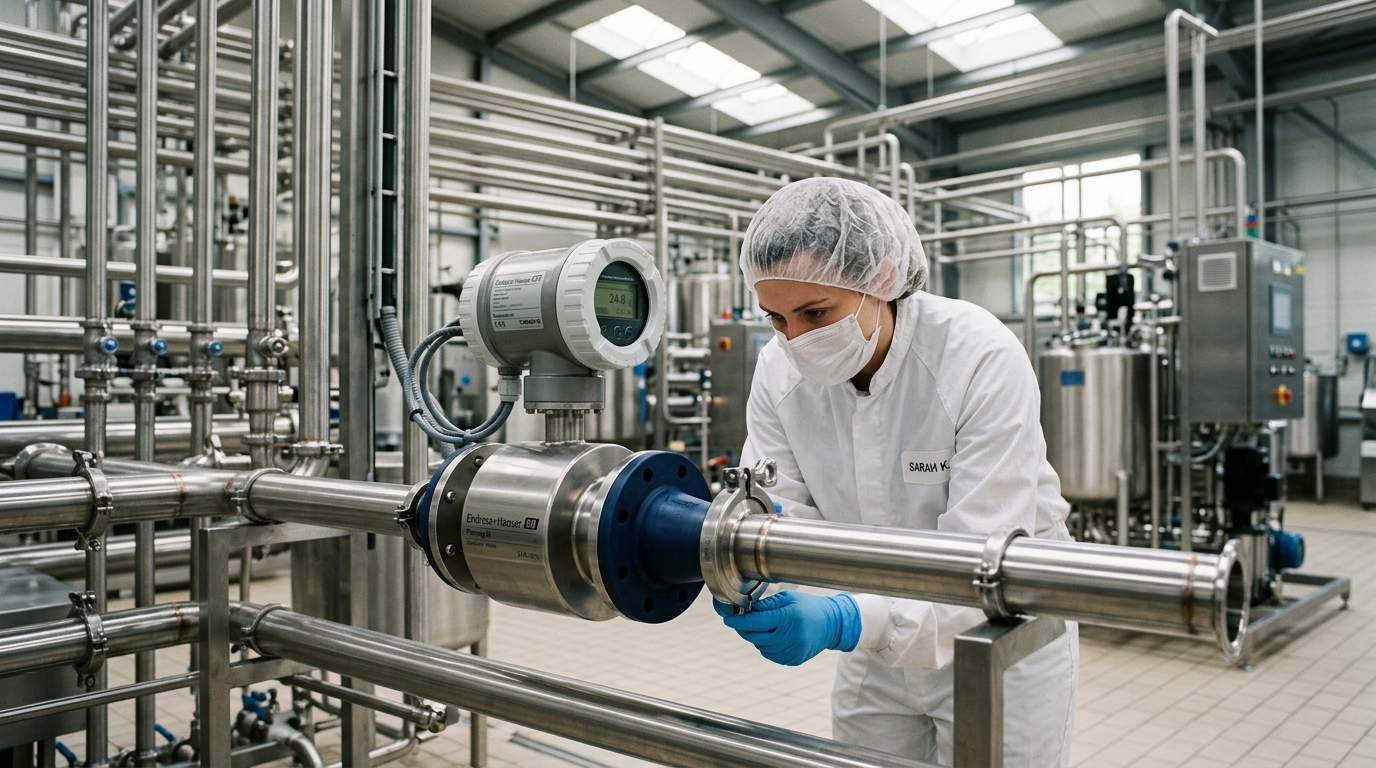
Aerospace-grade PA66-lined Electromagnetic Flow Meter Solution for Food and Pharma Sanitary Pipelines
Sanitary pipelines in food and pharmaceutical plants face harsh CIP/SIP temperature cycles, vacuum conditions and strict hygiene audits. This solution applies aerospace-grade PA66-lined electromagnetic flow meters (accuracy ±0.5%, sanitary clamp connection, 316L electrodes, IP69K) whose liners withstand 150°C steam sterilization and negative pressure without deformation, feeding metering data directly into batch control and MES systems to unify hygiene compliance with precise metering.
Overview
Summary
Sanitary pipelines in food and pharmaceutical plants face harsh CIP/SIP temperature cycles, vacuum conditions and strict hygiene audits. This solution applies aerospace-grade PA66-lined electromagnetic flow meters (accuracy ±0.5%, sanitary clamp connection, 316L electrodes, IP69K) whose liners withstand 150°C steam sterilization and negative pressure without deformation, feeding metering data directly into batch control and MES systems to unify hygiene compliance with precise metering.
Key Advantages
Challenges
- Sanitary pipelines undergo repeated hot-alkali CIP cleaning and steam SIP sterilization; ordinary liners age, deform and delaminate, and frequent replacement disrupts production continuity
- Condensation and vacuum after SIP sterilization collapse ordinary liners, blocking the pipe and interrupting metering, leaving batch data gaps
- Rubber liners absorb dairy fat and chemical components, failing cleaning validation and GMP/3-A hygiene audit requirements
- Low-conductivity media like purified water are hard to measure; syrup and dairy crystallize and coat electrodes, causing fouling and reading drift
- No compliant online metering data to support batch traceability; manual sampling metering is inefficient and cannot meet audit-trail requirements
Results
- Liners stably withstand 150°C steam sterilization and vacuum conditions, extending flow meter service life from an average of 1~2 years to over 5 years
- Metering accuracy stably held within ±0.5%, significantly narrowing batch input/output data deviations
- Uninterrupted metering through CIP/SIP cycles with automatic batch metering reports, meeting GMP data integrity and audit-trail requirements
- Dead-zone-free sanitary structure certified by EHEDG/3-A, raising cleaning validation pass rate to over 95%
- Metering data directly feeds MES batch control, automating material balance accounting and cutting manual reading workload by 90%
Solution Details
Aerospace-grade PA66-lined Electromagnetic Flow Meter Solution for Food and Pharma Sanitary Pipelines
Fluid metering in food and pharmaceutical production must satisfy strict hygiene regulations while surviving demanding process conditions. Sanitary pipelines are built from 316L stainless steel with clamp connections, and repeatedly endure hot-alkali CIP cleaning at 85~95°C and pure-steam SIP sterilization at 120~140°C. Media such as dairy products, juice, syrup and pharmaceutical purified water span a wide conductivity range, with some prone to fouling, crystallization and coating. Conventional sanitary flow meters show clear weaknesses: rubber liners absorb medium components and age quickly, failing hygiene audits; ordinary liners deform and delaminate after repeated thermal cycles, and collapse under SIP vacuum, blocking the line and compromising metering continuity and batch compliance.
Aerospace-grade PA66 (polyamide 66) is a high-performance engineering plastic long used in aviation hydraulic and fuel systems, offering high mechanical strength, creep resistance, dimensional stability and chemical resistance. An electromagnetic flow meter with a one-piece injection-molded aerospace-grade PA66 liner, combined with 316L measuring electrodes and sanitary clamp connections, retains the inherent advantages of electromagnetic metering — zero pressure loss, wide turndown, immunity to density and viscosity changes — while withstanding the thermal cycling, vacuum and washdown conditions of sanitary pipelines for the long term. It is the upgrade path that takes food and pharma sanitary metering from merely functional to compliant and durable.
Metering Challenges in Food and Pharma Sanitary Pipelines
Hygiene regulation constraints: GMP, FDA 21 CFR, EHEDG and 3-A standards require wetted instruments to have no dead zones or residue pockets and to be fully cleanable, with liner and sealing materials backed by food-contact compliance declarations.
Thermal cycling shock: Hot-alkali CIP cleaning and steam SIP sterilization repeatedly swing pipelines between ambient and 140°C; under long-term thermal expansion and contraction, liners and seals of ordinary materials age, deform, delaminate and leak.
Vacuum stress: Condensation after SIP and pipeline drainage create negative pressure, under which ordinary liners collapse, causing blockage, zero drift and even total meter failure.
Variable media: Dairy fat coats walls, syrup crystallizes, and purified water has extremely low conductivity (<5μS/cm), placing high demands on liner surface finish, electrode fouling resistance and low-conductivity measurement capability.
Aerospace-grade PA66-lined Electromagnetic Flow Meter Architecture
Liner material: One-piece injection-molded aerospace-grade PA66 liner with continuous service temperature of -40~120°C and short-term tolerance of 150°C pure steam; smooth inner wall with roughness Ra≤0.8μm, non-adsorbing, resistant to repeated flushing by CIP alkali and acidic cleaners, supplied with food-contact compliance declarations.
Metering performance: Accuracy ±0.5% (±0.2% optional), turndown ratio 100:1, applicable conductivity ≥5μS/cm; low-conductivity media covered by optional dedicated electrodes and high-frequency excitation, including purified water, pre-stage water for injection and CIP return metering.
Sanitary construction: Full 316L stainless steel measuring tube with clamp connections (ISO 2852/DIN 32676), electrodes in 316L or Hastelloy, seals in food-grade EPDM or perfluoroelastomer; EHEDG and 3-A sanitary design certified, no liquid-retention dead zones.
Signals and integration: 4-20mA, pulse and RS485 Modbus outputs supported; integral transmitter with stainless sanitary enclosure and IP69K protection against high-pressure washdown; metering data feeds batch control systems and MES, automatically generating batch metering reports and audit-trail records.
±0.5%
Accuracy (±0.2% optional)
100:1
Turndown Ratio
-40~120°C
Continuous Service Temp
150°C
Short-term Pure Steam
Ra≤0.8μm
Inner Wall Roughness
IP69K
Washdown Protection
Key Points of Selection and Installation
Liner selection: Lines with SIP sterilization or vacuum conditions should prefer aerospace-grade PA66 or PFA liners; avoid ordinary PTFE in large-bore negative-pressure service; for media below 5μS/cm choose low-conductivity electrodes with high-frequency excitation models.
Electrode selection: 316L electrodes suffice for ordinary dairy and beverage media; upgrade to Hastelloy C22 for high-chloride CIP chemicals or chlorinated washdown to extend electrode life.
Installation requirements: Install with the electrode axis horizontal to guarantee full-pipe measurement; keep 5D upstream and 2D downstream straight runs; clamp connections use sanitary gaskets that must not intrude into the pipe, eliminating metering dead zones; fit vent valves at high points of SIP lines to reduce vacuum shock.
Maintenance and calibration: The PA66 liner and 316L electrodes require little maintenance; routine checks need only zero and seal inspection. After each CIP batch, verify readings by standard comparison; perform on-site calibration when deviation exceeds 0.5%, keeping batch metering data trustworthy.
? 参考来源
- EHEDG Guidelines for Hygienic Design of Flow Meters
- 3-A Sanitary Standards for Instruments and Fittings
- FDA 21 CFR Food Contact Material Compliance
Approach
How we implement intelligence into your infrastructure step by step.
Condition survey and hygiene compliance assessment
Review sanitary pipeline media properties, CIP/SIP temperature profiles and vacuum conditions, verify GMP/3-A compliance requirements, and determine bore, liner and electrode configuration.
Selection, configuration and installation
Select aerospace-grade PA66-lined electromagnetic flow meters and sanitary clamp fittings per condition, complete horizontal installation, straight-run allowances and sanitary gasket assembly, eliminating metering dead zones.
System integration and batch commissioning
Connect metering signals to batch control and MES systems, configure batch reports, audit trails and low-conductivity excitation parameters, and commission continuous metering through CIP/SIP cycles.
Validation handover and O&M support
Perform cleaning validation and metering comparison, deliver IQ/OQ documentation, and establish periodic calibration and maintenance plans to guarantee long-term compliant operation.
❓ Related FAQs
Related Solutions
Split-Type Electromagnetic Flow Meter Solution for Pump Stations with High Humidity and Heavy Vibration
Inline Ultrasonic Flow Meter Solution for Pump Station Discharge Metering and Pump Efficiency Testing
Doppler Ultrasonic Flow Meter Solution for Flow Monitoring in Partially Filled Municipal Drainage Conduits

Ready to Optimize Your Business?
Contact us, and our professional team will provide customized solutions to help your business achieve digital transformation.
Get In Touch