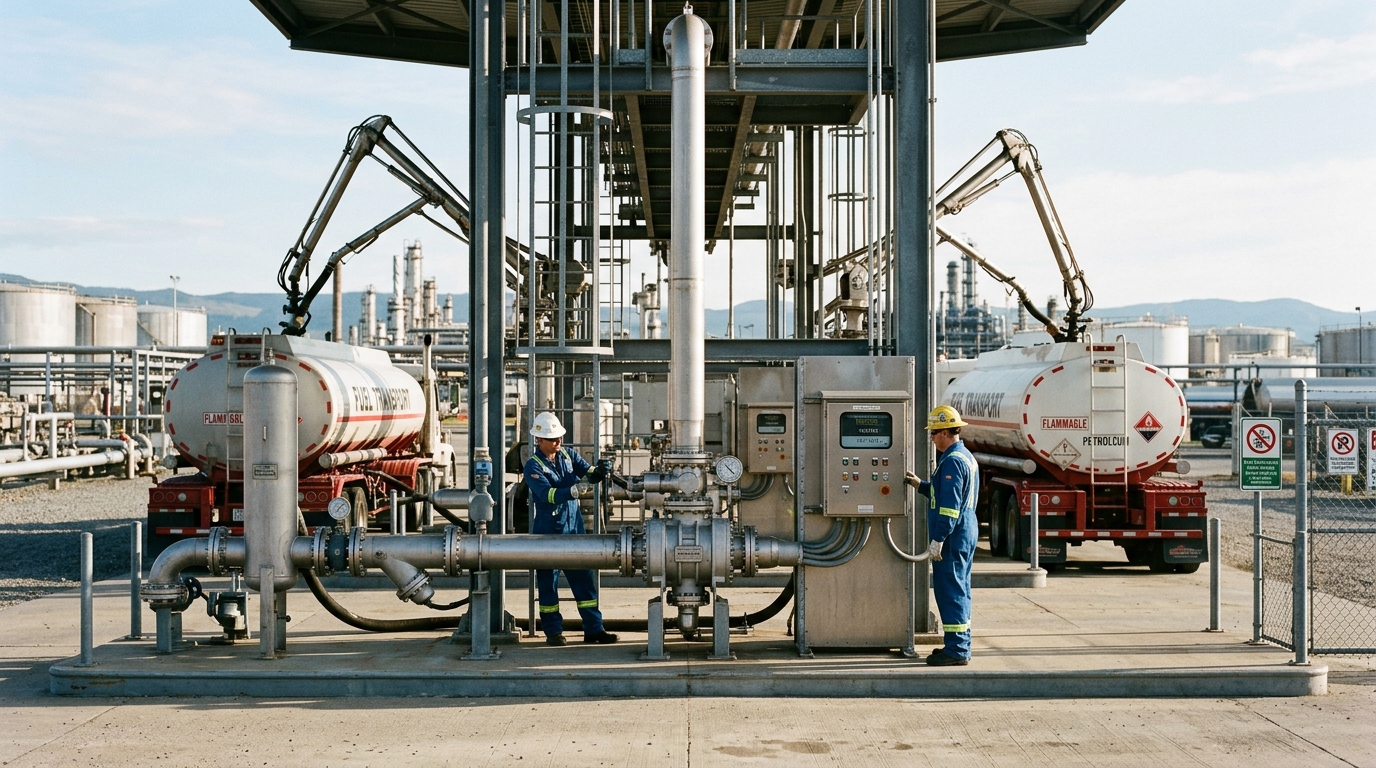
Roots (Waist-Wheel) Flow Meter Solution for Petrochemical Truck Loading and Marine Terminal Metering
Addressing high flow rates, wide viscosity ranges, frequent batch operations and strict explosion-proof requirements in petrochemical truck loading, rail rack and marine terminal custody transfer, this solution uses Roots-type (waist-wheel) positive displacement flow meters as the core metering element. With class 0.5/0.2 accuracy, pressure ratings up to 4.0 MPa and full explosion-proof certification, integrated with gas eliminators, strainers, temperature compensators and batch loading controllers into a standard metering skid, it delivers automatic preset batching, trustworthy fiscal metering data and digitized inventory reconciliation.
Overview
Summary
Addressing high flow rates, wide viscosity ranges, frequent batch operations and strict explosion-proof requirements in petrochemical truck loading, rail rack and marine terminal custody transfer, this solution uses Roots-type (waist-wheel) positive displacement flow meters as the core metering element. With class 0.5/0.2 accuracy, pressure ratings up to 4.0 MPa and full explosion-proof certification, integrated with gas eliminators, strainers, temperature compensators and batch loading controllers into a standard metering skid, it delivers automatic preset batching, trustworthy fiscal metering data and digitized inventory reconciliation.
Key Advantages
Challenges
- Loading racks and marine terminals run batch operations with high flow rates and frequent start-stops; media span from low-viscosity gasoline to high-viscosity heavy oil, and velocity meters such as turbines drift with viscosity and temperature, making it hard to hold class 0.2 fiscal accuracy
- Outbound oil dispatching is batch-preset driven; manual supervision of loading volume is inefficient and prone to over/under-filling, and per-truck or per-voyage discrepancies accumulate into annual product losses and trade disputes without automatic batching and interlocked shut-off
- Gasoline, naphtha and other light products are flammable and explosive; truck loading gantries and marine loading areas are classified hazardous zones where non-certified instruments are not admissible, blocking safety and fire-code acceptance
- Entrained gas and particulates in pipelines cause positive displacement meters to over-read; gas-liquid two-phase flow under pumping conditions inflates readings, and without gas elimination and filtration the metering data lacks credibility, with both parties disputing settlement
- A temperature-conversion gap exists between volumetric metering and mass settlement; product density changes markedly between summer and winter, and without temperature compensation the volume-based delivery and mass-based settlement data fail to reconcile, making stocktaking differences hard to arbitrate
Results
- Positive displacement rotor counter-rotation divides fixed volumes; accuracy is unaffected by viscosity, holding stable class 0.2 for custody transfer and class 0.5 for internal accounting, significantly reducing metering disputes and shortage claims
- Batch controller plus shut-off valve enables preset automatic loading with interlocked cut-off; over/under-filling eliminated, per-vehicle loading time shortened, rack and terminal throughput improved, and manual supervision posts cancelled
- Full explosion-proof certification (Ex db IIC T6 Gb / Ex tb IIIC T85°C Db) meets deployment requirements at loading gantries, filling arms and marine pump rooms, passing safety and fire inspections
- Upstream gas eliminator and strainer eliminate two-phase and particulate effects; the temperature compensator automatically converts operating volume to standard mass, aligning settlement data of both parties and eliminating seasonal temperature deviations
- Metering data is centrally uploaded via RTU, automatically generating batch reports, dispatch ledgers and inventory reconciliation; product-loss investigation has continuous data support, monthly stocktaking time is greatly shortened, and custody transfer is fully traceable
Solution Details
Roots (Waist-Wheel) Flow Meter Solution for Petrochemical Truck Loading and Marine Terminal Metering
In petroleum refining, storage logistics, marine terminals and depot dispatching operations, the outbound metering of gasoline, diesel, jet fuel, lubricants and even heavy oils directly determines the fairness of trade settlement and corporate margins. Loading racks and marine loading arms are characterized by high flow rates, frequent batches and rapid start-stop cycles, with wide spans of media viscosity and temperature. Velocity-type meters suffer discharge-coefficient drift at low Reynolds numbers and can hardly sustain class 0.2 fiscal metering requirements. The Roots flow meter (waist-wheel meter) is a positive displacement meter in which a pair of figure-eight rotors counter-rotate synchronously inside the measuring chamber, dividing the fluid into fixed volumes for continuous discharge. Its accuracy is virtually unaffected by viscosity, with low pressure loss and wide turndown, making it the classic core instrument for truck-loading and marine custody transfer in the petrochemical industry.
Built around three series — AL cast iron, EL cast steel and LL light cast aluminum — the solution covers media temperatures from -40°C to +200°C and working pressures from 0.6 to 4.0 MPa. An upstream gas eliminator removes entrained gas, a strainer protects the rotor pair, a temperature compensator converts volume to standard mass, and a batch loading controller interlocked with shut-off valves performs automatic batch cut-off. Metering data is uploaded via RTU to the supervisory platform, automatically generating batch reports and inventory ledgers, helping depots, refineries and terminals achieve accurate fiscal metering, higher loading efficiency and traceable product loss management.
Key Features of the Roots Flow Meter Solution
- High-accuracy positive displacement metering: a pair of waist-wheel rotors counter-rotate to divide fixed volumes, accuracy class 0.5/0.2 selectable, repeatability within 1/3 of the basic error limit, conforming to JJG667-2010 for liquid positive displacement meters
- Wide viscosity, temperature and pressure adaptability: AL/EL/LL series cover -40°C to +60°C standard media, extendable to 200°C with high-temperature heat-dissipation sleeves, working pressures 0.6/1.0/1.6/2.5/4.0 MPa, suitable from gasoline to heavy oil
- Multiple housing materials: AL cast iron for general oil products, EL cast steel for high-pressure low-corrosivity media, LL light cast aluminum for low-viscosity low-pressure media — precise selection by service conditions
- Full-unit explosion-proof certification: Ex db IIC T6 Gb / Ex tb IIIC T85°C Db for direct installation in loading racks, filling-arm areas and marine pump rooms
- Diverse signal outputs: mechanical register local indication, pulse, 4-20mA and RS485 remote outputs, compatible with batch loading controllers, PLCs and RTU networking
- Standard metering skid integration: gas eliminator, strainer, temperature compensator and batch controller supplied as a complete set, heat tracing available for wax-bearing oils, factory prefabricated for plug-and-play installation
Technical Specifications at a Glance
Accuracy Class
0.5 / 0.2
Media Temperature
-40°C to +200°C
Working Pressure
0.6 – 4.0 MPa
Series
AL / EL / LL
Explosion Proof
Ex db IIC T6 Gb
Signal Outputs
Pulse / 4-20mA / RS485
Applications in Petrochemical Truck Loading and Marine Terminal Metering
The Roots flow meter solution is engineered for the demanding outbound metering operations found in petroleum refineries, storage logistics hubs, marine terminals and depot dispatching facilities. Whether measuring gasoline, diesel, jet fuel, lubricants or heavy oils, the positive displacement design ensures accurate fiscal metering across wide viscosity and temperature ranges. The standard metering skid integration — combining gas eliminator, strainer, temperature compensator and batch controller — enables plug-and-play installation on loading racks and marine loading arms, while RTU networking to the supervisory platform automates batch reports and inventory ledgers for full traceability.
? 参考来源
- JJG667-2010 Liquid Positive Displacement Meters Verification Regulation
- Ex db IIC T6 Gb / Ex tb IIIC T85°C Db Explosion-proof Certification Standards
Approach
How we implement intelligence into your infrastructure step by step.
Service survey and metering class definition
Review outbound product types, viscosity-temperature characteristics, batch flow ranges and working pressures; define class 0.2 for custody transfer or class 0.5 for internal accounting; classify hazardous zones at loading gantries and marine terminals; and produce a metering point list with sizing basis data.
Sizing and metering skid configuration
Select Roots meter size and series (AL/EL/LL) by media viscosity and batch flow; configure an upstream gas eliminator to remove entrained gas, a strainer to protect the rotor pair, a temperature compensator for volume-to-mass conversion, and a batch loading controller interlocked with shut-off valves into a standard dispatching skid.
Installation and explosion-proof work
Install horizontally per requirements with a bypass line; apply heat tracing and insulation for wax-bearing oils; complete cable entries, sealing and grounding in hazardous areas per explosion-proof codes; and fit check valves on lines with large elevation differences to prevent backflow and dry running.
Calibration, verification and batching commissioning
Verify factory wet-calibration certificates and submit the meter to legal metrology authorities for periodic verification per JJG667-2010; configure batch presets, two-stage shut-off logic and deviation alarm thresholds on the batch controller; and complete loop commissioning at loading bays and the ship-shore interface.
Data networking and periodic maintenance
Upload pulse/RS485 signals via RTU to the supervisory platform, automatically generating batch reports, dispatch ledgers and inventory data; establish maintenance plans for rotor wear inspection, strainer cleaning, gas eliminator venting and periodic re-verification to keep fiscal metering trustworthy long term.
❓ Related FAQs
Related Solutions
Split-Type Electromagnetic Flow Meter Solution for Pump Stations with High Humidity and Heavy Vibration
Inline Ultrasonic Flow Meter Solution for Pump Station Discharge Metering and Pump Efficiency Testing
Doppler Ultrasonic Flow Meter Solution for Flow Monitoring in Partially Filled Municipal Drainage Conduits

Ready to Optimize Your Business?
Contact us, and our professional team will provide customized solutions to help your business achieve digital transformation.
Get In Touch