Urban Pipeline Network Trend Outlook: Pipeline Leakage Reshaping the Urban Pipeline Network
Urban pipeline networks are typical concealed engineering projects and the foundational infrastructure for urban operations. Over the past two decades, the industry's focus has been on road expansion, new district construction, and water supply coverage; as the urbanization rate enters a stage of stable growth, the scale of pipeline assets has accumulated rapidly, and the importance of operation and maintenance has begun to surpass new construction and expansion.
Public industry data shows that the total length of urban water supply pipeline networks nationwide has exceeded one million kilometers, with the total annual urban water supply reaching approximately 60 billion cubic meters. The larger the pipeline network scale and the longer the operation years, the more leakage management becomes a core issue for water supply safety, resource conservation, and enterprise operations.
"The leakage rate not only reflects the physical condition of the pipelines but also mirrors metering accuracy, district management, pressure control, and repair efficiency."
YiCai Technology's industry observation suggests that the urban pipeline network industry is shifting from "visible construction" to "calculable operations."
Market Trends: Shifting from Expansion to Efficiency
1. Shift in Growth Logic
The investment focus is shifting towards detection, repair, monitoring, and refined management. As pipelines age (grey cast iron, prestressed concrete), leakage triggers public safety risks like road collapses and secondary pollution, moving beyond simple water loss.
2. Systematic Services over Single Procurement
The industry now emphasizes a closed-loop process: "diagnosis—zoning—metering—pressure regulation—repair—evaluation." This integrates smart meters, flowmeters, digital twins, and trenchless rehabilitation into a unified leakage control system.
3. Regional Stratification
Tier-1 cities focus on predictive maintenance and ultra-low leakage; prefecture-level cities balance DMA zoning with renovation; county-level systems still address basic metering gaps. A 1% drop in national leakage could save ~600 million cubic meters annually.
Policy Impact: From Soft Indicator to Hard Constraint
Policy is the most direct variable driving urban pipeline network leakage management. With targets set to control the leakage rate within 9% by 2025, the metric has transformed from an internal technical indicator into a comparable, assessable, and accountable public management indicator.
- Pricing Mechanisms: Water pricing reforms incorporate pipeline depreciation and maintenance costs, incentivizing enterprises to reduce leakage.
- Funding Tools: Special bonds and ultra-long-term treasury bonds provide capital for old network renewal and smart platform construction.
- Standardization: Strict requirements for statistical calibers force enterprises to distinguish between physical and commercial leakage, establishing unified ledgers and assessment criteria.
District Management: DMA as the Operational Unit
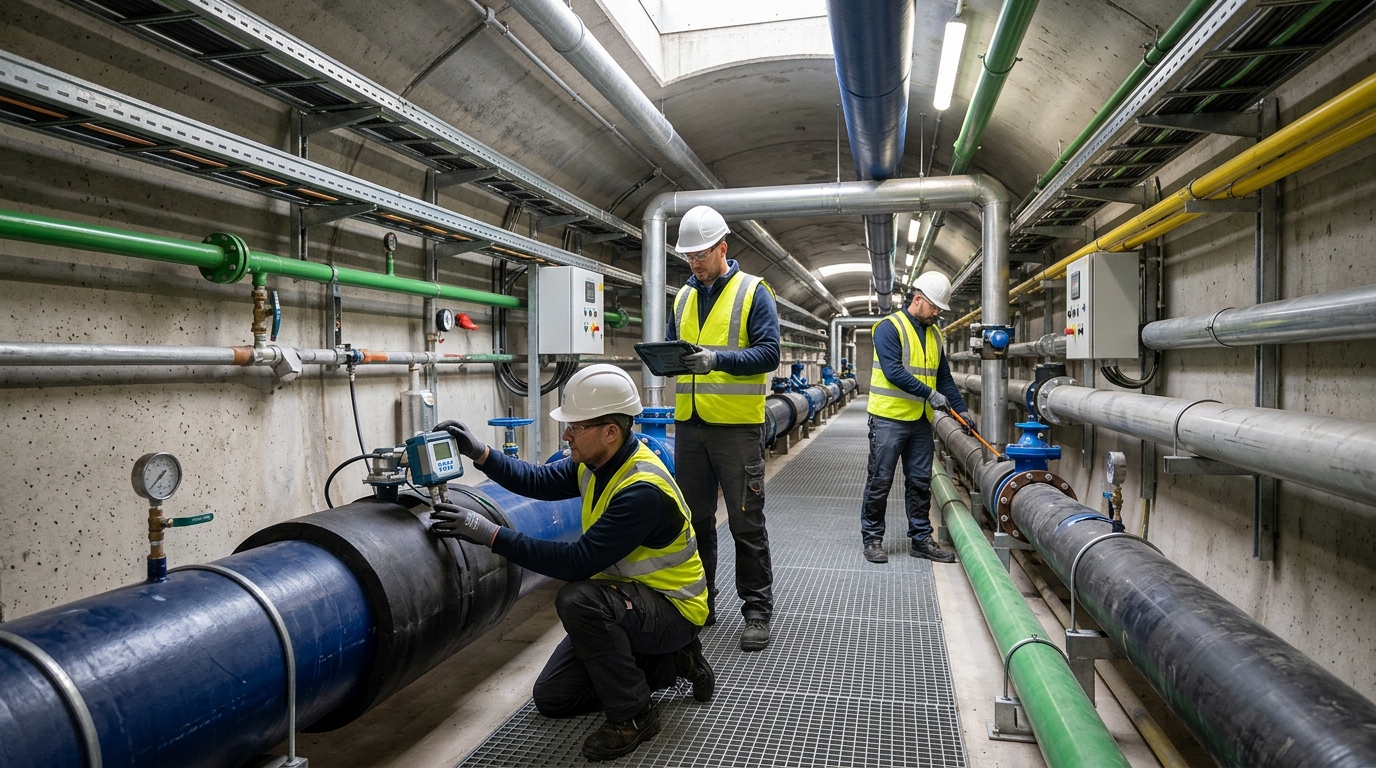
District Metered Areas (DMA) divide complex networks into independently assessed units. By monitoring minimum night flow and pressure changes, utilities can shift from "finding a needle in a haystack" to "precise positioning."
Case Study: A Yangtze River Delta city reduced its leakage rate from 16.8% to 10.9% over 18 months by implementing 128 DMAs, 312 boundary flowmeters, and acoustic monitoring, saving approximately 38 million cubic meters of water annually.
Metering Upgrade: Data Foundation for Leakage Accounting
If zoning solves "where to calculate," metering solves "what to calculate with." The transition from mechanical meters to smart water meters (NB-IoT, LoRa) and high-accuracy electromagnetic/ultrasonic flowmeters is transforming metering from a trade settlement tool into the data foundation for leakage management.
Small Diameter Meters
High turndown ratios (R160/R250) capture small flows; long battery life (6-10 years); frequent reporting cycles (15min-1hr).
Large Diameter Meters
Electromagnetic/Ultrasonic types with ≥0.5 accuracy; bidirectional flow monitoring; empty pipe alarms; critical for district-level accounting.
Future upgrades focus on data governance: handling clock drift, reverse flow, and correlating metering data with GIS maps and work order systems to ensure completeness, continuity, and traceability.
Technology Direction: Perception, Modeling, and Rehabilitation
Perception Layer
Utilizes acoustic correlators (positioning error <1.5m), noise loggers, distributed optical fiber sensing, and satellite remote sensing to detect anomalies across long-distance trunk lines and high-risk sections.
Modeling Layer
Hydraulic models and AI algorithms analyze minimum night flow and pressure fluctuations to identify high-leakage risks. Pressure management is key: every 0.1 MPa reduction in average service pressure can decrease physical leakage by 5-10%.
Rehabilitation Layer
Trenchless technologies (CIPP lining, spiral winding) reduce construction time by >50% and minimize traffic impact. New materials like ductile iron and PE100 pipes aim for 50-year design lives to reduce source leakage.
Outlook: Asset Health and Resilience Management
In the next three to five years, the industry will upgrade from "controlling the leakage rate" to "managing pipeline network asset health." Key trends include:
- Integration of Underground Data: Combining water, drainage, gas, and heating data into comprehensive risk maps under urban information models.
- Digital Automation: AI, IoT, and robotics will automate inspection and diagnosis, reducing reliance on manual labor.
- Resilience & Sustainability: Integrating leakage management with carbon reduction and climate resilience, ensuring service capabilities during extreme weather events.
Ultimately, urban pipeline networks are evolving from underground infrastructure into part of urban digital assets. Those who can truly integrate data, assets, and operational closed loops will take the initiative in the next round of high-quality development.