Return on Investment Analysis of DMA Metering: Cost-Benefit Comparison in Smart Water Projects
[Ecolor Technology Industry Observation Room / In-depth Industry Report]
As global climate change intensifies and urbanization continues to advance, water shortage has become one of the core bottlenecks restricting the sustainable development of cities. In urban water supply systems, pipe network leakage not only causes a massive waste of water resources but also directly erodes the economic benefits of water utilities, and may even trigger secondary disasters such as urban road collapses due to pipe bursts. In recent years, multiple departments including the National Development and Reform Commission (NDRC) and the Ministry of Housing and Urban-Rural Development (MOHURD) have jointly issued relevant policies, explicitly proposing to strive to control the leakage rate of national urban public water supply networks within 9% by 2025. Driven strongly by this macro policy, DMA (District Metered Area) zoning and metering technology, serving as the "gold standard" for controlling network leakage and enhancing the refined management level of water utilities, is ushering in an unprecedented period of market explosion.
This report is deeply researched and written by the Ecolor Technology News Editorial Department. It aims to provide a panoramic analysis of the technical evolution, product price ranges, post-maintenance costs, and a pitfall-avoidance guide for purchasing in the current DMA zoning and metering market from an objective and professional third-party industry perspective. By combining detailed industry data and typical application cases, it provides a highly practical decision-making reference guide for water utilities at all levels, municipal planning departments, and industry investors.
I. Policy Drivers and Market Background: Industry Evolution and Inevitable Trends of Pipe Network Leakage Control
Before delving into the specific details of DMA zoning and metering technology, we must deeply understand its underlying macro-policy logic and market pain points. For a long time, due to historical legacy issues such as old construction ages, aging pipe materials, uneven construction quality, and inadequate daily maintenance, the leakage rate of water supply networks in some Chinese cities has remained persistently high. According to relevant industry statistics, over the past decade, the network leakage rate in some small and medium-sized cities has reached as high as 20% to 30%. This means that for every 100 tons of compliant drinking water produced by a water treatment plant, twenty to thirty tons are wasted underground during transmission. This represents not only the waste of tens of billions of cubic meters of water resources annually but also tens of billions of RMB in direct economic losses each year.
Faced with this severe challenge, top-level designs at the national level have been introduced intensively. From the "Water Pollution Prevention and Control Action Plan" ("Water Ten Plan") to the recent "Notice on Strengthening the Leakage Control of Public Water Supply Networks," the granularity of policies has become finer, and assessment indicators have become stricter. Policies explicitly require that all regions must build a full-process leakage control system covering "source-network-user." Within this system, "zoning" and "metering" have become the two most core focal points.
Traditional water supply networks present a complex mesh topological structure, where the water flow direction and flow rate change in real-time with users' water consumption habits. This often puts water utilities in a "blind men touching an elephant" dilemma when facing massive underground networks. Once a hidden leak occurs, it is extremely difficult to locate. The core philosophy of DMA zoning and metering is to slice the infinitely complex physical pipe network into relatively independent, moderately sized virtual or physical metering areas with clear boundaries by closing valves or installing flowmeters. By comparing the total water volume flowing into the area with the legal billed water volume of all users within that area, combined with precise monitoring of the "Minimum Night Flow (MNF)," water utilities can accurately pinpoint high-leakage "lesion" areas, much like a doctor using a CT scan. This completely transforms traditional "passive repair" into "active leakage control." This shift from extensive management to digital, refined operations is an irreversible and inevitable trend in the current water industry.
II. Core Principle Analysis and Technical Architecture Breakdown of DMA Zoning and Metering
To scientifically evaluate the market value of a DMA system, it is first necessary to thoroughly understand its technical architecture. A standard and efficient DMA zoning and metering system is not simply installing a few water meters on pipes, but a complex system engineering integrating fluid mechanics, sensing technology, Internet of Things (IoT) communication, and big data analysis. From a hierarchical architecture perspective, modern DMA systems are usually divided into three-tier or four-tier networks.
Level-1 zones are typically bounded by the water plant's outlet network or the city's main ring network, covering hundreds of thousands of people, and are mainly used for macro water volume deployment and regional water pressure balancing; Level-2 zones are further refined into administrative districts or large water supply areas; Level-3 zones (i.e., standard DMAs) are the frontlines of leakage control, typically covering 500 to 3,000 households with a pipe network length of 3 to 10 kilometers; In some old residential areas with extremely high leakage control requirements, Level-4 zones (community-level or even building-level DMAs) may be established.
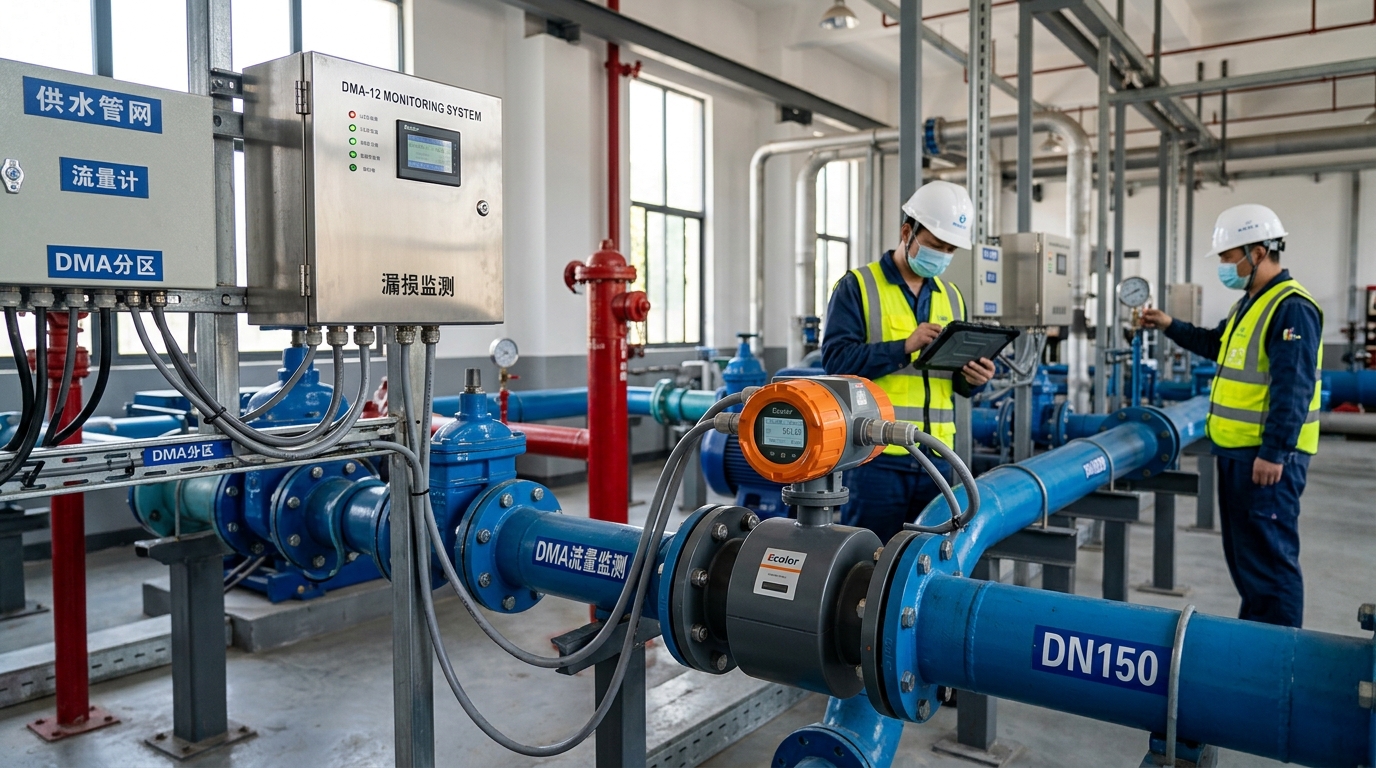
On the physical level, the construction of a DMA requires clear boundaries. The formation of boundaries relies on two methods: first, physical isolation, which involves permanently closing certain connecting valves (boundary valves) to cut off loop connections with other areas, allowing water to flow in only from specific inlets; second, metering isolation, which involves installing high-precision flowmeters and pressure sensors at the inlets or outlets where water flow channels are retained. To ensure water supply safety and firefighting needs, a standard Level-3 DMA usually sets 1 to 2 inlet metering points to minimize the accumulation of metering errors caused by multi-point inflows.
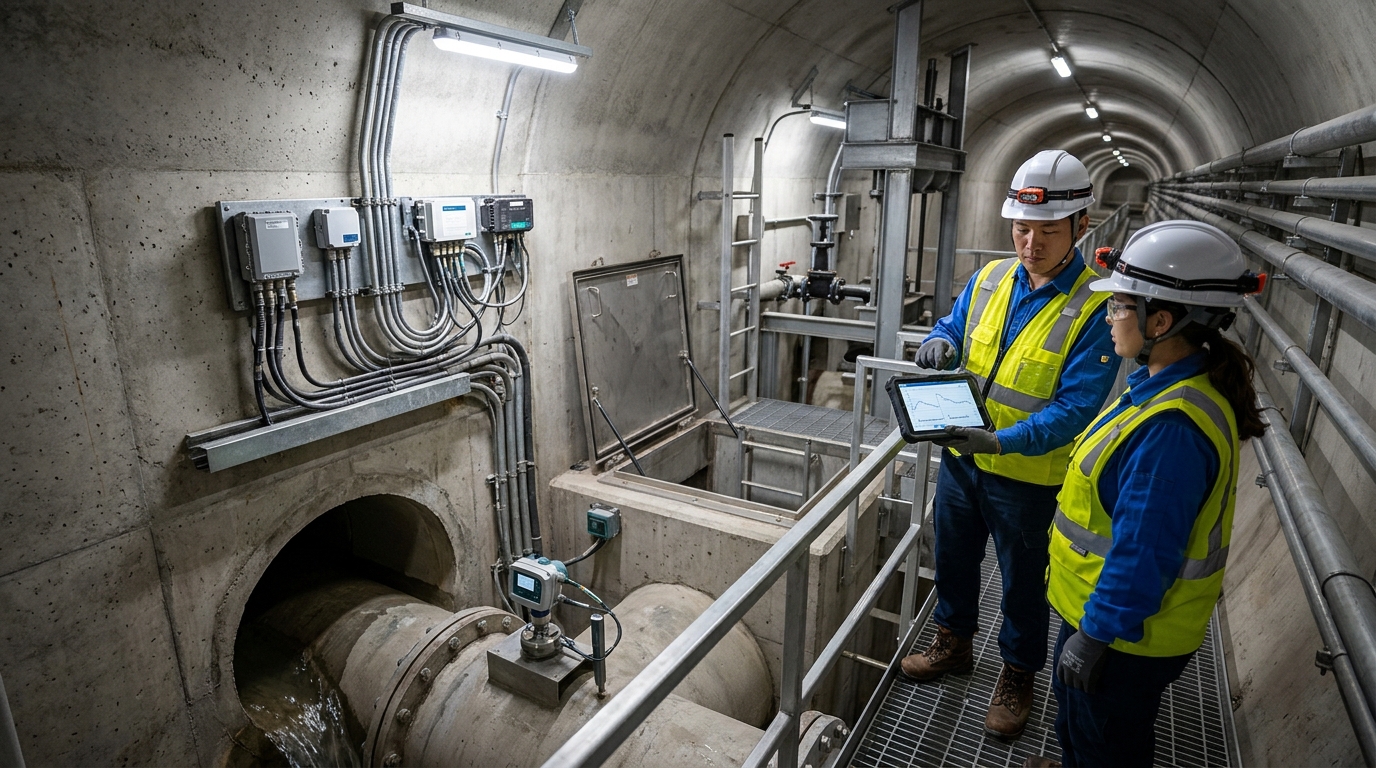
At the data acquisition and transmission layer, modern DMA systems widely adopt IoT technology. Flowmeters and pressure transmitters installed in underground meter wells use RTU (Remote Terminal Unit) or DTU (Data Transfer Unit) to transmit high-frequency data (collected every 15 minutes or every hour) to cloud servers at regular intervals via wireless communication protocols such as NB-IoT, 4G Cat.1, 5G, or LoRa. This poses extremely high requirements for the protection level of the equipment. Because underground meter wells are perennially in high humidity or even flooded conditions, core equipment must possess the highest IP68 level of waterproof and dustproof capabilities.
At the platform analysis layer, after the system receives massive amounts of data, core algorithms begin to operate. The most critical indicator here is the "Minimum Night Flow (MNF)". Typically between 2:00 AM and 4:00 AM, the vast majority of residents are asleep, and legal water consumption drops to its lowest. At this time, the water volume flowing into the DMA area mainly consists of background leakage (minor crack seepage), burst leakage (pipe rupture), and a small amount of legal night water use (such as toilet flushing and night-time commercial venues). If the system detects an abnormal continuous rise in the MNF of a certain DMA for several days, and rules out the possibility of a surge in legal water use, the platform will automatically trigger a leakage warning and generate a work order to be dispatched to frontline leak detection teams. This data-driven, closed-loop management is the soul of the DMA technical architecture.
III. Core Equipment and Systems: In-depth Breakdown of Market Price Ranges and Investment Costs
For water utilities preparing to implement DMA zoning and metering transformations, the preparation of the investment budget is of utmost importance. The construction cost of a DMA system is not a fixed number but is highly dependent on the current status of the pipe network, the precision of selected equipment, communication schemes, and the degree of software platform customization. To provide an objective market reference, we break down the initial investment cost of DMA construction into three major modules: hardware equipment, civil construction, and software platforms, and deeply analyze the price ranges in the current mainstream market.
The foremost is the core hardware equipment—the flowmeter. At the DMA inlet, the precision of the flowmeter directly determines the accuracy of leakage calculation. Currently, mainstream DMA flowmeters in the market are divided into two major camps: electromagnetic flowmeters and ultrasonic flowmeters. Electromagnetic flowmeters are technologically mature, with high measurement accuracy (usually 0.2 to 0.5 class), and have relatively low requirements for straight pipe sections (generally 5D upstream and 3D downstream). However, they require external power supply or large-capacity battery support, and are relatively sensitive to bubbles in the water. Taking the common DN300 (300 mm diameter) size as an example, the market price of battery-powered electromagnetic flowmeters from top-tier domestic brands usually ranges from 12,000 to 25,000 RMB; while imported top-tier brands may be as high as 35,000 to 50,000 RMB. Ultrasonic flowmeters have developed rapidly in recent years. Their advantages lie in an extremely wide turndown ratio (often reaching R400 or even above R500), the ability to acutely capture minute flow changes at night, no mechanical moving parts, almost zero pressure loss, and a longer battery life. Similarly, for the DN300 size, the price range of domestic high-precision multi-path ultrasonic flowmeters is about 18,000 to 35,000 RMB, while imported brands are above 40,000 RMB. In addition, pressure transmitters (including high-frequency acquisition modules) used in conjunction with flowmeters usually cost between 2,000 and 5,000 RMB per unit. If pressure management needs to be implemented at the inlet, a Smart Pressure Reducing Valve (PRV) must be added. A DN200 PRV set with a smart controller often costs between 40,000 and 80,000 RMB.
Next is the civil engineering and installation construction cost. This is a step that is often overlooked but consumes a large amount of the budget. Excavating roads in urban main streets or old residential areas, building standardized underground meter wells, and performing pipe cutting and flange welding not only require significant labor but also involve hidden costs such as municipal road excavation approval, traffic diversion, and road surface restoration. Depending on the price levels and construction difficulties in different cities, the construction cost of a single standard medium-sized DMA meter well (including earthwork excavation, masonry, waterproofing, manhole covers, and equipment hoisting) usually ranges from 15,000 to 40,000 RMB. If encountering areas with complex underground pipelines that require trenchless pipe jacking operations, the cost will multiply.
Finally, there are the software platform and system integration fees. A fully functional DMA leakage management platform needs to possess comprehensive functions such as GIS network visualization, SCADA data acquisition, minimum night flow analysis, Non-Revenue Water (NRW) calculation, pressure transient monitoring, and work order routing. For standard SaaS-based DMA management platforms on the market, charged by the number of connected nodes or annual subscriptions, the initial installation fee is typically between 15,000 and 50,000 RMB, with an annual service fee of tens of thousands of RMB. For medium and large water utilities, private deployment is usually required, along with deep integration with the enterprise's existing billing system, customer service system, and asset management system. This highly customized software platform development and system integration cost often exceeds 500,000 to 2,000,000 RMB, depending on the complexity of data interfaces and the depth of customized functions.
Overall, the comprehensive initial construction cost (including hardware, software, and construction) of establishing a standard Level-3 DMA zone containing 1 inlet metering point and 3 pressure monitoring points is usually between 80,000 and 150,000 RMB. If a medium-sized city wants to fully implement more than a hundred DMA zones, its overall investment scale will often reach tens of millions. Therefore, scientific cost control and reasonable equipment selection are crucial.
IV. In-depth Analysis: Post-Maintenance and Operational Costs of DMA Systems (TCO Analysis)
Within the industry, there is a saying: "Building a DMA is only the first step of a long march; the real test lies in the subsequent operation and maintenance." Many water utilities invest heavily in the early stages to build beautiful DMA systems, but because they ignore the Total Cost of Ownership (TCO), the systems suffer from data distortion and equipment paralysis after two or three years of operation, ultimately becoming mere decorations. Therefore, objectively evaluating and reserving post-maintenance costs is the key to ensuring that the DMA system continues to exert its leakage control effectiveness.
The first major maintenance cost comes from the natural aging and calibration of hardware equipment. Whether electromagnetic or ultrasonic flowmeters, in the complex underground pipe network environment, long-term exposure to water flow scouring, sediment abrasion, and water quality scaling will cause their measurement accuracy to drift over time. According to relevant national metrology regulations, large-diameter water meters need periodic online comparison or removal for calibration. An online ultrasonic comparison calibration for a DN300 flowmeter costs about 2,000 to 4,000 RMB per service; if removal for inspection is required, plus water shutdown construction and hoisting fees, the cost per instance may exceed 10,000 RMB. In addition, mainstream DMA metering equipment currently mostly uses built-in lithium batteries for power. Although manufacturers claim a lifespan of 5 to 8 years, under high-frequency data transmission (e.g., once every 15 minutes) and harsh temperature difference environments, the actual battery life is often 3 to 5 years. Replacing a large-capacity industrial-grade lithium battery module, along with manual down-well operation fees, costs about 1,500 to 3,000 RMB per point.
The second major cost is communication tariffs and cloud server maintenance fees. Hundreds or thousands of IoT terminals continuously send data every day, and each terminal needs to be equipped with an IoT SIM card. Although the NB-IoT or 4G tariffs of the three major operators have dropped significantly, calculated annually, the annual communication fee for a single data acquisition terminal still requires 20 to 50 RMB. For a water utility with thousands of monitoring points, this is a considerable recurring expense. At the same time, privately deployed server clusters require regular cybersecurity inspections, database expansions, and system upgrades. Software developers usually charge an annual software maintenance fee of 10% to 15% of the total contract amount after the warranty period expires. If this part of the budget is not planned in advance, once the system encounters bugs or suffers network attacks, it will face the dilemma of having no one to repair it.
The third major hidden cost, which is also the most core operational cost, is the human resources cost. The DMA system itself does not automatically repair leak points; it is simply a powerful "alarm" and "navigator." When the DMA platform issues a leakage alert through abnormal night flow, it must rely on professional manual leak detection teams carrying professional equipment such as listening sticks, correlators, and ground-penetrating radars (GPR) to conduct precise on-site positioning in the dead of night. It often takes years to train an experienced "leak listener," making the labor cost extremely high. Furthermore, the daily inspection of DMA boundary valves is also a heavy task. If boundary valves are not closed tightly or are opened by mistake, it will lead to water flow cross-connections with adjacent DMA areas, and the entire metering model will collapse instantly. Therefore, water utilities must set up specialized DMA operation and maintenance teams responsible for regular valve inspections, zero-point calibrations, and on-site leak detection. This specialized human resource cost often accounts for over 40% of the overall DMA operational cost.
In summary, when water utilities initiate a DMA project, they must not only focus on the initial construction bidding price. They must allocate 10% to 15% of the initial investment amount as the annual operation and maintenance budget baseline to establish a long-term funding guarantee mechanism, so as to ensure the long-term freshness and accuracy of DMA system data.
V. Scientific Pitfall Avoidance: DMA Purchasing Advice and Implementation Strategies for Water Utilities
Faced with a dazzling array of DMA solutions and uneven equipment suppliers on the market, how can water utilities make the best choice within a limited budget? Combining a large number of successful and failed industry cases, we have summarized the following highly practical purchasing advice and implementation strategies to help enterprises scientifically avoid pitfalls.
1. Reject the "lowest-price-wins" mentality, and focus on the equipment's "turndown ratio" and "starting flow rate" parameters.
In public bidding, winning with a low price is often the primary culprit leading to the failure of DMA projects. The core of DMA metering lies in capturing extremely small leakage flows at night, which requires the flowmeter to have an extremely wide turndown ratio and an extremely low starting flow rate. If an ordinary water meter with a turndown ratio of only R80 or R160 is selected, it may not rotate at all or have massive errors during low flows at night, causing the leakage rate calculated by the system to be negative or severely distorted. Therefore, in procurement technical specifications, it should be explicitly required that the flowmeter's turndown ratio be no less than R250. Enterprises with favorable conditions are advised to directly request R400, and factory verification certificates from authoritative metrological institutions should be required. It is better to reduce the number of DMAs built in the first phase than to compromise on ensuring that the equipment precision of every metering point can withstand scrutiny.
2. Be wary of "data silos" and mandatorily require open APIs and underlying protocols.
Many hardware vendors often bundle their own closed-loop software platforms when pitching equipment. Water utilities must be highly vigilant against this "technological kidnapping" when purchasing. Future smart water management inevitably requires the interconnection of all-domain data. If the data from the DMA platform cannot seamlessly integrate with the enterprise's existing GIS system and customer billing system, it will be impossible to accurately calculate the "legal billed water volume" for each area, and calculating the Non-Revenue Water (NRW) will be out of the question. Therefore, in procurement contracts, it must be mandatory for suppliers to provide free access to all underlying communication protocols of the hardware (such as MQTT, CoAP, Modbus, etc.) and API interfaces of the software platform, ensuring that water utilities have absolute ownership of the data and the freedom for secondary development.
3. Adapt to local conditions and avoid blindly pursuing "gridification" and "the smaller the better".
Some water utilities have a misconception when implementing DMAs, believing that the smaller and more fragmented the zoning, the better the leakage control effect. However, excessive physical cutting will destroy the original loop hydraulic model of the pipe network, causing severe consequences such as insufficient end-point water pressure and water quality deterioration (increased dead water zones). Moreover, too many metering points will exponentially increase equipment investment and maintenance difficulties. The scientific approach is to adopt a "top-down, gradually refined" strategy. First, establish macroscopic Level-1 and Level-2 zones to figure out the overall water volume of the city; then, carry out refined Level-3 DMA cutting specifically for those key areas with obviously high leakage rates and old pipe networks. The scale of a single Level-3 DMA should ideally be controlled at a pipe network length of 3-5 kilometers and around 1,000-2,000 households. This ensures leak detection efficiency without excessively increasing management costs.
4. Value "pressure management" and organically integrate leakage control with pressure reduction.
The laws of physics indicate that the leakage volume of a pipe network is positively correlated with the water pressure inside the pipe. Often, simply reducing the excess pressure in the pipe network during non-peak night hours can yield immediate results in reducing background leakage and significantly lowering the burst frequency. Therefore, when selecting a DMA solution, one should not just focus on "metering" but also pay attention to "pressure control." It is recommended to procure comprehensive control units integrating flowmeters and smart pressure reducing valves at DMA inlets with large elevation drops or excessively high night-time water pressure. By issuing commands through the platform to achieve dynamic pressure regulation based on time or flow, this constitutes one of the leakage control methods with the highest Return on Investment (ROI) at present.
VI. Typical Case Analysis: Leakage Rate Control Practices of Water Utilities of Different Scales
Theoretical discussions ultimately need to be grounded in practice. To more intuitively demonstrate the actual effectiveness of DMA zoning and metering, we selected two representative anonymous water utility practical cases from different regions in China for in-depth analysis. These cases not only showcase successful experiences but also reveal real challenges encountered during implementation.
Case 1: A Water Group in a Tier-1 Coastal City in East China — Refined Breakthrough Under High Investment
As one of the most economically developed regions in China, this city has a daily water supply exceeding 3 million tons and a total pipe network length approaching 10,000 kilometers. Due to the extremely fast pace of early urban construction, the underground pipe network is highly complex, and historical legacy leakage issues were very prominent. In 2019, the group launched a three-year city-wide smart water and DMA zoning and metering campaign. In terms of implementation strategy, the group invested nearly 100 million RMB and adopted the strictest standards. More than 1,200 Level-3 DMAs were delineated across the city, all inlets used imported high-precision multi-path ultrasonic flowmeters, and an enterprise-level private cloud big data management platform was built.
In the initial stage of implementation, they faced huge challenges: due to inaccurate historical GIS drawings, nearly 15% of the DMAs had issues of "unclear boundaries and connected hidden pipes." After night flow data was transmitted back, a large number of logical errors appeared. Faced with this problem, the group did not rush for quick results. Instead, they spent a full six months organizing a team of over a hundred people to conduct night-time "valve-closing and water-shutoff tests (Step-Testing)" to verify the topological relationships of the pipe network one by one and recalibrate the GIS model. After the data was cleansed and made accurate, the power of the platform began to show. The system automatically generated a "Top 10 Abnormal Night Flow Ranking" every week, and leak detection teams conducted targeted patrols directly based on the list. After three years of continuous operation, the city's pipe network leakage rate dropped sharply from the initial 14.5% to a historical low of 7.8%. In 2022 alone, it recovered over 25 million cubic meters of leaked water, saving nearly 60 million RMB in water production and power costs, achieving a double harvest of economic and social benefits.
Case 2: A Water Supply Company in an Inland Mountainous Prefecture-level City in Southwest China — A Clever Breakthrough Using Pressure to Control Leakage
Unlike Tier-1 cities in East China, this mountainous city in Southwest China has a daily water supply of only 300,000 tons, and the water company was relatively tight on funds. Even more challenging was the city's huge terrain fluctuations, with a maximum elevation difference exceeding 200 meters. This caused the pipe network in low-lying areas to bear ultra-high water pressure exceeding 0.8 MPa for a long time, leading to frequent pipe burst accidents, and the leakage rate once approached 25%. Limited by funds, the company did not adopt a comprehensive grid-based DMA construction but chose a "precision strike" strategy. Relying on hydraulic model analysis from research institutes like Tsinghua University, they selected 30 high-pressure and high-leakage key areas across the city and established "Advanced DMAs" equipped with pressure regulation functions.
At the inlets of these areas, not only were domestic highly cost-effective electromagnetic flowmeters installed, but more importantly, battery-powered smart PRV sets were installed. During daytime peak water usage, the valves are fully open to ensure water supply; from 1 AM to 5 AM, the platform automatically issues commands to smoothly reduce the post-valve pressure to 0.25 MPa (just enough to meet the water demand of the top floors of multi-story residential buildings). This highly targeted measure achieved amazing results: in the first quarter after the project's implementation, the night-time leakage volume in these 30 areas plummeted by 45%, and the frequency of pipe burst repairs dropped by 60% year-on-year. The company recovered all its costs within a year with an initial investment of less than 8 million RMB, providing a textbook-level classic example for small and medium-sized water utilities implementing DMA on a low budget.
VII. Industry Outlook: Next-Generation DMA Technology Empowered by Digitalization and AI
Looking forward from the current point in time, DMA zoning and metering technology is undergoing a profound transformation from "automation" to "intelligence". With the further popularization of IoT technology and the decline in computing power costs, next-generation DMA technology will present several significant development trends.
First, Artificial Intelligence (AI) and machine learning will play a core role in leakage analysis. Current DMA systems mainly rely on manually set thresholds (e.g., triggering an alarm if the night flow exceeds a fixed value), which are easily affected by seasonal changes and holiday water usage fluctuations, resulting in a large number of false alarms. Future AI algorithms will be able to automatically establish a unique "water usage fingerprint model" for each DMA through long-term deep learning. It will not only accurately identify extremely minute gradual leakages (background leakage) but also predict burst risk points in the pipe network in advance through high-frequency waveform analysis of pressure transients (water hammer phenomenon), achieving a leap from "post-leakage alarm" to "pre-leakage warning."
Second, "Digital Twin" technology will be deeply integrated with physical DMAs. Future water control centers will have a 3D digital model perfectly mapped to the underground pipe network. Water managers will be able to simulate in real-time the changes in water pressure and flow throughout the entire region after closing a boundary valve or adjusting a pressure reducing valve parameter within the digital twin system. This ability to conduct trial and error in the virtual world will greatly reduce the risks of real-world network scheduling and enhance the scientific nature of decision-making.
Finally, the large-scale popularization of Advanced Metering Infrastructure (AMI) / smart water meters will drive DMA to evolve into more microscopic levels. When all the mechanical water meters in thousands of households are replaced by smart water meters capable of transmitting data daily or even hourly, water utilities will be able to achieve daily "dynamic water balance calculations." By then, DMA boundaries will no longer be limited to physical valves but can be "virtual metering areas" flexibly delineated by algorithms. This will completely break the limitations of traditional physical zoning and refine the granularity of network leakage control to every building or even every apartment unit.
In conclusion, pipe network leakage control is a marathon without a finish line. As the sharpest weapon in this battle, the core value of DMA zoning and metering technology lies not only in the accumulation of hardware equipment but also in the reshaping of water utilities' management concepts and the enhancement of digital operational capabilities. Under the strong guidance of national policies and the empowerment of next-generation information technology, we have every reason to believe that the leakage control level of China's water industry will undoubtedly enter a brand-new era of intelligence, building a solid foundation for the efficient utilization and sustainable development of urban water resources.