DMA Zone Metering Selection and Maintenance: What Is the Cost of Pipe Network Leakage?
As urban water supply networks expand and aging pipeline sections increase, leakage management is shifting from “passive emergency repair” to “proactive control.” District Metered Area (DMA) metering uses boundary metering, pressure monitoring, flow analysis, and minimum night flow assessment to divide systems into monitorable zones. This article analyzes market trends, cost structures, and maintenance strategies for DMA implementation.
1. Market Background: Drivers of Demand
Pipeline leakage remains a critical operational challenge. Industry surveys indicate that while newly developed areas can maintain leakage rates below 10%, some old urban areas reach 15% to 25%. With tightening water resource constraints, leakage-rate indicators have shifted from reference data to strict management targets. Many projects now aim to reduce regional leakage by 3 to 5 percentage points or achieve targets below 8–10%.
Traditional methods rely on experience-based inspections and manual investigation, making it difficult to answer questions such as “where water is leaking,” “which zones have high leakage,” and “whether pressure is too high.”
The value of DMA lies in breaking large networks into small units. A typical DMA covers 1,000 to 5,000 households, 10 to 30 km of pipeline, and 20,000 to 100,000 m³ of daily supply. By installing flow meters at boundaries and deploying internal monitoring points, utilities can identify abnormal fluctuations and link them to leak detection and repair, forming a closed loop.
- Cost Reduction: Lowering expenses for water production, transmission, and pump-station energy.
- Regulatory Compliance: Meeting government requirements for water-saving assessments and smart water management.
- Internal Efficiency: Serving industrial parks and complexes needing precise internal metering and anomaly identification.
2. Product Composition & Price Ranges
DMA projects encompass hardware, communication, software, and services. Prices vary significantly based on configuration and scale. Below is a breakdown of typical costs (in CNY):
Boundary Meters
- DN50–DN200: ¥8,000 – ¥35,000 per device (Electromagnetic/Ultrasonic)
- Small-bore/Low-flow: ¥3,000 – ¥12,000
- ≥ DN300: ¥20,000 – ¥60,000 (Depends on brand/pressure rating)
Sensors & Communication
- Pressure Transmitters: ¥300 – ¥2,000 (Standard) / ¥1,500 – ¥4,500 (Smart IoT)
- Flow Monitoring Points: ¥5,000 – ¥30,000
- Comm Modules/Gateways: ¥200 – ¥1,200 (Modules) / ¥3,000 – ¥15,000 (Gateways)
Software platforms show the widest price variance. Lightweight SaaS annual fees range from ¥30,000 to ¥120,000, while mid-sized private deployments cost ¥300,000 to ¥1,500,000. Including advanced analytics like minimum night flow models and GIS integration can push software costs to ¥80,000–¥600,000. Integration with billing or SCADA systems adds another ¥100,000–¥600,000.
Total Project Investment Estimates:
- Small Park/Single-Zone Pilot: ¥300,000 – ¥800,000
- Mid-Sized Urban DMA Construction: ¥1,500,000 – ¥4,000,000
- City-Level Platform/Multi-DMA: ¥5,000,000 – ¥20,000,000
3. Typical Case Analysis: ROI and Impact
Case Study 1: Mid-Sized City Water Supply Zone
Context: Daily supply of 120,000 m³, 950 km pipeline network, historical leakage rate of 16.5%.
Implementation: Phase 1 built 50 DMAs covering 180,000 residents. Installed 60 boundary meters (DN100–DN200), 120 pressure points, and 45 flow points using NB-IoT communication.
Investment: ~¥3.2 million total (45% Hardware, 20% Sensors/Comm, 25% Software, 10% Services).
Results after 12 months: Leakage rate dropped to 12.1% (a 4.4 percentage point reduction). Average minimum night flow decreased by 18%. Annual water savings valued at ~¥5.79 million resulted in a static payback period of 3 to 5 years.
Key Takeaway
Even in low-leakage scenarios, DMA creates value through abnormal usage detection and refined management, not just raw volume reduction.
Case Study 2: Industrial Park
A park with 50,000 m³ daily supply and an initial 9.2% leakage rate invested ~¥800,000 in 10 DMAs using ultrasonic/electromagnetic meters and hybrid SaaS/local architecture. Within six months, leakage fell to 8.1%, and two continuous low-flow anomalies were identified. This demonstrates that benefits often stem from pressure optimization and accurate metering rather than solely reducing high leakage volumes.
4. Procurement Recommendations
The most common failure mode in DMA construction is "emphasizing equipment while neglecting data." Before procurement, a comprehensive pipeline diagnosis is essential.
- Pre-Procurement Diagnosis: Assess pipeline topology, valve controllability, user composition, and historical burst records. If boundary valves cannot be reliably closed, DMA results will be invalid.
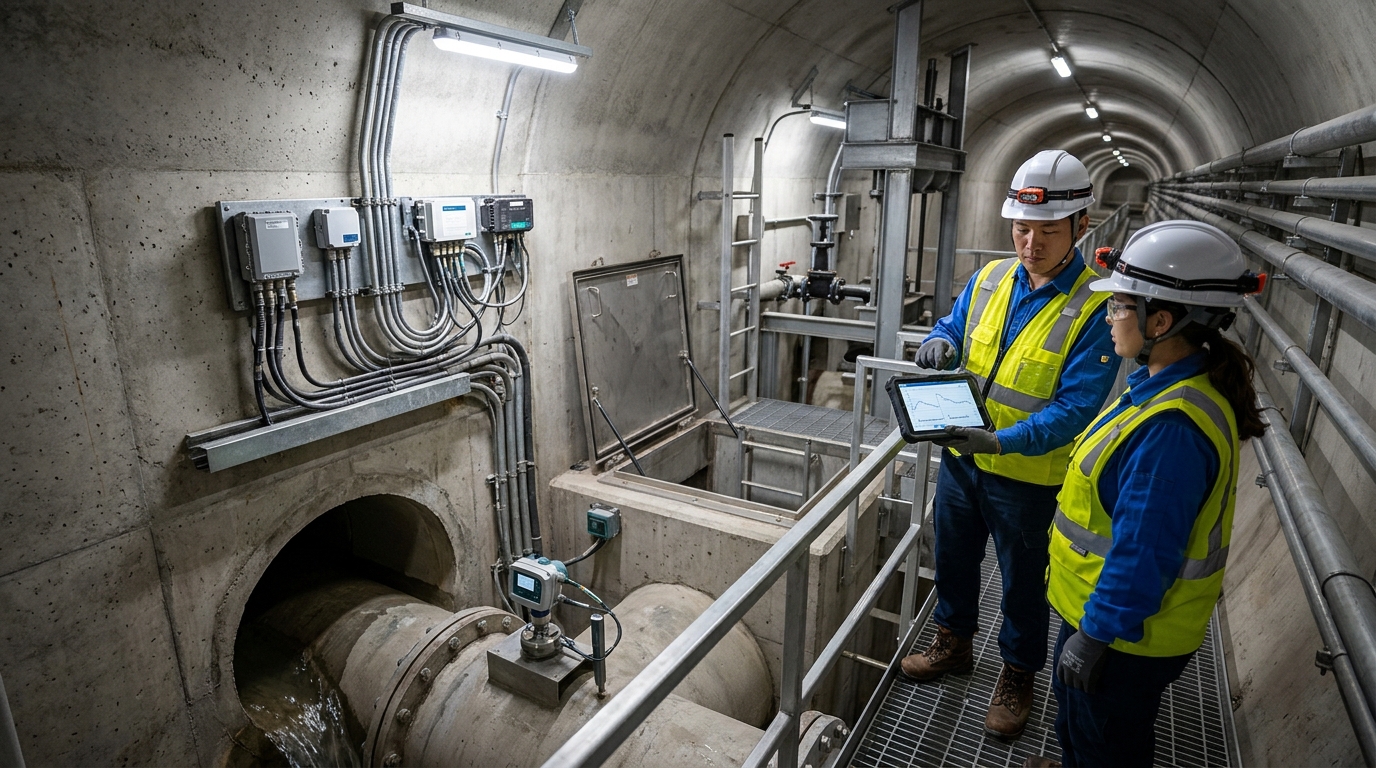
- Meter Selection Criteria: Focus on rangeability (recommended ≥ 1:50 due to night/day flow variances), accuracy (±1% to ±2%), and installation environment (IP68 protection). Do not select solely by quotation; consider clogging resistance and straightening structures for impure flows.
- Communication Strategy: Underground vaults pose signal challenges. Evaluate NB-IoT, LoRa, 4G, or wired options based on on-site signal strength and power availability. Stability affects outcomes more than unit price.
- Pilot Approach: Follow a path of "1 to 3 pilot DMAs + effectiveness evaluation + batch expansion" to avoid excessive one-time investment risks.
5. Maintenance Cost Analysis
DMA is a long-term operational program, not a one-time construction project. Hidden costs arise from network changes and data quality degradation.
Hardware & Calibration
Annual calibration/maintenance per meter: ¥300–¥1,500. Pressure sensor calibration: ¥200–¥800/point. Battery replacement every 5–10 years.
Software & Data
SaaS fees: 10–20% of construction investment annually. Private platforms require server/database/security O&M staff (~¥30k–¥80k/year/staff).
Network Changes
New users, road construction, or valve replacements alter DMA topology. Failure to update GIS/billing data causes water balance deviations and false leakage reports.
For a 50-DMA project, reserve 8% to 15% of total investment as annual maintenance budget. Mid-sized city-level projects may incur ¥500,000–¥2,000,000/year in O&M costs.
6. Implementation Path & Future Outlook
A mature DMA implementation follows six stages: Current-status diagnosis → Zone design → Boundary engineering → Device installation → Platform deployment → Operational closed loop. Risks such as insufficient low-flow accuracy or delayed data updates must be managed via quantitative acceptance indicators (e.g., >95% online rate, >90% data completeness).
Future Trends
- Value Shift: Hardware costs will decline, but the value of high-quality data services, algorithm models, and work-order closed loops will rise.
- Integration: DMA will merge with hydraulic models, digital twins, and GIS for more accurate leak localization.
- Process Indicators: Management assessment will shift from simple "leakage-rate results" to process metrics like metering online rate, anomaly-handling timeliness, and repair verification rates.
For water supply enterprises, DMA is infrastructure for pipeline leakage management. Under limited budgets, prioritize pilot zones with clear boundaries, good data foundations, or significant pressure fluctuations. Validate through actual water-saving benefits before scaling.