An In-depth Comparison of Four District Metered Area (DMA) Metering Technology Approaches
Leakage management in water supply networks is shifting from a passive model of “discover a burst pipe and then rush to repair” to a refined model centered on districting, metering, pressure, and acoustic diagnostics. This guide explores six technical routes to help utilities select the right combination for their specific network structure and budget.
Introduction: The Shift to Refined Districting
The core of DMA district metering is to define measurable boundaries within a water supply network. By utilizing boundary flow, pressure, customer consumption data, and changes in minimum night flow, utilities can identify leakage, pipe bursts, water theft, metering errors, and abnormal network operations. Unlike network-wide averages, post-districting metrics such as leakage rate per unit pipe length and pressure fluctuation are more diagnosable and easier to resolve through targeted work orders.
"The key to selection is not chasing new technologies but combining them according to network structure, leakage type, data foundation, and budget."
Current technical routes extend beyond simple flow measurement. They include wired fixed metering, wireless low-power wide-area networks (LPWAN), acoustic monitoring, pressure management, hydraulic models, AI diagnostics, mobile patrols, and temporary DMAs. Each route varies significantly in cost, accuracy, deployment difficulty, and maintenance requirements.
Technical Route 1: Wired Fixed Metering & SCADA
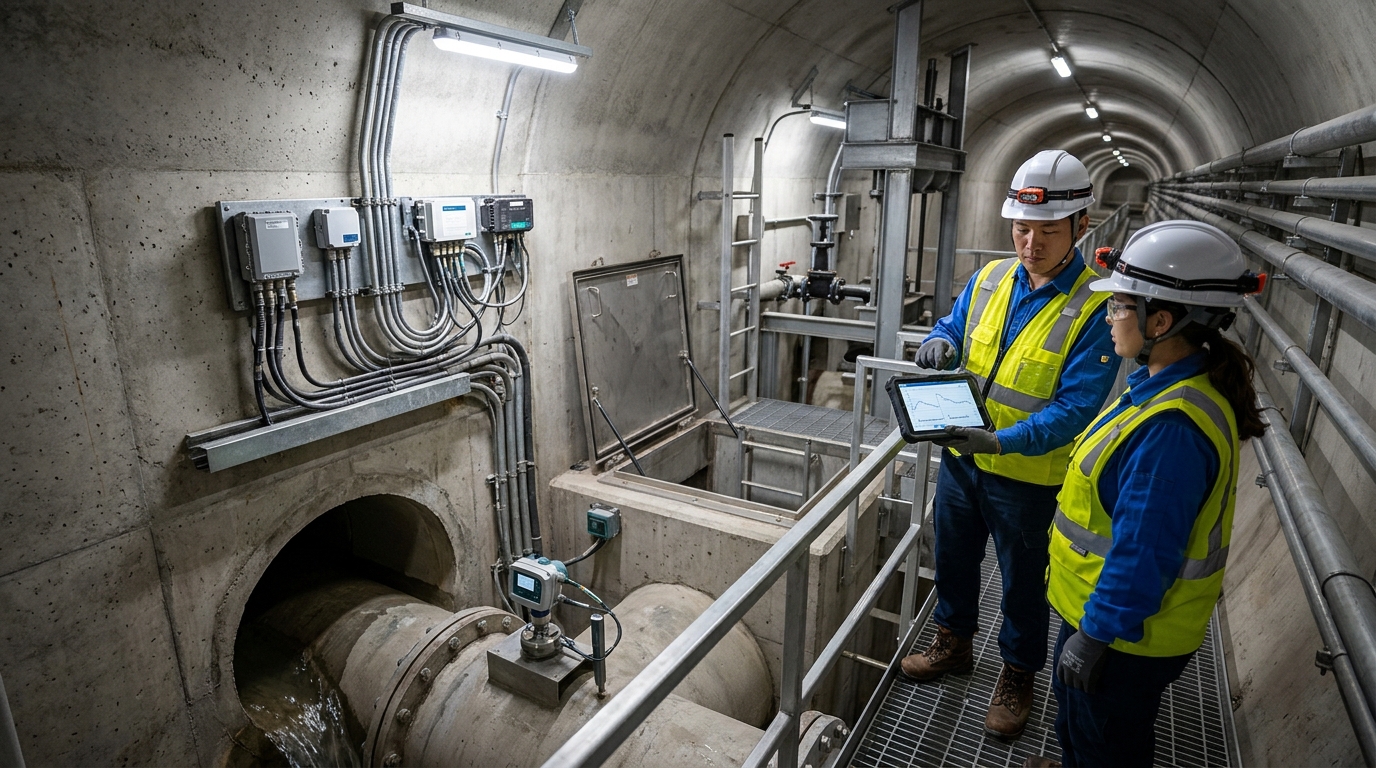
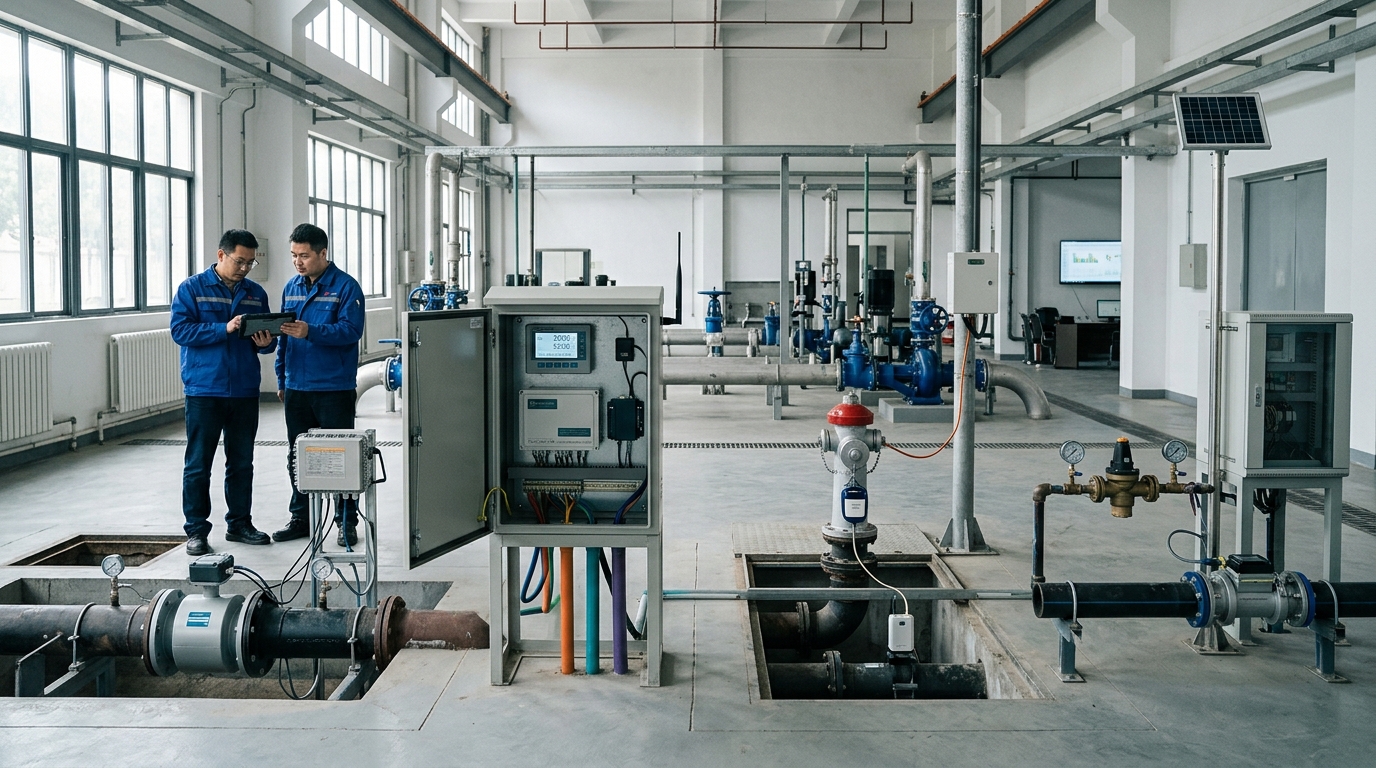
Wired fixed metering involves installing electromagnetic flow meters, ultrasonic water meters, and pressure sensors at large-diameter boundary points, trunk-line nodes, and booster stations. These connect to SCADA systems via RS485, fiber optics, or industrial Ethernet.
- Accuracy: ±1% to ±2% full scale for flow; Class 0.5 for pressure.
- Sampling: Intervals from 1 to 15 minutes.
- Suitability: Ideal for critical nodes with DN300–DN600 pipes where power and communication infrastructure are stable.
While construction costs are higher than wireless solutions, the stability and real-time capability make it an excellent long-term data foundation. A prefecture-level city case study showed that after retrofitting 50 wired boundary nodes, the leakage rate dropped from ~18% to ~10% over one year.
Case Study Insight
In areas with good power/communication conditions and manageable node counts, wired metering provides the most reliable baseline. However, applying this to dispersed small-diameter nodes is often too costly and slow.
Technical Route 2: Wireless LPWAN (NB-IoT, LoRa)
Wireless routes utilize NB-IoT, LoRaWAN, 4G Cat.1, and Bluetooth Mesh to deploy smart water meters and wireless pressure recorders. This approach offers lower construction effort and faster deployment, making it suitable for dispersed nodes, new residential communities, and township networks.
- Battery Life: Typically 5 to 10 years.
- Reporting: Daily, hourly, or 15-minute intervals.
- Range: LoRaWAN achieves 3–15 km in open environments, though underground shielding requires testing.
Data integrity depends on signal strength and battery voltage. If communication success rates fall below 95%, antenna placement or gateway density must be reassessed. It is not "maintenance-free"; periodic verification of battery life and meter drift is still required.
Efficiency Gain
A county utility deployed 3,000 wireless nodes across 120 DMAs. Result: Meter-reading labor reduced by 70–80%, and leakage rate fell from ~14% to ~9%. This proves wireless is optimal for rapid establishment of district metering in dispersed scenarios.
Technical Route 3: Acoustic Monitoring & Correlation
Acoustic monitoring detects "invisible" background leakage by capturing noise generated by escaping water. Devices include acoustic recorders, noise correlators, and hydrophones. This route is crucial when Minimum Night Flow (MNF) is elevated but there are no surface signs of bursting.
Frequency Band
Typically 500 Hz – 2,000 Hz, with automatic nighttime operation.
Positioning Accuracy
±0.5 m to ±2 m under ideal conditions (affected by pipe material/burial depth).
Best Use Case
Locating concealed leaks in cast iron pipes; less effective in plastic/concrete.
"Acoustic routes are suitable as a 'location tool' after flow and pressure monitoring, not as a stand-alone replacement for district metering."
In an old urban DMA, MNF remained high (~65 m³/h). After deploying 10 fixed acoustic recorders, three concealed leak points were found. Repair resulted in a 22% drop in MNF and reduced the overall leakage rate from 13% to below 10%.
Technical Route 4: Pressure Management
Pressure management reduces average network pressure using pressure-reducing valves (PRVs) and smart control systems. Industry experience suggests that within certain ranges, a 10% reduction in average pressure may lower leakage rates by 5% to 10% and significantly reduce burst risk.
- Control Range: Service pressure typically maintained between 0.2 MPa and 0.6 MPa.
- Accuracy: Control precision of ±0.02 MPa to ±0.05 MPa.
- Strategy: Nighttime pressure reduction while ensuring fire-fighting demand and end-user safety.
Smart PRVs must be linked with hydraulic models to avoid insufficient end-point pressure. A hilly city lowered local average pressure from 0.55 MPa to 0.38 MPa in a high-pressure zone. Over one year, bursts decreased by 35%, and leakage rate fell from 15% to 11%.
Technical Route 5: Hydraulic Models, AI & Digital Twins
This advanced route integrates data from districting, metering, pressure, weather, and work orders to create an operational profile. The goal is anomaly identification, leakage typing, burst prediction, and work-order optimization.
Mature AI systems can raise anomaly work-order accuracy to over 70%. However, reliable data quality is a prerequisite. If boundary valves leak internally or meters are uncalibrated, model judgments will be biased.
Recommendation: Suitable for utilities with many DMAs and rich historical data, aiming to improve diagnostic efficiency rather than starting from zero.
Digital Twin Impact
A city built a platform on 120 DMAs integrating all sensor types. After 6 months, average anomaly localization time shortened from ~5 days to ~1 day, and work-order closure rates increased by 30%.
Technical Route 6: Mobile Patrols & Temporary DMAs
For budget-constrained stages or unclear boundaries, mobile patrols use portable flow meters, handheld detectors, and temporary valves. Advantages include low cost, fast deployment, and high flexibility. Disadvantages include dependence on manual experience and limited data continuity.
- Accuracy: Portable devices typically ±2% to ±5%.
- Coverage: Best for small zones (300–2,000 households).
- Function: Verifies boundary reasonableness and flow balance before permanent installation.
A water supply office used temporary meters to diagnose a new district, finding multiple post-meter leaks. The leakage rate dropped from ~20% to 12%. This serves as a low-cost verification tool before formal investment.
Selection Recommendations: A Three-Stage Approach
Stage 1: Boundaries
Focus on "districting and metering boundaries." Ensure each DMA has clear inlet, outlet, pressure, and flow points. Start with wired for critical nodes and wireless for dispersion.
Stage 2: Diagnosis
Combine MNF, pressure, and acoustic data to identify leakage. Use pressure management in high-elevation zones and acoustic correlation for concealed leaks.
Stage 3: Optimization
Introduce hydraulic models and AI for integrated management of leakage rate, burst risk, and customer complaints. Requires solid data foundation from Stages 1 & 2.
Key Performance Indicators (KPIs)
To quantify success, track: Leakage Rate, Minimum Night Flow, Leakage Volume per Unit Pipe Length, Pressure Deviation, Number of Bursts, Work-Order Closure Time, Water-Meter Calibration Cycle, Communication Success Rate, and Boundary Valve Status Accuracy.
In mature projects, the payback period for DMA retrofits usually ranges from 2 to 5 years, depending on leakage scale, water tariffs, emergency repair costs, and energy-saving benefits.