In-Depth Comparison of Four DMA Metering Technology Approaches
A comprehensive guide to District Metered Area (DMA) strategies, covering boundary metering hardware, communication protocols, leakage diagnosis algorithms, and digital foundations for modern water networks.
I. Leakage Control in Water Distribution Networks Enters a Refined Phase
Leakage in water supply networks is typically measured by leakage rate, i.e., the proportion of lost water volume to total supplied water volume. Under water-saving target constraints, many urban water supply enterprises need to keep comprehensive leakage rates within 10% or 12%; some aging pipeline network areas still face leakage pressures of 18% to 25%. Traditional approaches relying on experience-based patrol inspections, manual meter reading, and burst-pipe emergency repair cannot sustainably reduce background leakage.
"DMA district metering divides a large network into multiple independently metered, monitorable, and assessable districts, transforming leakage from a 'whole-network problem' into a 'unit-level problem.'"
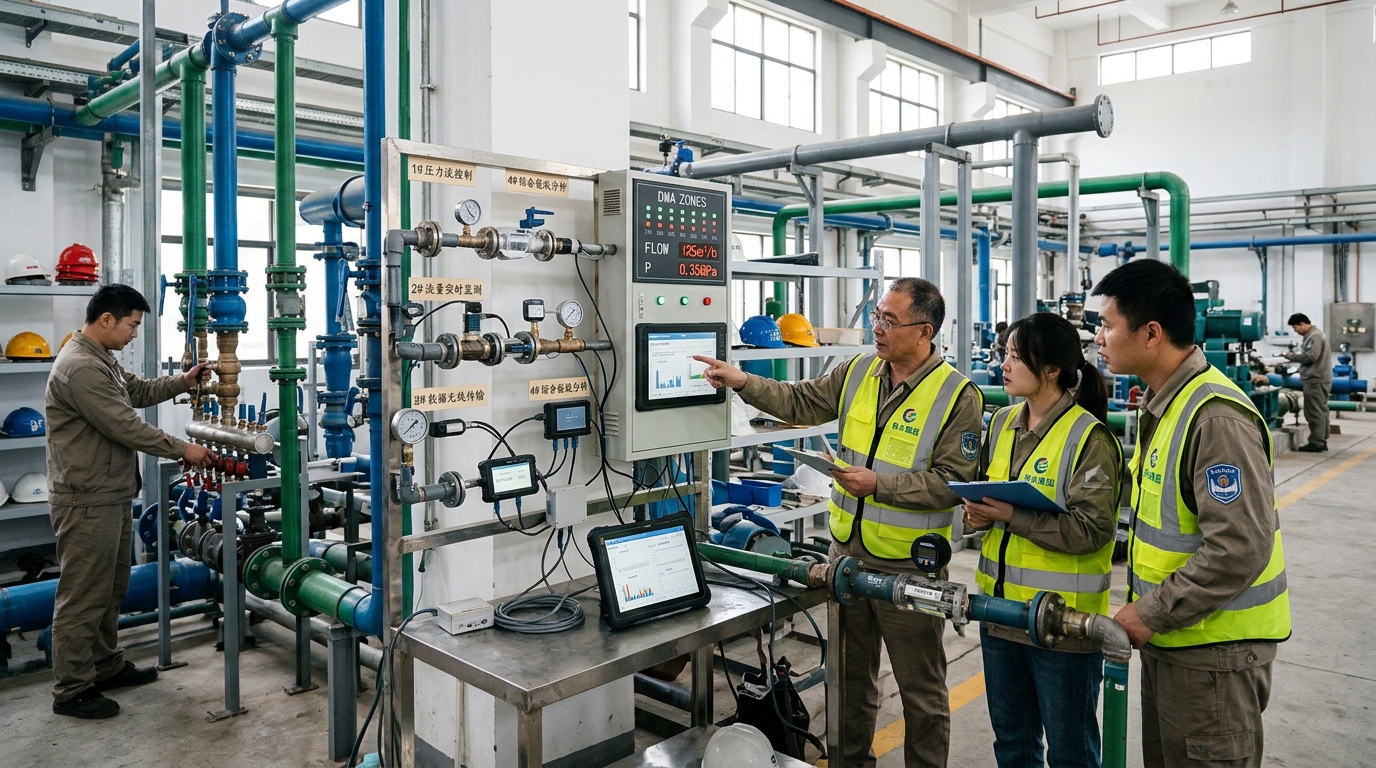
A typical DMA usually contains 500 to 3,000 customer connections, with 2 to 4 metering points set at its boundaries. Its core is not simply installing water meters, but forming a data chain of "boundary metering, pressure monitoring, flow analysis, leakage location, and operations and maintenance closed loop." Whether a reduction in leakage rate can be sustained depends on metering accuracy, data frequency, rationality of districting, pressure management, and repair response speed. Therefore, the choice of technical route requires a comprehensive judgment based on pipeline network structure, budget, O&M capability, and communication conditions.
II. Comparison of Boundary Metering Routes
Mechanical Water Meters
The most common devices in existing networks. Low procurement cost (DN100-DN300 range). Suitable for limited budgets and stable flows.
- Limitation: Narrow turndown ratio; significant errors under low-flow conditions.
- Data Cycle: Often monthly/quarterly if manual, hindering minimum night flow analysis.
Electromagnetic Water Meters
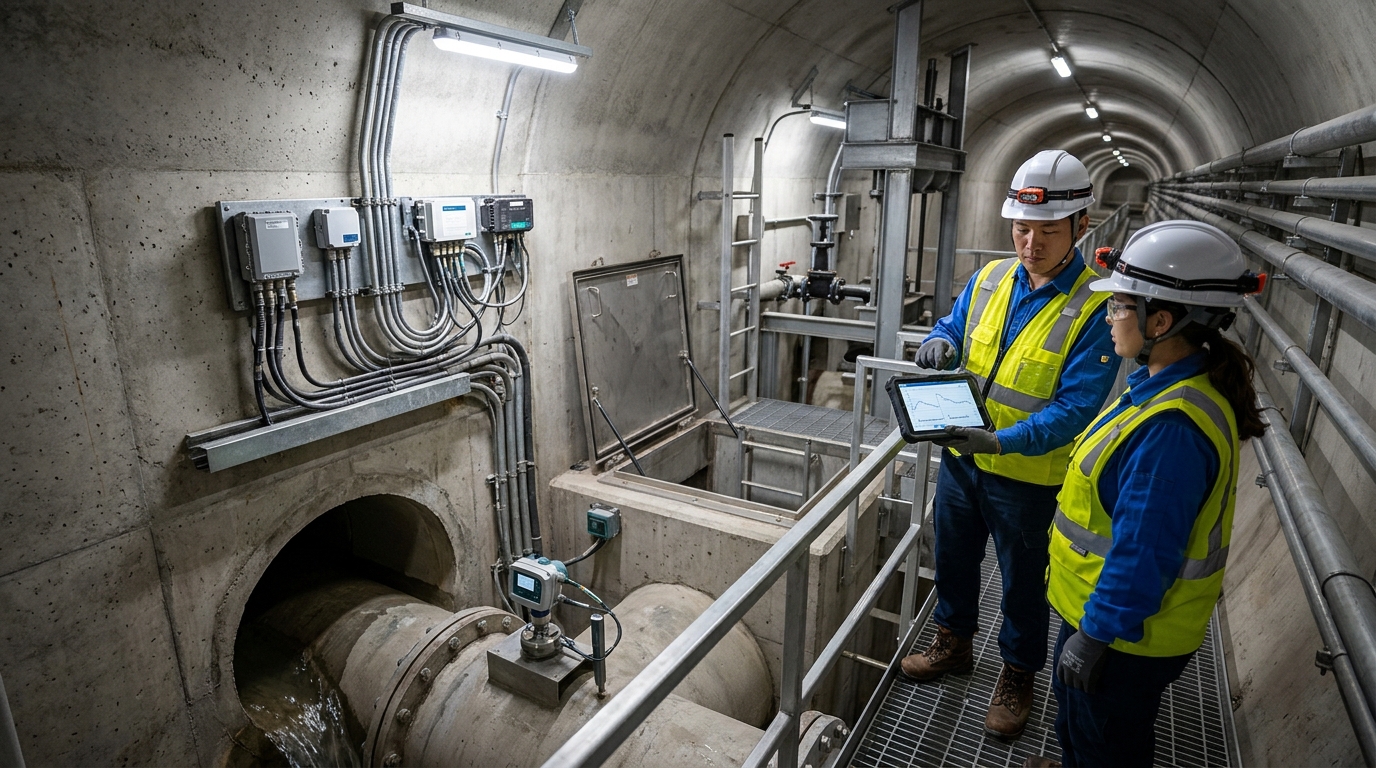
Based on Faraday’s principle. No moving parts, wide turndown ratio, accuracy ±1% to ±2%. Reliable for both large daytime and small nighttime flows.
- Requirement: Stable power, good grounding, straight pipe sections (5D upstream/2D downstream).
- Best For: Key DMAs, commercial areas, industrial park boundaries.
Ultrasonic Water Meters
Transit-time or Doppler methods. No pressure loss, low maintenance. Good adaptability for DN150+ pipes with gas/particles.
- Sensitivity:
- Cost:
Remote Meter Reading Integration
Technologies like M-bus, LoRa, and NB-IoT increase data density from daily to every 15 minutes/hour.
- KPI: Monthly completeness ≥98%, Daily completeness ≥95%.
- Risk: Unstable links render high-quality meters ineffective for curve generation.
III. Sensing and Communication Routes
Selecting the right communication protocol is critical for data integrity. Below is a breakdown of common routes:
| Technology | Ideal Scenario | Key Advantage | Limitation & Mitigation |
|---|---|---|---|
| LoRa | Campuses, Urban Areas | Low per-node cost, self-built networks, 1-5km coverage. | Limited bandwidth. Use repeaters/gateways for underground chambers. |
| NB-IoT | Distributed Points | Simple deployment via carrier networks, low power. | Signal weak in deep underground/mountains. Requires signal surveys + hybrid backups. |
| 4G/5G | High-Bandwidth Needs | Real-time acoustic/video data backhaul. | Higher power/tariff. Not for battery-powered meters. Use for edge nodes. |
| Edge Gateway | Unstable Networks | Local caching, protocol conversion, anomaly flagging. | Requires initial setup investment but drastically improves completeness (e.g., 91% → 99.2%). |
Hybrid Strategy Recommendation: Mature projects often adopt a mix: Boundary meters use NB-IoT/LoRa; Pressure/Flow use 4G/LoRa; Acoustic devices use 4G/5G; Platform side uses edge gateways for resume-after-disconnect transmission.
IV. Leakage Diagnosis Routes
1. Minimum Night Flow (MNF)
Analyzes flow between 2:00–4:00 AM. Identifies step-like jumps and sustained highs. Depends heavily on meter accuracy and clear boundaries.
2. Pressure Management
Leakage correlates with pressure. Reducing pressure by 0.1 MPa can cut background leakage by 5–15%. Must balance against fire protection and user needs.
3. Acoustic Detection
Fixed loggers identify noise; portable detectors/correlators locate leaks. Best for metal pipes; less accurate for plastic/large diameter due to attenuation.
4. Combined Workflow
Screen high-risk DMAs via MNF → Check Pressure Data → Narrow scope via Acoustics → Confirm via Correlation/Excavation. Reduces location cycle from 7 days to 2 days.
Case Study: A water supply enterprise conducted combined detection on 30 high-risk DMAs, finding 18 hidden leak points (12 joint seepage/small branch leaks), significantly improving operational efficiency.
V. Digital Foundation Routes
Hardware alone is insufficient. A robust digital ecosystem supports closed-loop management:
- GIS (Geographic Information System): The spatial foundation. Accurate pipeline attributes (diameter, material, burial depth) are crucial. Poor GIS leads to distorted boundary metering and misdirected work orders.
- Hydraulic Models: Tools like EPANET or InfoWorks simulate pressure/flow propagation. Essential for scenario evaluation (e.g., impact of valve closure or pressure reduction). High construction cost, best for utilities >100,000 m³/day.
- AI Anomaly Detection: Builds models on historical data to identify bursts, theft, and meter failures. (Example: Reduced burst response time from 12h to 2h; annual leakage down 3 percentage points.)
- Closed-Loop Platform: Must go beyond visualization. Implement district assessment, work-order dispatch, and re-measurement verification. Acceptance should focus on explainability and closure rates, not just device online status.
VI. Typical Scenario Selection Strategies
Aging Residential Areas
Challenge: Small diameters, complex materials, fluctuating usage.
Strategy: Start with mechanical remote meters for basic districting. Upgrade high-leakage (>15%) DMAs to DN50-DN150 electromagnetic/ultrasonic meters with LoRa/NB-IoT. Focus on MNF and pressure monitoring.
Industrial Parks
Challenge: Large day-night differences, continuous process water, theft risk.
Strategy: Use wide-turndown electromagnetic/ultrasonic meters with bidirectional capability. Add turbidity/residual chlorine sensors. Subdivide into secondary DMAs to isolate master/sub-meter errors. AI focuses on abnormal usage patterns.
Mountainous Water Supply
Challenge: Elevation differences >50m, high burst frequency, terminal monitoring difficulty.
Strategy: Prioritize pressure zoning and management. Use LoRa repeaters for valleys and 4G gateways for key nodes. Result: Burst occurrences dropped from 18 to 7/year; leakage from 22% to 13%.
Secondary Pump Rooms / Chambers
Challenge: Weak signal, no mains power, harsh environment.
Strategy: Battery-powered meters (evaluate replacement cycles). Deploy edge gateways/external antennas for signal. Use multi-parameter acquisition (meter + pressure + temp) to distinguish faults from real leaks. Target: Error ±2%, Completeness >98%.
VII. Return on Investment & Implementation Roadmap
ROI Analysis
DMA investment includes meters, valves, communication, and platform integration. Estimated cost per key DMA: 20,000 – 80,000 RMB.
Example Calculation:
Daily Supply: 100,000 m³ | Leakage Reduction: 18% → 12% (6,000 m³ saved/day)
Annual Direct Water Saving Value (at 3 RMB/m³): ~6.57 Million RMB
Note: Does not include reduced electricity, chemical costs, or emergency repair savings.
Four-Step Implementation Roadmap
- Inventory & Design: Complete pipeline survey, boundary design, and valve isolation tests. Ensure "clear boundaries, traceable users."
- Infrastructure Deployment: Install boundary meters, pressure monitors, and comms. Prioritize data completeness over advanced analytics.
- Indicator Establishment: Define baselines for MNF, leakage rate, and pressure anomalies. Form a maintenance closed loop.
- Advanced Analytics: Introduce hydraulic models, AI diagnostics, and performance assessments to transition from project-based to operations-based models.
Warning: Skipping steps 1 and 2 to deploy models directly often results in "untrusted data, unusable models, and non-closed-loop maintenance."
Future Outlook
DMA will integrate with digital twins, carbon emission management, and resilient water supply systems. As low-power sensing, edge computing, and smart pressure control mature, DMAs will evolve from simple "metering districts" into operating units that are diagnosable, predictable, and controllable. Success relies on balancing technology suitability with long-term O&M mechanisms.