Pipe Network Leakage vs. District Metering Areas: A Selection Guide for Urban Pipe Network Scenarios
Comparison of DMA District Metering Technology Routes: Metering, Zoning, and Water-Loss-Rate Selection in Water Distribution Network Loss Control
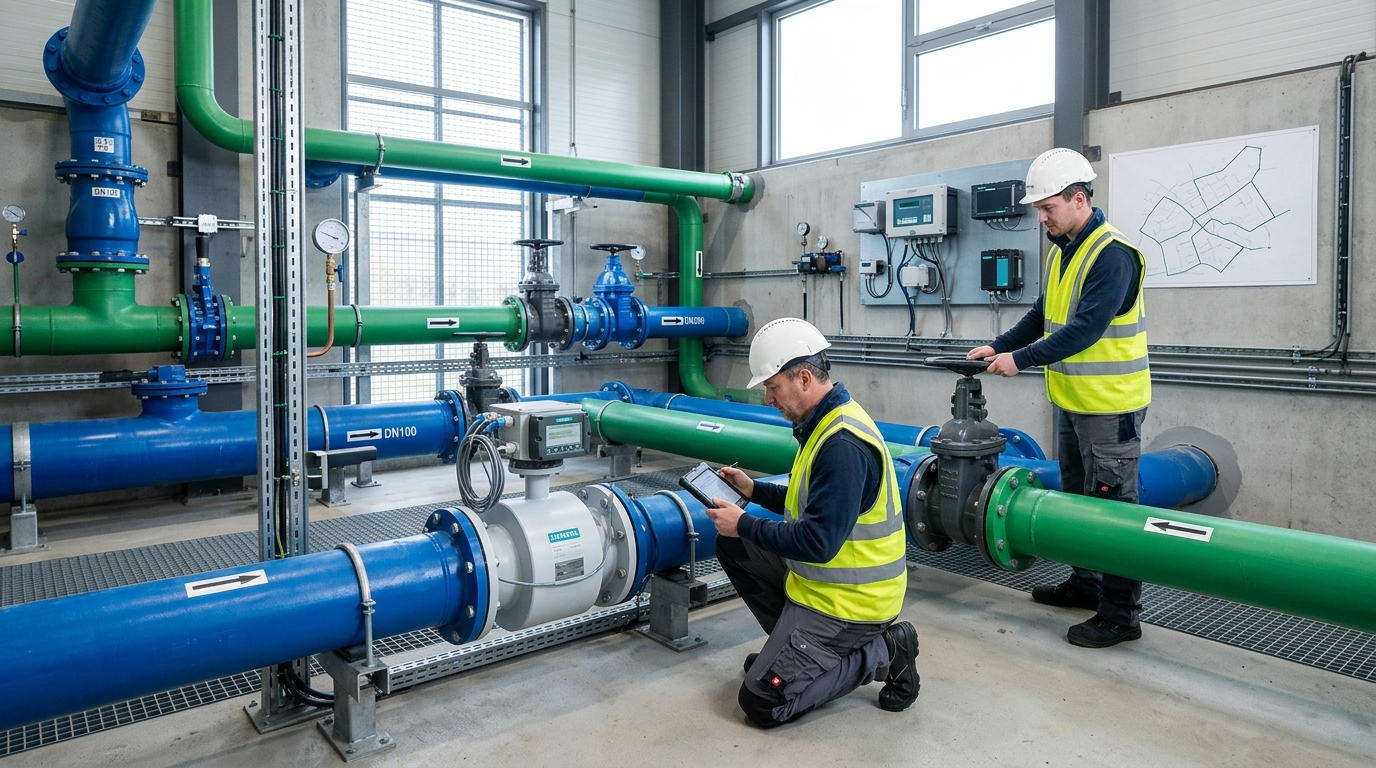
As water distribution network leakage control shifts from experience-based inspection to data-driven management, DMA (District Metered Area) has become an important lever for water utilities to identify abnormal consumption, detect pipe bursts, and reduce water loss rates. A DMA divides the water distribution network into a number of independently metered and independently analyzable areas; using boundary flow, node pressure, and customer metering data, utilities calculate water supplied, authorized consumption, water loss volume, and loss rate.
Industry practice shows that DMA is not merely installing a few flow meters, but a systems engineering effort involving network topology, metering accuracy, communications and data acquisition, pressure management, leak location, and O&M organization. Different technology routes differ significantly in investment intensity, applicable scenarios, speed of water-loss-rate improvement, and long-term O&M costs. This article compares mainstream DMA technology routes from dimensions such as boundary metering, pressure and acoustic methods, hydraulic models and AI, scenario adaptation, and selection recommendations, providing reference for water utilities to develop water distribution network leakage control programs.
I. Why DMA Metering Has Become the Main Line of Leakage Control
DMA's core value is transforming abstract network leakage into manageable units that can be zoned, metered, and assessed. Traditionally, water utilities relied mainly on emergency repair response and manual inspection; loss-rate statistics had long cycles and large errors, and bursts and background leakage were easily averaged out. After establishing DMAs, each area has boundary metering and an internal consumption ledger; the loss rate can be calculated by the formula "(supply volume minus authorized consumption) divided by supply volume, multiplied by 100%"; night minimum flow can serve as an important indicator for judging background leakage. Many cities, after promoting DMAs, have gradually reduced loss-rate targets from around 15% to within 10%, shifting management focus from repairing bursts after occurrence to abnormal-fluctuation early warning and proactive investigation.
From policy and industry goals, many Chinese cities set control of the public water distribution network loss rate within 9% as a phased indicator, and some advanced cities propose targets below 8%.
For example, a prefecture-level city has a total pipe network length of about 2,800 km and serves about 3 million people; its 2021 loss rate was about 14.8%. After promoting DMA construction, the city divided into 860 independently metered areas, deployed about 1,200 boundary meters and about 900 pressure monitoring points, and included night minimum flow in daily reports. After 18 months of operation, the city's loss rate decreased to 9.6%, annual water losses were reduced by about 1.8 million cubic meters, and average burst response time shortened from about 2 hours to within 35 minutes. This shows that DMA's value first comes from quantifiability, then from locatability.
II. Boundary Metering Technology Routes: Balancing Accuracy and Cost
Boundary metering is the foundation of DMA. Mechanical remote-reading water meters or mechanical flow meters are usually used for small-to-medium bore and budget-limited scenarios. Common bore sizes are DN50 to DN300; accuracy is mostly around ±2%, and turndown ratio is about R50 to R100. Their advantages are low procurement cost, mature installation methods, and familiarity to maintenance personnel, making them suitable for older urban areas with smaller bores and relatively stable flow at boundaries. However, mechanical parts wear, long-term accuracy drift is more significant, and readings are sensitive to sediment in water, pipe vibration, and straight-pipe length. If the installation location has entrained air, biased flow, or downstream valve throttling, errors may be amplified, causing the loss rate to be overstated or understated.
Electromagnetic water meters and electromagnetic flow meters have become mainstream choices for urban DMA boundary meters in recent years. They have no moving parts, turndown ratios can reach R160 to R200, accuracy is commonly ±1%, suitable for DN80 to DN600 boundaries, with relatively low pressure loss and good adaptability to flow fluctuations. Electromagnetic meters require full-pipe operation and good grounding; air bubbles in water, high-velocity erosion, or poor insulation can affect readings. Ultrasonic water meters or ultrasonic flow meters use principles such as transit-time measurement, cover a wider bore range, can extend from DN50 to above DN1000, have low pressure loss, and are suitable for large-bore trunk boundaries and newly built areas. Ultrasonic devices usually cost more than mechanical meters; some models are sensitive to installation conditions, air content in water, and temperature changes, requiring stricter acceptance testing and periodic verification.
Configuration Strategy Recommendations
- Key DMAs & High-Flow Boundaries: Preferentially adopt high-accuracy electromagnetic or ultrasonic meters, with accuracy targets controlled within ±1%.
- General Residential Areas: Use mechanical remote-reading meters or mid-range ultrasonic meters, where ±2% accuracy is sufficient for trend judgment.
- Data Collection: Interval typically set to 15 minutes; intensified to 5 minutes for key burst-monitoring scenarios.
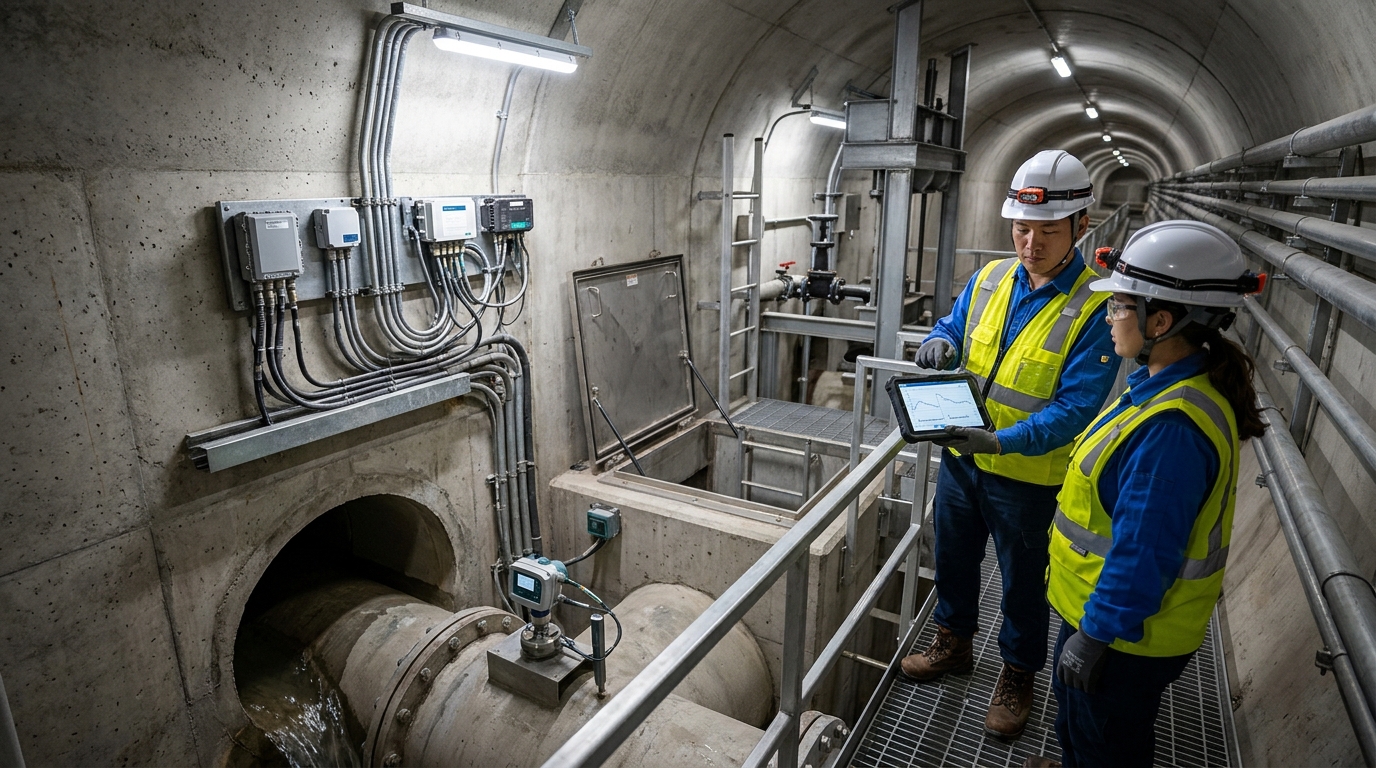
- Communication: NB-IoT, LoRa, and 4G are common. Underground vaults require consideration of antenna position, ingress protection rating (IP68+), and battery life (5–8 years).
- Redundancy: Configure 1 to 3 boundary meters per DMA to avoid data gaps caused by single-point failures.
III. Synergy of Flow, Pressure, and Acoustic Methods
With boundary flow alone, a DMA can determine whether an abnormality exists, but it cannot answer where the leak is. Therefore, pressure management and acoustic detection are often combined with metering. Pressure management reduces network operating pressure through pressure-reduving valves, variable-frequency pumps, pressure gauges, and zone optimization. Background leakage usually has a nonlinear relationship with pressure; common pressure exponents are between 0.5 and 1.5, while bursts or joint leakage may have higher pressure exponents. Industry experience shows that, under safe water-supply conditions, reducing node pressure in high-elevation-difference or low-pressure areas by 10 m of head may reduce background leakage by 10% to 25%.
A mountainous city with significant elevation differences had nighttime pressure reaching 0.55 MPa in some areas; after adding pressure-reducing valves and pressure monitoring, average pressure dropped to 0.35 MPa, related DMA night minimum flow decreased by about 18%, and annual water loss decreased significantly.
Acoustic detection is an important means of leak location. Noise correlators use two microphones to capture leakage noise, achieving location accuracy of 0.5 to 2 meters, suitable for metal pipes, shallow burial, and nighttime inspection where background noise is low. Noise logger arrays can continuously collect sound from multiple nodes, suitable for long-term monitoring of key DMAs, but require many sensors and higher O&M investment. For non-metallic pipes such as PVC and PE, acoustic signals attenuate quickly and location difficulty increases; for joint leakage, minor seepage, and complex underground void propagation paths, acoustic detection can also produce false judgments. In practice, DMA boundary metering first narrows the abnormal area, and acoustic equipment then precisely locates leaks at night; this is usually more efficient than a network-wide survey. After an urban district deployed pressure gauges and acoustic inspection plans in 200 key DMAs, leak detection rate increased by about 70%, and average inspection distance decreased by about one-third.
IV. Hydraulic Models and AI: Data Density Determines Decision Quality
Hydraulic models and AI analysis are key to moving DMA from monitoring to prediction. Real-time hydraulic models simulate network pressure distribution, burst risk, and abnormal flow sources based on pipe diameter, material, node elevation, boundary flow, pressure monitoring, and demand allocation. Models can be used to verify whether DMA boundaries are reasonable, whether pressures are too high, and whether metering errors affect loss-rate calculation. Their advantage is converting isolated data into spatially explicit conclusions, suitable for large cities, complex networks, and newly built areas. However, model development has a high threshold, requiring complete GIS, accurate topology, historical burst records, and continuous calibration; if input data are insufficient, model outputs may be significantly biased, even producing decisions that appear refined but are actually distorted.
AI methods emphasize discovering abnormalities from time-series data. Common approaches include change-point detection, clustering analysis, residual analysis, and threshold alarms on night minimum flow; they compare early-morning flows on different dates within the same DMA against historical baselines to identify sudden increases, gradual increases, or periodic fluctuations. After a city connected 1,500 DMAs, it generated about 288,000 flow and pressure records per day. Previously, manual threshold judgment yielded an abnormality recognition rate of about 62%, with many false alarms. After introducing AI baseline models, incorporating weather, holidays, consumption categories, and pressure fluctuations, the abnormality recognition rate improved to about 85%, and false alarms decreased by about 40%. However, AI cannot replace field verification; it is better suited to ranking high-risk areas and shortening investigation scopes. Ultimately, a closed loop still requires metering verification, pressure patrols, and acoustic detection.
V. Applicable Scenarios: New Cities, Old Cities, and Complex Networks
Newly Built Urban Areas
Characterized by new pipe materials, regular layouts, and controllable valves. Suitable for dividing DMAs directly along roads and parcels. Boundary metering uses electromagnetic or ultrasonic meters, with pressure monitoring and remote data acquisition constructed synchronously. Targets are often 8% to 10%; focus is on maintaining metering accuracy and preventing unauthorized connections.
Older Urban Areas
Often have small pipe diameters, complex joints, incomplete water-meter records, and coexisting unauthorized bypasses. Direct DMA construction may distort loss rates due to metering errors. Recommended path: First complete meter replacement, network surveys, valve rehabilitation, and zoning-boundary cleanup, then deploy boundary metering. Combine acoustic inspection and pressure control where necessary.
High-Elevation-Difference Areas
Prioritize dividing DMAs along isobaric lines or pressure risk rather than administrative boundaries. Otherwise, pressure differences within the same area are large and loss rates are hard to explain. Effective pressure management is critical here.
Long Transmission Trunk Lines
Large diameters, high flows, and wide burst impact areas. Suitable for large-bore ultrasonic or electromagnetic boundary metering. Advanced technologies like fiber-optic vibration sensing or distributed acoustic sensing are used for trunk mains and river-crossing segments, though they involve high investment and complexity.
VI. Selection Recommendations: Prioritizing by Targets and Complexity
Selection recommendations can be prioritized by loss-rate targets:
- Loss Rate > 15%: Establish boundary metering and night minimum flow monitoring to quickly identify bursts and obvious background leakage. Prioritize cost-controllable mechanical remote-reading or mid-range electromagnetic meters.
- Loss Rate 10% - 15%: Add pressure management, acoustic inspection, and more refined DMA zoning to convert abnormality detection into leak location.
- Loss Rate < 10%: Further reduction is difficult. Requires coordinated advancement of hydraulic models, AI abnormality detection, customer-metering governance, and network renewal. Shift from single-point monitoring to system optimization.
When selecting by network complexity, DMA size is recommended to be controlled within 1,000 to 5,000 households or 1 to 10 km of pipe network. Boundary meters should be configured at 1 to 3 per DMA. For urban communications, prioritize NB-IoT; for suburban areas or weak-signal vaults, use LoRa self-built networks or 4G. Assessment boundaries should preferably use ±1% accuracy, while general trend judgment can use ±2%.
Investment Payback Example
In one city, the total DMA project investment was about RMB 28 million. Equipment accounted for ~55%, construction/communications ~25%, and platforms/data governance ~20%. Annual water-saving benefits were about RMB 5 million, resulting in an overall payback period of 5 to 6 years. Including reductions in emergency repair costs and service quality improvements, the payback period can be further shortened.
VII. Implementation Risks: Metering, Communication, and Data Governance
Implementation risks first arise from metering errors. Insufficient installation conditions, non-full-pipe flow, downstream valve throttling, air content, or meter-body wear can cause supply-volume readings to deviate. If customer meters have low accuracy or unauthorized connections are not in the ledger, loss rates may be overstated; if boundary meters have negative bias or bypass valves leak, loss rates may be understated. During the first six months after commissioning, loss rates often fluctuate; this is usually due to instability in metering, reading, and zoning, not sudden leakage changes. Therefore, include a calibration period with periodic verification before assessment.
Communication coverage and data governance are equally critical. Weak signals, battery depletion, and clock drift cause missing data. On the platform side, network codes, meter IDs, DMA boundaries, and work-order processes must be unified. DMA requires coordination among network operations, emergency repair, customer service, revenue, and GIS. Without controllable zoning boundaries and closed-loop work orders for abnormality alarms, rich data cannot translate into lower loss rates.
VIII. Outlook: From Static DMAs to Digital Twin Pipe Networks
Future DMA technology routes will show three trends: continuously improving metering accuracy, dynamic zoning, and decision-modeling. Costs of ultrasonic and smart meters are falling, enabling high-density DMAs in smaller cities. Virtual zoning based on real-time hydraulic models and AI may replace some static physical zoning, dynamically adjusting boundaries according to pressure risk and burst probability. Leakage control will expand to improving water-supply resilience, including water-quality monitoring and extreme-weather response.
However, technology choices must return to engineering reality. DMA's value lies in forming a system with accurate boundary metering, controllable zoning, credible data, actionable leak location, and closed-loop O&M. For cities with loss rates above 12%, consolidate boundary metering and night minimum flow analysis first. For cities near 9%, focus on pressure management, acoustic inspection, and model calibration. The ultimate goal is to continuously reduce loss rates at reasonable cost while ensuring safe water supply and operational transparency.