Full-Process Guide for Installation and Commissioning of Drainage Network Monitoring
From "Visibility" to "Precision": A practical implementation guide for urban drainage authorities, municipal O&M units, and smart water project teams.
I. Introduction: Evolution from "Visibility" to "Precision"
In the operation and management of urban drainage systems, monitoring is no longer simply about "installing a few sensors." It has evolved into a comprehensive perception system integrating liquid level, flow rate, rainfall, and ponding status.
- Liquid Level: Determines if manholes or underpasses are approaching overflow.
- Flow Rate: Reflects pipeline conveyance capacity, siltation trends, and abnormal dry-weather sewage.
- Waterlogging Prevention: Directly serves flood warning, pump station dispatch, and emergency rescue.
For drainage authorities, the key to long-term stable operation lies not in procurement, but in standardized installation, commissioning, and maintenance. This guide covers scenarios ranging from DN300 to DN2000 pipelines and 0.2m to 8m measurement ranges, establishing fundamental references for project design and O&M.
Practices show that effective monitoring reflects in three indicators: online rate, data accuracy, and warning response time. After deploying monitoring at 36 flood-prone points in one district, the online rate remained above 98%, and abnormal data identification time dropped from 40 minutes to just 5–10 minutes.
II. Monitoring Point Layout & Equipment Selection
Layout Strategy
Avoid "evenly scattering points." Prioritize five types of locations: historical flood-prone areas, underpasses/low-lying overpasses, confluence nodes of main stormwater pipelines, pump station inlet/outlet cross-sections, and discharge outlets.
- Main Pipeline Nodes: Set up one level observation point every 300m to 800m for zones >50 hectares.
- Large Diameter Pipelines (DN1200+): Combine flow monitoring with level monitoring to assess conveyance changes.
Equipment Selection Guide
Level Gauges
- Radar: Best for environments with foam/water vapor (e.g., pump wells). Reserve top blind zone ≥0.3m.
- Ultrasonic: Suitable for regular manholes with minimal turbulence. Range 0.2m–8m; blind zone ≤0.25m.
- Submersible: Long-term submerged use. Requires probe fixation to avoid damage by desilting machinery.
Flow Meters & Others
- Doppler/EM Flow Meters: Prioritized for partially full/full pipe conditions. Range: 0.03m/s–5m/s.
- Ponding Monitors: Resolution ≥1cm, range 0–100cm. Place at road low points and tunnel entrances.
- Rain Gauges: Resolution 0.2mm; cross-verify with meteorological data.
III. Installation Steps: Survey to Fixation
1. On-site Survey
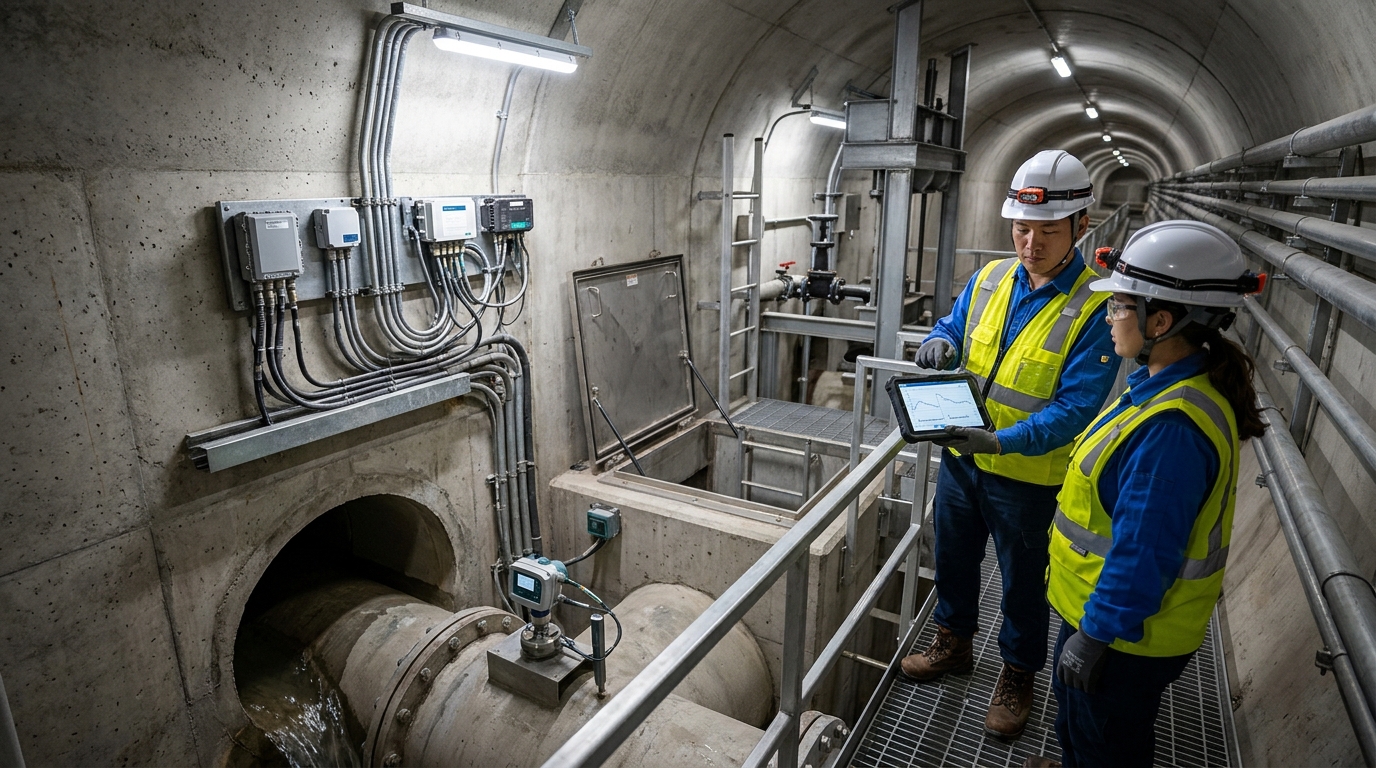
Verify manhole numbers, pipe invert elevations, and upstream/downstream relationships. Check for drop manholes, inverted siphons, or concealed connections. Test NB-IoT/4G signals; if weak, plan for external antennas or RS485 wired backhaul.
2. Sensor Positioning
- Radar/Ultrasonic: Install slightly upstream of center. Keep ≥150mm from walls to avoid echo interference. Ensure no ladders or floating debris obstruct the path.
- Submersible: Fixed on brackets/guides. Probe should be 200mm–500mm from bottom to prevent silt burial.
- Flow Meters: Prefer straight pipe sections (5D upstream, 3D downstream). Ensure acoustic path is free of silt/oil.
3. Wiring, Power & Communication
Use waterproof connectors and conduits. Cables must have a bending radius ≥10x diameter. For solar-powered sites without grid power:
Recommended Specs: 20W–50W Solar Panel + 12V 20Ah–40Ah Battery. Ensure endurance for 5–7 consecutive rainy days.
Outdoor boxes require IP65 rating; underground sensors need IP68. Grounding resistance should be ≤10Ω in lightning-prone areas.
IV. Commissioning: Calibration & Closed-Loop Alarms
Power & Signal Inspection
Confirm voltage (10.8V–14.4V for 12V systems). Test communication for ≥30 minutes. Packet loss during commissioning should be controlled within 2%.
Calibration Methods
Level Gauge Calibration
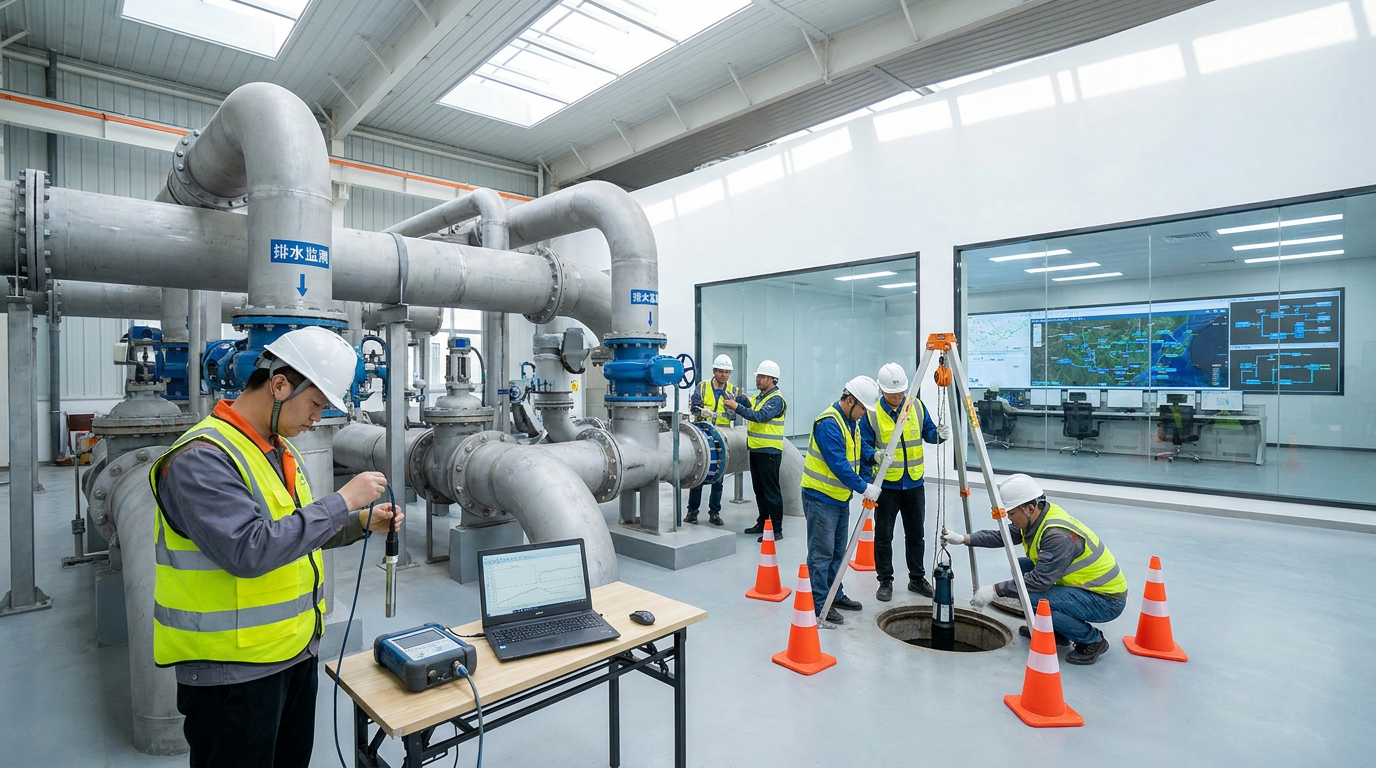
Compare sensor readings against manual measurements (steel tape/ruler) at low, medium, and high levels. Deviation target: ±3mm to ±10mm (or ±0.5% full scale).
Flow Meter Calibration
Check static zero point (should be ≈0m/s). Compare with portable meters or volumetric methods. Target deviation: ±5%.
Alarm Threshold Configuration
Establish a closed-loop alarm mechanism (Pre-warning → Alarm → Emergency):
- Road Ponding: 15cm (Alert), 25cm (Traffic Control), 35cm (Road Closure).
- Water Level: Pre-warning at +0.3m above normal high water; Alarm at +0.5m above pipe crown.
- Flow Anomalies: Alert if flow increases >30% vs. historical same period with synchronous level rise.
Conduct a continuous 72-hour trial run to verify platform refresh, SMS pushes, and work order dispatch.
V. Daily Maintenance: Ensuring Data Credibility
Without stable maintenance, data quality declines rapidly. Establish four maintenance categories:
- Platform Inspection (Daily): Monitor offline devices, voltage anomalies, and signal delays.
- On-site Inspection (Monthly/Bi-weekly): Check manhole covers, sensor brackets, cable exposure, and antenna obstruction. Increase frequency during flood season.
- Sensor Cleaning: Clean radar/ultrasonic surfaces to remove oil/spider webs. Clear submersible probes of plastic/leaves. Use soft cloths only.
- Desilting Management: Measure siltation quarterly. If thickness exceeds 10% of pipe diameter, arrange desilting and re-verify calibration.
Maintenance Impact: One municipal unit improved their online rate from 94.5% to 99.2% and reduced data abnormalities by implementing quarterly calibrations for 48 points.
VI. Troubleshooting Common Issues
Level Faults
- Unchanged Data: Check for obstruction, silt burial, or wrapped probes.
- Frequent Jumping: Caused by pump start/stop vortices. Solution: Add moving average filtering or adjust sampling time.
- Falsely High/Low: Often due to incorrect height parameters, wall echoes, or excessive blind zone settings.
Flow Faults
- Static Flow Velocity: Check for bottom vortices or incorrect parameter direction.
- Level Up, Flow Down: Indicates downstream blockage or gate closure.
- Low Curve: Check for silt burial or incorrect area parameters.
Communication & False Alarms
- No Data: Check battery, fuses, and SIM card credit.
- Intermittent Disconnect: Likely caused by damp connectors or lightning interference.
- False Alarms: Optimize logic. E.g., require threshold exceedance to last 3–5 minutes to filter out vehicle-induced waves.
VII. Data Application: From Display to Action
The value of monitoring lies in the linked chain: "Rainfall → Network Level → Flow → Ponding → Handling."
- Pre-Rainfall: Display initial levels and forebay status.
- During Rainfall: Real-time rise rates and peak times. If a manhole rises >0.5m in 30 mins, dispatch patrols immediately.
- Post-Rainfall: Generate reports on dissipation duration and handling efficiency.
Case Study: An old urban area integrated 58 level, 24 flow, and 16 ponding points. During heavy rain, the system detected a discrepancy between rising main pipe levels and stagnant pump station inflows, identifying a blocked DN1200 pipe. Post-intervention, average ponding dissipation time shortened by 28%.
VIII. Conclusion
Future drainage monitoring will integrate digital twins and AI algorithms to predict risks 30–120 minutes in advance. However, advanced algorithms rely entirely on basic data accuracy. Standardized installation, rigorous commissioning, and normalized maintenance are the foundations of a resilient, safe, and refined urban drainage system.