How to Choose the Right Drainage Network Monitoring Solution? Accuracy and Stability Are Key
Introduction: Urban drainage systems are transitioning from a management model dominated by manual inspection and post-event response to a refined operation model supported by real-time data such as water level, flow, pressure, and rainfall.
Drainage pipe networks are highly concealed, have large cross-section variations, complex media, and intermittent operating conditions. This article compares common monitoring technologies including pressure-type, ultrasonic, radar, Doppler, and electromagnetic methods, outlining their advantages, disadvantages, and selection logic for different scenarios.
Level Monitoring: The “First Threshold” for Flood-Prevention Early Warning
Water level is the most basic and also the most easily overestimated indicator in drainage pipe network monitoring. For partially full stormwater pipes, combined sewer pipes, inspection manholes, storage tanks, and pump station forebays, water level often directly indicates whether the water surface is approaching the pipe crown or if overflow is imminent.
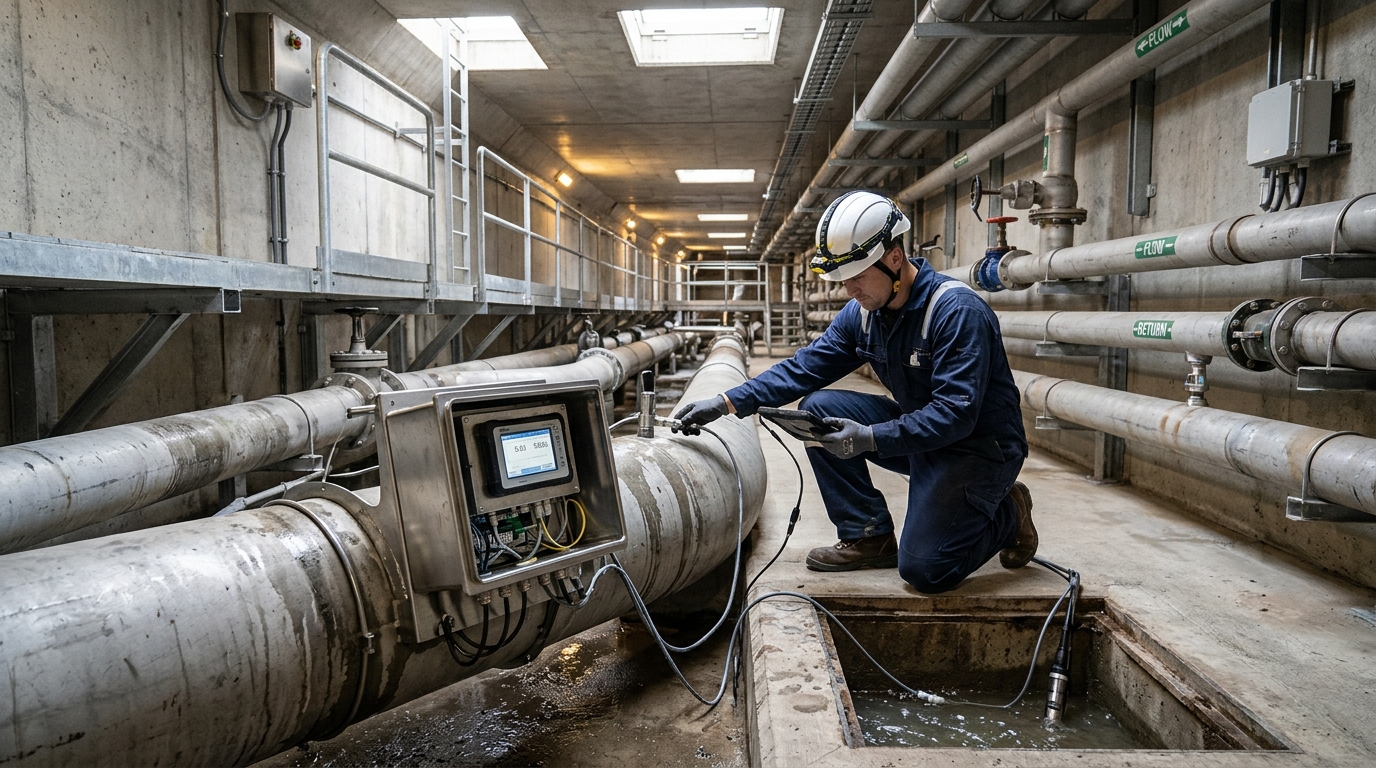
Pressure-Type Level Transmitters
These measure static water pressure and convert it to level height using the relationship $P=\rho gh$. Their advantages include small probe size, installation at the bottom of manholes, no measurement blind zone, and immunity to fog and steam. They are suitable for inspection manholes and cost-sensitive projects. Typical accuracy is 0.5% to 1% of full scale.
Limitation: They assume stable liquid density. Sediment accumulation can raise the zero point, causing falsely high readings. Best suited for scenarios requiring regular calibration and shallow manholes.
Ultrasonic vs. Radar Level Transmitters
Ultrasonic sensors are non-contact and easy to install, suitable for dry, low-fog open channels. However, they have a measurement blind zone (typically 20–50 cm) and are affected by fog, condensation, and probe fouling in sewage environments.
Radar level transmitters use electromagnetic waves (24 GHz or 80 GHz). Compared with ultrasonic, radar is less sensitive to environmental disturbances. The blind zone can be as low as 10–30 cm, offering better stability in deep wells and key flood-prevention points, though at a higher cost.
Flow Monitoring: From “Whether There Is Water” to “How Much Water There Is”
If level answers “whether the water level is too high,” flow answers “how much water the pipe can still drain.” Flow data is critical for planning, dispatching, and verifying drainage capacity against rainfall intensity.
Open-Channel Flow Meters
Uses weirs or flumes combined with level transmitters. Mature principles and low cost, but susceptible to floating debris and sediment accumulation. Requires regular clearing and rating.
Doppler Ultrasonic Flow Meters
Measures velocity via sound wave scattering from suspended particles/bubbles. Suitable for partially full sewage. Sensitive to low velocity (<0.1 m/s) and requires clean probes.
Electromagnetic Flow Meters
Based on Faraday’s law. High accuracy (0.5–2%) and no moving parts. Must operate full-pipe; cannot measure partially full open-channel flow directly without level integration.
Transit-Time Ultrasonic Flow Meters
Suitable for full pipes and clean liquids. Less applicable in dirty drainage networks due to bubble/sediment interference. Best used as auxiliary verification tools.
Typical Scenario Selection Strategies
- Combined Sewer Networks: Use radar for level at overflow risk points and Doppler flow meters for estimating mixed flow during wet weather. Pressure-type transmitters can serve as low-cost supplements for general branch pipes.
- Stormwater Pipe Networks: Face "dry normally, urgent during rain." Radar level transmitters are more stable in deep wells than ultrasonic. Doppler flow meters need minimum velocity thresholds; open-channel meters require regular maintenance against debris.
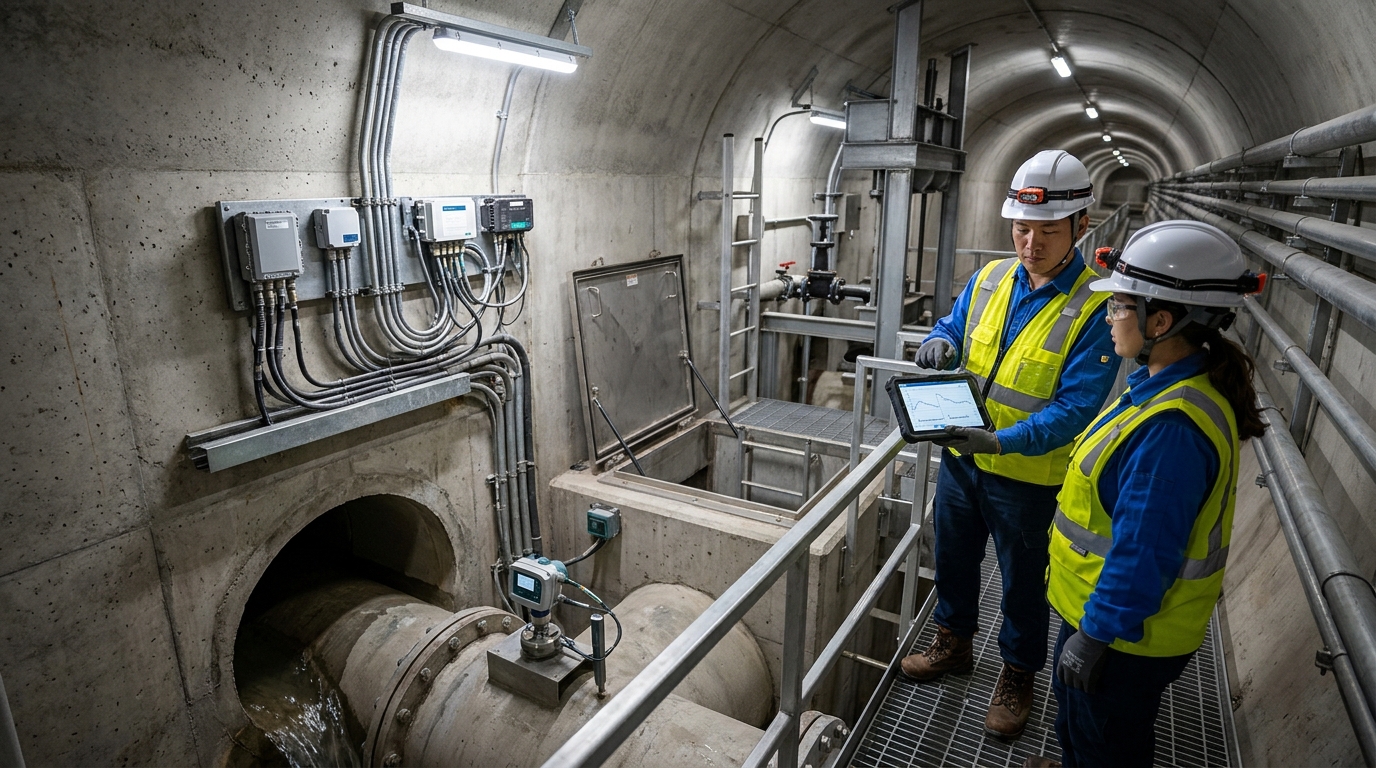
- Pump Station Forebays: Require high accuracy and real-time performance for pump start/stop control. Radar or pressure-type transmitters with sampling frequencies up to 10 seconds are recommended. Electromagnetic flow meters are ideal for discharge pipes under full-flow conditions.
- Road Ponding: Combine electronic water level gauges, radar transmitters, and Video AI. Set notification thresholds at 10–15 cm and traffic risk warnings at 20–30 cm. Data must be linked with pipe network levels to determine root causes (e.g., backwater vs. pump failure).
Data Governance and Integration
The value of monitoring lies in data quality. Common issues include zero drift, frozen values, and communication interruptions. A ponding point with a 30 cm alarm threshold may miss the optimal response window if data is delayed by more than 10 minutes.
Only with a unified datum—converting raw sensor values to relative water levels, associating flow with cross-sectional area, and linking pressure with structural models—can data from different points be comparable and useful for hydraulic modeling.
In flood-prevention integration, level, flow, rainfall, tide level, and pump status jointly drive model-based dispatching. System integration allows pre-drawing down storage facilities or starting additional pumps based on predictive models, which is far more valuable than reactive single-point alarms.
Conclusion: A Technical Decision-Making Framework
The selection recommendation for drainage pipe network monitoring can be summarized as: level first, flow verification, pressure assistance, and scenario adaptation.
Summary of Sensor Choices
- General Inspection Manholes/Budget-Sensitive: Pressure-type level transmitters.
- Key Overflow Risks/Deep Wells: Radar level transmitters.
- Dry Open Channels: Ultrasonic level transmitters.
- Partially Full Sewage/CSO Outlets: Doppler flow meters.
- Full-Pipe Pump Stations/Pressure Pipes: Electromagnetic flow meters.
- Road Ponding: Combination of electronic gauges, radar, and video AI.
For urban flood prevention, what truly matters is not using the highest-accuracy device at every point, but using sufficiently reliable technical routes at risk points and ensuring long-term data availability through robust O&M mechanisms.