Electromagnetic Flowmeters in Water Supply Networks: Precision Metering and Long-Term Stability Engineering Guide
Urban water supply networks form the backbone of municipal lifeline infrastructure. Unlike wastewater or chemical processing applications, potable water distribution imposes three distinct requirements on flow measurement that are critical for regulatory compliance and operational efficiency.
High Accuracy Class
Revenue-grade metering demands compliance with ISO 4064 R400 or higher, with permissible errors typically not exceeding ±0.5%.
Hygienic Certification
Sensors in contact with drinking water must comply with GB/T 17219, NSF/ANSI 61, or equivalent WRAS approval.
Long-Term Stability
Networks operate 24/7, requiring flowmeters to maintain accuracy over a 5–10 year lifecycle while minimizing recalibration shutdowns.
Critical Sensor Selection Parameters
Liner Material Selection
- PTFE (Polytetrafluoroethylene): Offers maximum chemical inertness and a wide temperature range (−10 °C to 150 °C), though it has limited negative-pressure resistance. Best suited for large-bore trunk mains.
- Polyurethane (PU): Provides excellent abrasion resistance and negative-pressure tolerance. Appropriate for raw water lines carrying trace particulates, but unsuitable for high-temperature thermal disinfection cycles.
- Monolithic Ceramic: The latest technical approach—a one-piece alumina ceramic measuring tube combining hygienic grade with abrasion resistance. Bore coverage DN15–DN600 makes it the preferred choice for new DMA zones.
Electrode & Excitation Strategy
Potable water conductivity typically ranges from 100 to 800 μS/cm. Recommended electrode materials include:
- 316L Stainless Steel: Cost-effective for the majority of potable water applications.
- Hastelloy C: Superior pitting resistance for sections with elevated residual chlorine after disinfection.
- Titanium: Ideal for coastal cities with high chloride content in raw water sources.
Excitation Frequency
Low-frequency rectangular wave excitation (1/16 mains frequency) effectively suppresses mains-frequency interference in buried pipelines. High-frequency excitation (25–50 Hz) improves signal-to-noise ratio for large-bore, low-velocity applications. Dual-frequency excitation combines both advantages and represents the premium choice for custody transfer.
Installation Standards and Engineering Practices
Upstream/Downstream Straight Run
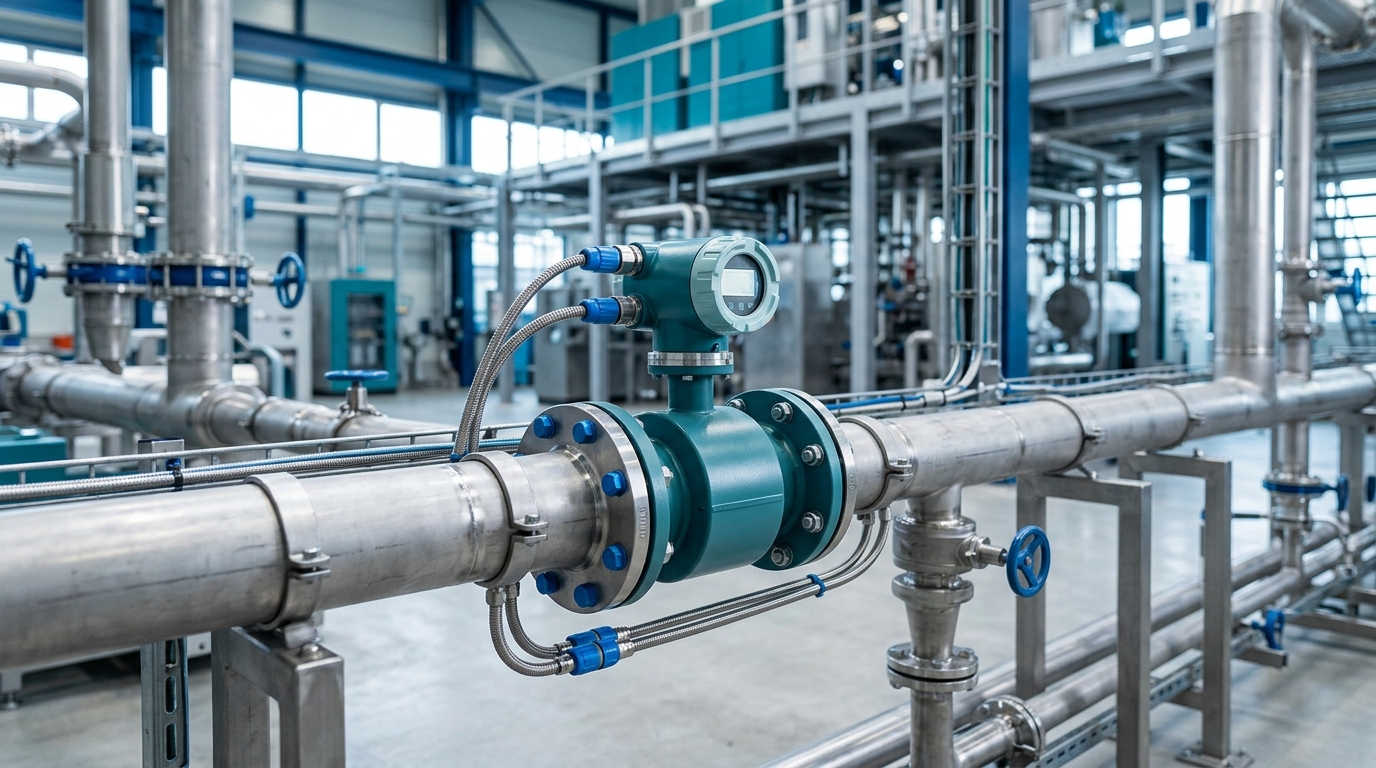
Electromagnetic flowmeters require strict straight-run conditions: minimum 5D upstream and 2D downstream (where D = pipe diameter). When elbows, tees, or valves are present upstream, extend this requirement to ≥ 10D or install a flow conditioner to ensure profile stability.
Grounding and Equipotential Bonding
Supply pipelines commonly use ductile iron or PE pipes. Since PE pipes are non-conductive, grounding rings or sensors with dedicated grounding electrodes are mandatory. Proper equipotential bonding is essential to prevent electrical noise from affecting measurement accuracy.
Full-Bore Assurance
Electromagnetic flowmeters require the measuring tube to remain fully filled. Install air-release valves upstream at high points or potential air-pocket locations. Alternatively, select transmitters with empty-pipe detection capabilities that automatically blank the output when an air-filled condition is detected.
Online Verification and Long-Term Maintenance
Ensuring long-term reliability requires a proactive maintenance strategy rather than reactive repairs. Modern digital transmitters enable predictive maintenance through continuous monitoring.
Use a clamp-on ultrasonic flowmeter (accuracy ±1%) on the same pipe section. A deviation within ±2% is considered acceptable for field verification.
Periodically measure insulation resistance of excitation coils and electrodes. Values below 20 MΩ indicate potential liner damage or junction-box water ingress.
Modern transmitters with SPI digital communication can remotely monitor electrode contamination level, signal strength, and excitation current.
Summary
Electromagnetic flowmeter selection for water supply networks must balance accuracy class, hygienic certification, liner material, electrode compatibility, and installation constraints. With the large-scale rollout of DMA zoning, intelligent electromagnetic flowmeters featuring digital communication and self-diagnostics not only improve revenue metering accuracy but also reduce whole-life costs through remote condition monitoring.
Strict adherence to installation standards and establishment of periodic verification protocols form the foundation for reliable long-term operation of supply network metering systems.