Converting an irrigation district from experience-based to data-based water allocation requires reliable telemetry at every diversion point — yet canal sites are typically far from grid power and fiber. Field deployments face four hard constraints: no mains power, no wired backhaul, long point-to-point distances (hundreds of meters to kilometers), and exposure to lightning and dust. A robust RTU architecture must be designed around these constraints from day one.
1. Measurement Point Planning: Follow the Water, Not the Map
Instrument points should be defined by hydraulic boundaries — rotation groups and delivery turns — not administrative ones. Metering accuracy at each group inlet directly determines the fairness of volumetric water charging. A typical tiered configuration:
- Headworks and main canal offtakes: radar level sensor + gate opening sensor + RTU, computing discharge through the gate from combined level and gate-position data;
- Branch canal offtakes: Parshall flume or rectangular weir with ultrasonic/radar level sensing — standardized structures keep the stage-discharge rating stable;
- Farm-level (tertiary) turnouts: cost-optimized integrated open-channel flow meters on battery-powered RTUs to cap per-point CAPEX.
Recommended density: water-surface-profile check points every 2–5 km on main canals, full coverage of branch offtakes, and at least 80% coverage at tertiary turnouts.
2. Solar Power Budgeting: Size for the Worst Week, Not the Average Day
The most common design error is sizing batteries on mean consumption while ignoring consecutive cloudy winter days. A defensible budget:
- Typical load: RTU sleep current ≤ 2 mA; one collect-and-transmit cycle ≤ 30 s at 150–300 mA peak. At a 15-minute reporting interval, daily drain is roughly 0.8–1.5 Ah;
- Battery capacity for 7 consecutive overcast days plus 30% margin — e.g., a 12 V/14 Ah LiFePO4 pack;
- PV panel sized on the worst winter month irradiance (2.5–3.0 kWh/m²/day across much of northern China): a 10–20 W monocrystalline panel suffices;
- Below −20 °C, specify LiFePO4 chemistry or packs with low-temperature charge protection — charging standard NMC cells in the cold causes lithium plating and permanent failure.
3. Telemetry Backhaul: Tiered Networks Beat All-4G
Connecting every field point directly over 4G inflates SIM/data costs and leaves radio-shadowed sites offline. Field-proven practice is a two-tier topology:
- Last mile to aggregation node: sub-GHz LoRa (470/868/915 MHz per region) mesh or star links covering 3–5 km line-of-sight per hop; tertiary and branch sites multi-hop into a canal-side shelter;
- Aggregation to platform: 4G Cat.1 (or fiber where a management building allows), with dual-link failover;
- In hilly districts, account for LoRa diffraction losses and add repeater masts on ridgelines; keep normal reporting at 15–30 min and switch remotely to 5-min storm mode during flood season.
4. Gate Instrumentation and Data Integrity
Gate opening plus upstream/downstream levels form the basis of hydraulic discharge estimation. Specify absolute-encoder gate position sensors (±2 mm, zero position retained through power loss) and prefer non-contact radar level sensors — irrigation water carries debris and sediment that foul contact probes. Every RTU must provide store-and-forward buffering of at least 30 days, automatically backfilling after link outages; otherwise billing records develop gaps that undermine user trust. On the platform side, re-verify stage-discharge rating curves periodically and trigger re-rating when deviation exceeds 5%.
5. Lightning Protection and Installation Practice
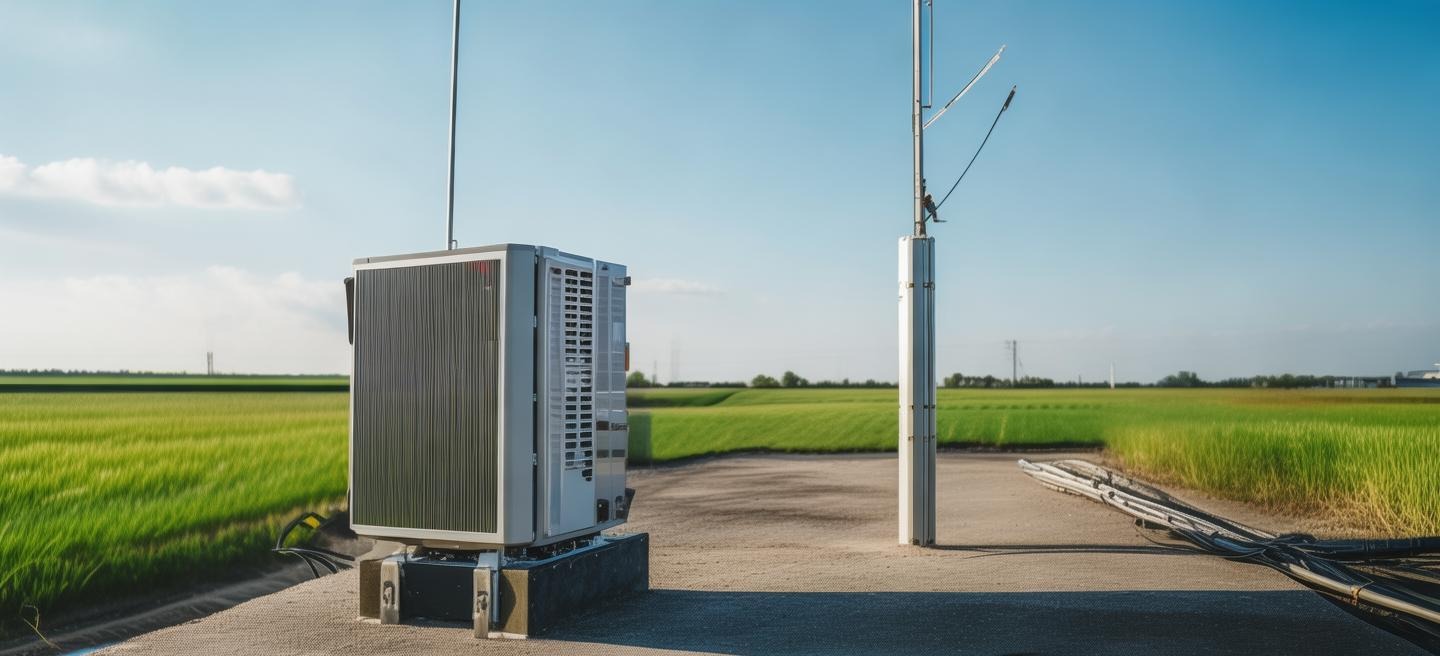
Isolated metal structures on open canal banks are prime lightning targets. Bond PV frames, antenna masts and RTU enclosures to a common earth (≤ 10 Ω ground resistance; drive 2–4 rods with soil conditioning where resistivity is high). Fit gas-discharge plus TVS two-stage surge protection on all signal entries. Use IP65-rated enclosures minimum, and house RTUs inside gate-operator buildings wherever practical rather than on exposed poles.
Conclusion
Success in irrigation telemetry is decided by system engineering, not unit hardware cost: power budgets that survive the worst weather week, backhaul tiered to terrain, store-and-forward that protects billing data, and lightning practices that protect asset life. Follow these, and telemetry availability routinely holds above 98% — a credible foundation for volumetric charging and water-saving operations.