1. Background: Why Unattended Hydrological Stations Shift All Risk to the RTU
Hydrological monitoring stations sit at remote river reaches, dam tails and basin outlets where manual gauge reading is slow and expensive. The modernisation path is unattended operation: an IoT RTU with level and flow sensors reports automatically to a central platform, in China typically under the SL 651-2014 hydrological telemetry protocol. Going unattended transfers every failure mode — power loss, link outage, lightning strike — onto the RTU, and any of them during flood season creates a data black hole exactly when data matters most. This article covers the three reliability designs that decide station uptime: power, communications and lightning protection.
2. Technical Analysis
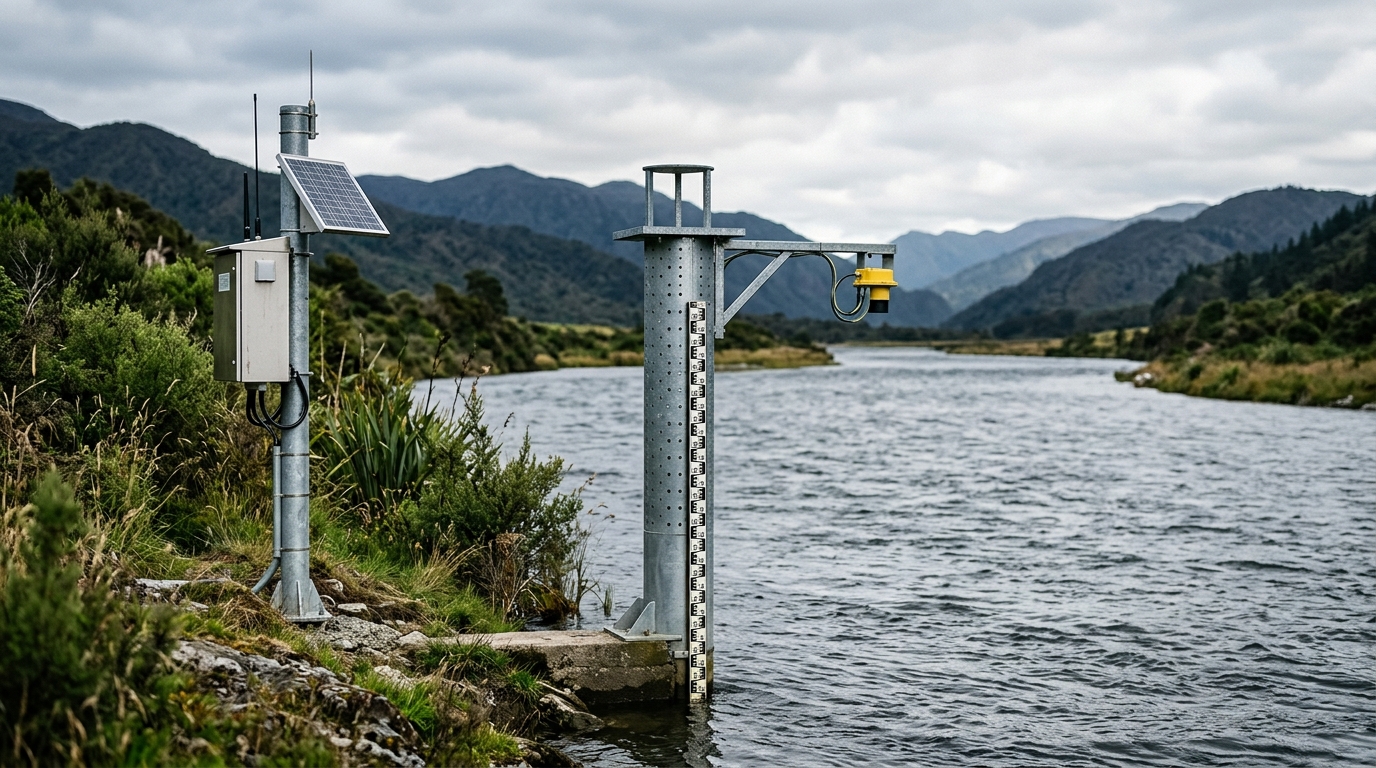
Power: size for the worst month, not the average. Solar budgets must use the site's worst-month peak-sun hours (2.5–3.5 h/day in most regions) plus 5–7 days of continuous overcast reserve. A typical two-element station (level + flow) draws 3–6 Wh/day — RTU sleep current below 1 mA, 5-minute sampling, 4–8 reports daily — matched by a 30–50 W panel and a 20–38 Ah LiFePO4 pack rated for low temperatures. Mandate battery-voltage telemetry inside the RTU: the voltage curve is the first diagnostic for panel shading, ageing and charge-controller faults.
Communications: dual link with store-and-forward. A single 4G link in mountainous terrain delivers only 95–97% availability, and flood season coincides with base-station congestion and grid outages. The proven architecture is 4G primary plus a satellite short-message backup (BeiDou in China, Iridium SBD or similar elsewhere): when the heartbeat fails or 4G cannot register, the RTU switches automatically and transmits critical stage data — rain and water-level elements compress into a single 78-byte message. Local storage for at least one year with resumable retransmission keeps platform data availability above 99%, the hard acceptance metric of any Smart Water platform.
Lightning protection: the number-one killer of field stations. Field stations fail from surges far more often than from component defects. Install an air terminal on the mast; ground with ≥2.5 m hot-dip galvanised angle steel or resistance-reducing modules to ≤10 Ω earth resistance (≤30 Ω acceptable on rocky riverbeds with chemical treatment); protect all three ports of the RTU — power, RS-485/SDI-12 signal and antenna feed; run sensor cabling in buried galvanised conduit, never bare overhead wire. Under USD 300 of hardware typically cuts annual lightning damage from double digits to near zero. IEC 62305 zoning and IEC 61643 surge-protector classes are the reference standards; environmental resilience per IEC 60068 and enclosure rating IP66 minimum should be contractually specified.
3. Engineering Practice: Protocol Integration and Acceptance Testing
- Protocol layer: the RTU should natively speak SL 651-2014 upstream while also publishing MQTT/JSON to modern Smart Water platforms, running both outputs during migration. Station codes and element identifiers must match the hydrological authority's register, or the central platform silently fails to decode.
- Acceptance layer: run three field tests before handover — a 72-hour link-pull test verifying storage completeness and retransmission; a failover test confirming backup-link takeover in under 5 minutes; and a real sleep-current measurement with a series multimeter against the power budget.
- O&M layer: turn battery voltage, RSSI and report-delivery rate into a daily platform report with auto-generated tickets for anomalies; re-measure earth resistance and clean panels every pre-flood season — trivial cost, decisive for season reliability.
4. Conclusion
Unattended hydrological monitoring converts patrol labour into design redundancy and remote diagnostics. Power sized for the worst month, dual communication links, three-stage surge protection, protocol-grade integration and pre-flood acceptance testing turn an IoT RTU into the most dependable sensing edge of Urban Lifeline monitoring. For integrators, station delivery ends not at power-on but at sustained data availability through the flood season.