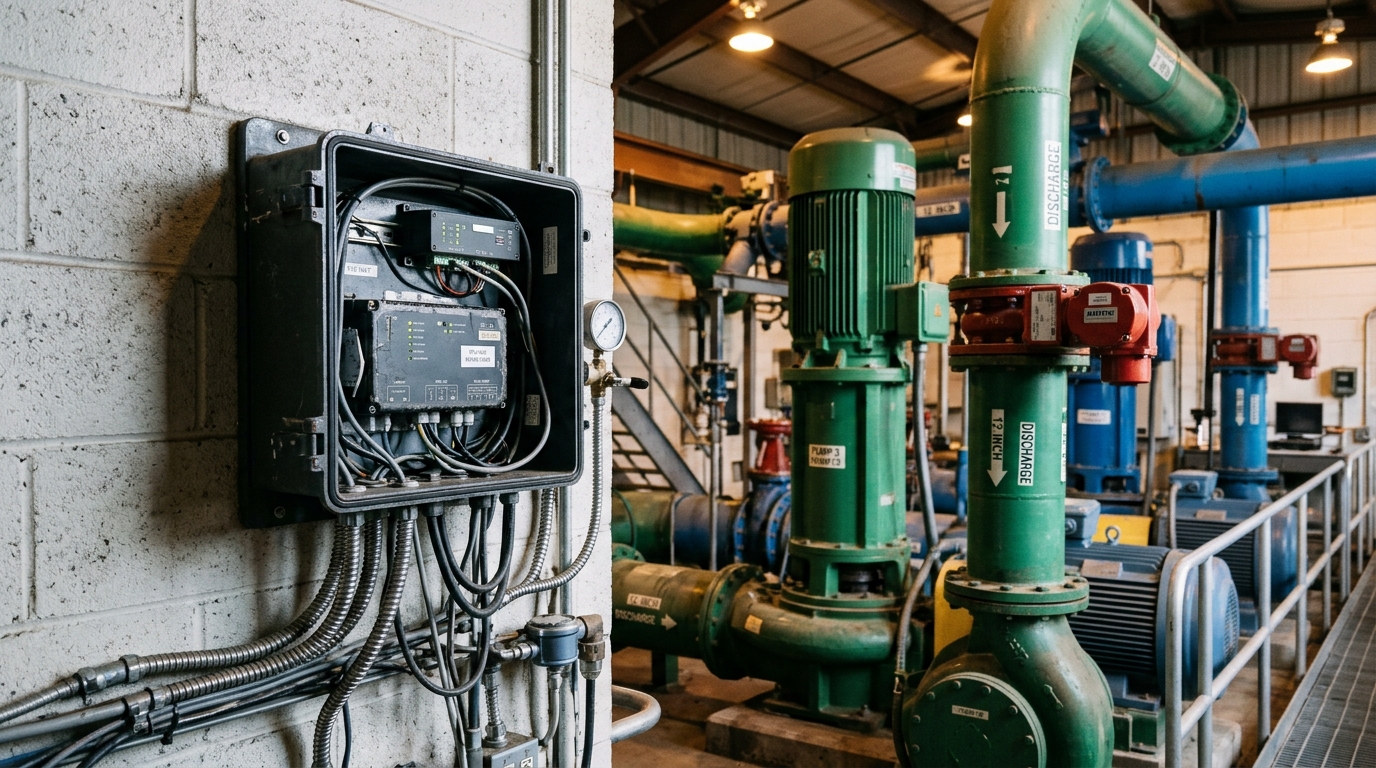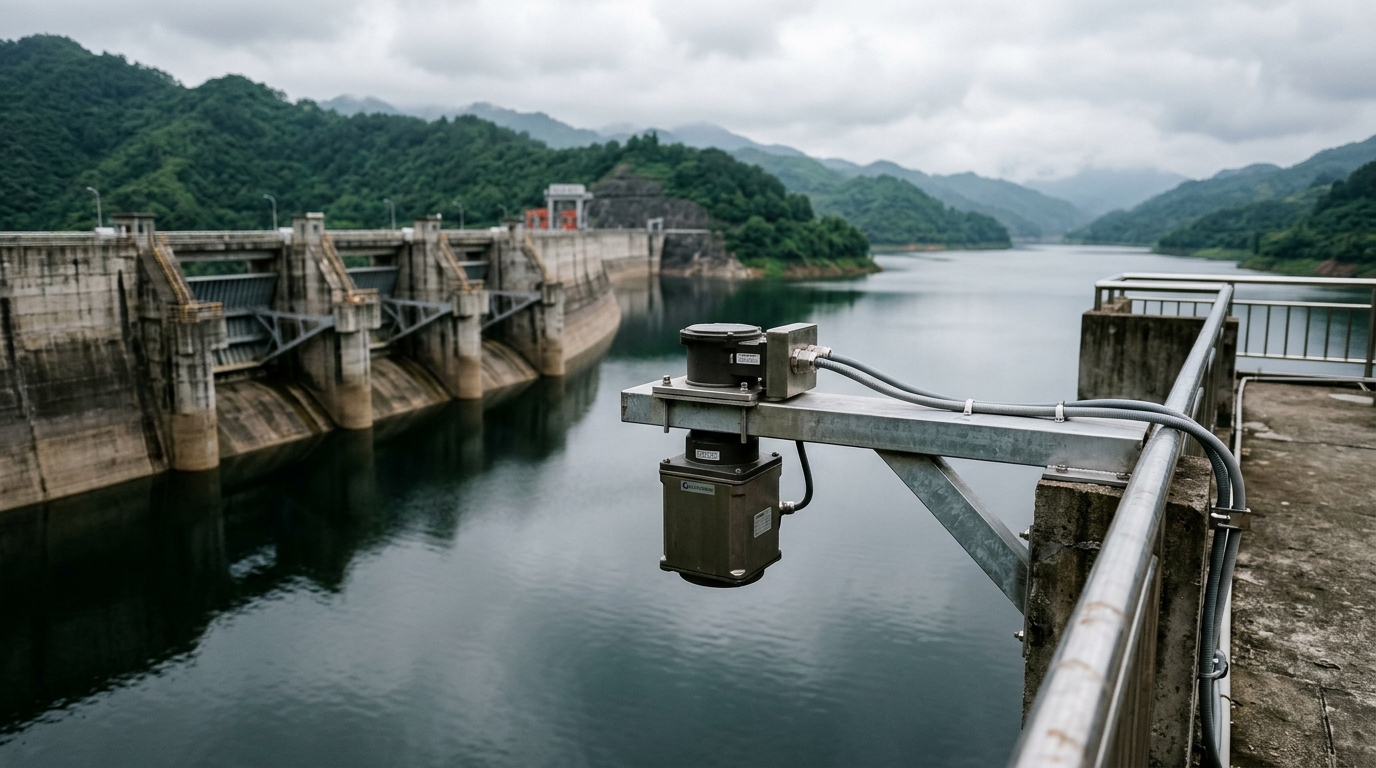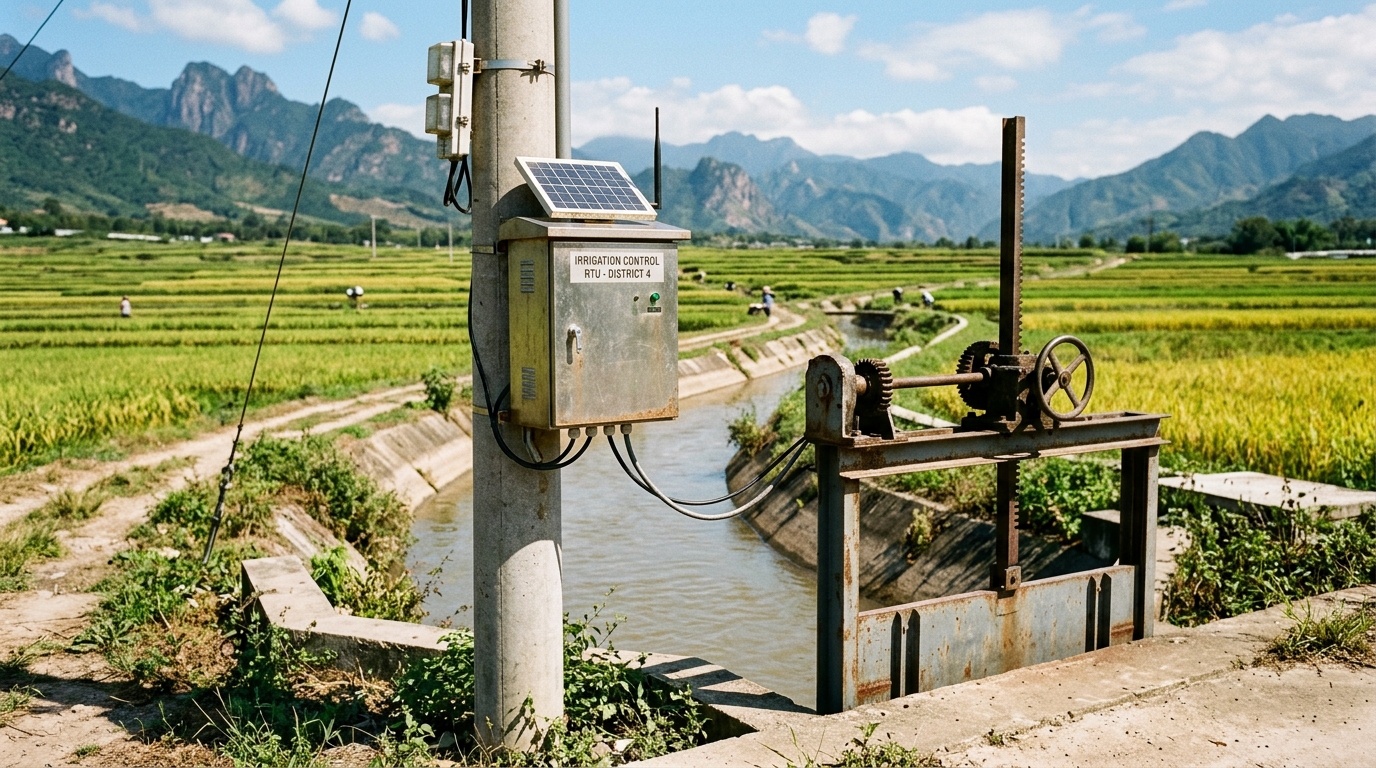
Agricultural water metering and canal automation are among the fastest-growing segments of rural telemetry, driven by water-rights allocation and irrigation modernisation programmes. An RTU deployed in an irrigation district faces constraints rarely found in urban networks: dispersed sites with no grid power, patchy cellular coverage, and — critically — responsibility for operating sluice gates. A typical canal modernisation project may have only 3-5 monitoring points per 5 km of main canal, yet each point must independently measure water level, flow and gate opening, report upstream, and in many cases execute gate commands from the district control centre.
1. Solar Power Budgeting: Design to Worst-Month Irradiance
Nearly all irrigation-district RTUs are solar powered, and the system must be sized from irradiance data, not rule of thumb:
- Load profiling. A typical RTU draws 30-80 mA in acquisition and peaks at 300-500 mA during transmission. With a 4-times-per-day reporting schedule, daily consumption is roughly 1.5-2.5 Wh. Gate actuation (electric hoist or hydraulic) adds 10-30 Wh per stroke and must be budgeted separately.
- Use the worst month, not the annual average. Size against December-January peak sun hours — often only 2.5-3.5 h/day in continental climates. Systems sized on annual averages reliably fail during winter cloud spells.
- Seven days of autonomy minimum. A 12 V/24 Ah LiFePO4 or gel battery loses 20-30 % of capacity at -20 °C; cold-climate districts should step up to 35 Ah, optionally with a battery heating pad.
Field experience: a 20 W panel with a 24 Ah battery covers monitoring-only sites; sites with gate actuation need 40 W panels and 38 Ah or more.
2. Communications: Two-Tier LoRa Self-Organised Network with 4G Cat.1 Fallback
Cellular coverage along main canals is uneven, and SIM data fees multiply quickly across hundreds of sites. The recommended architecture is a two-tier design: LoRa from field stations to a powered gateway at the district office or pumping station, then 4G or Ethernet backhaul to the cloud:
- LoRa link budget designed for 155 dBm EIRP (regional sub-GHz bands) achieves 5-8 km in open farmland; one gateway typically serves 8-15 stations along a canal.
- Gate-command channels require end-to-end latency below 5 s with acknowledgement and retransmission. One-way LoRa broadcast does not qualify for control duty — use a bidirectional protocol with ACK (LoRaWAN Class C or a vendor two-way protocol).
- For isolated head-of-canal sites, deploy a direct 4G Cat.1 RTU rather than building a gateway for a single node.
3. Closing the Gate-Control Loop: Accuracy and Safety Interlocks
- Position sensing. Prefer absolute encoders, which retain position through power loss; ±1 cm resolution satisfies volumetric accounting requirements. Screw-type hoists can derive position from turn count; hydraulic actuators need an added displacement sensor.
- Local safety interlocks. The RTU must enforce hard-wired upper/lower limit switches and refuse — and report — any remote command beyond limits. Safety logic must never live solely in the cloud.
- Volumetric reconciliation. Convert gate opening plus head differential to discharge via orifice equations, and cross-check against downstream metering (transit-time ultrasonic or radar surface velocity × cross-section). Flag sites for inspection when deviation exceeds 15 %.
4. Takeaways
Roughly 70 % of irrigation RTU project outcomes are decided by power and radio link budgeting, and 30 % by gate-control safety design. Commission through a full winter cycle before acceptance. On the O&M side: clean panels quarterly (dust in windy districts cuts yield 15-20 %), verify gate limits before each irrigation season, and log battery capacity fade. Finally, store full raw telemetry — including battery voltage and RSSI — not just business variables; the voltage trace answers most intermittent-data-loss investigations.