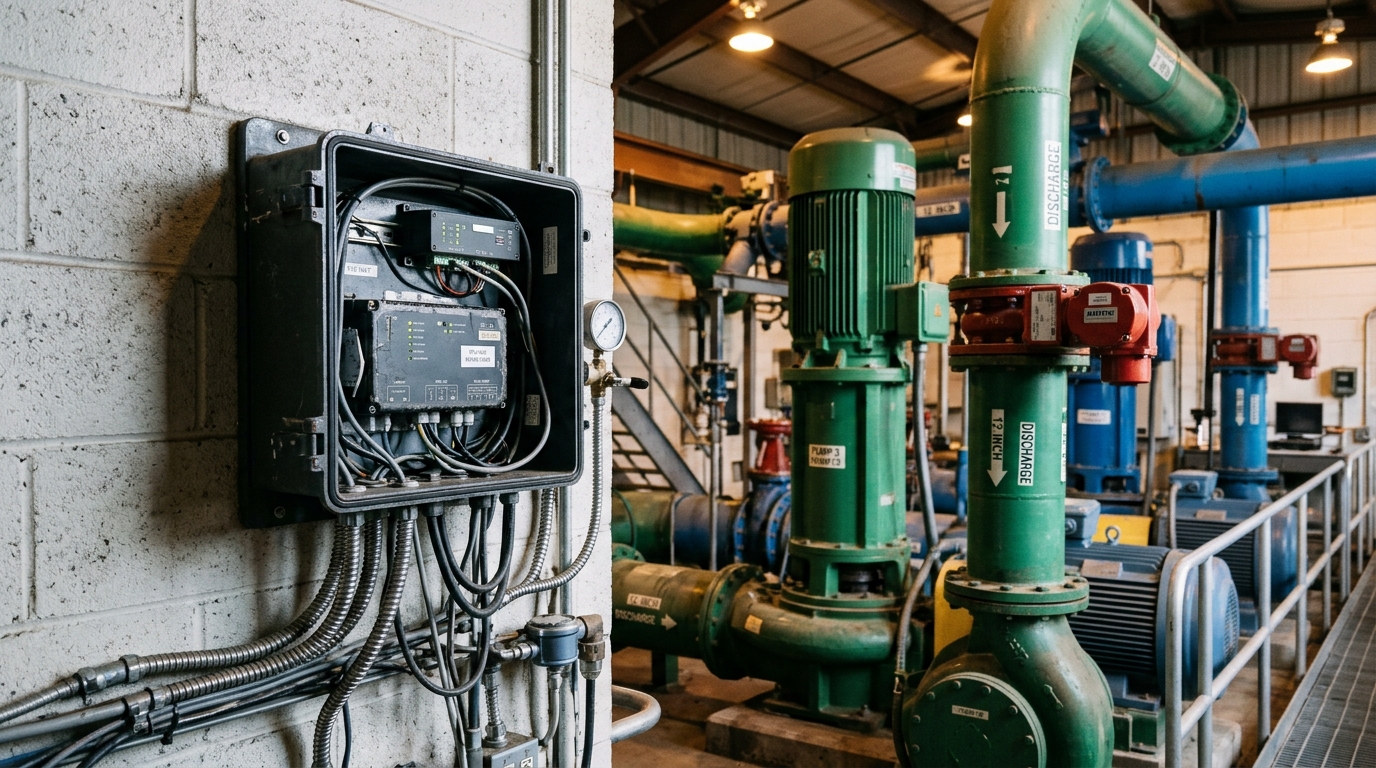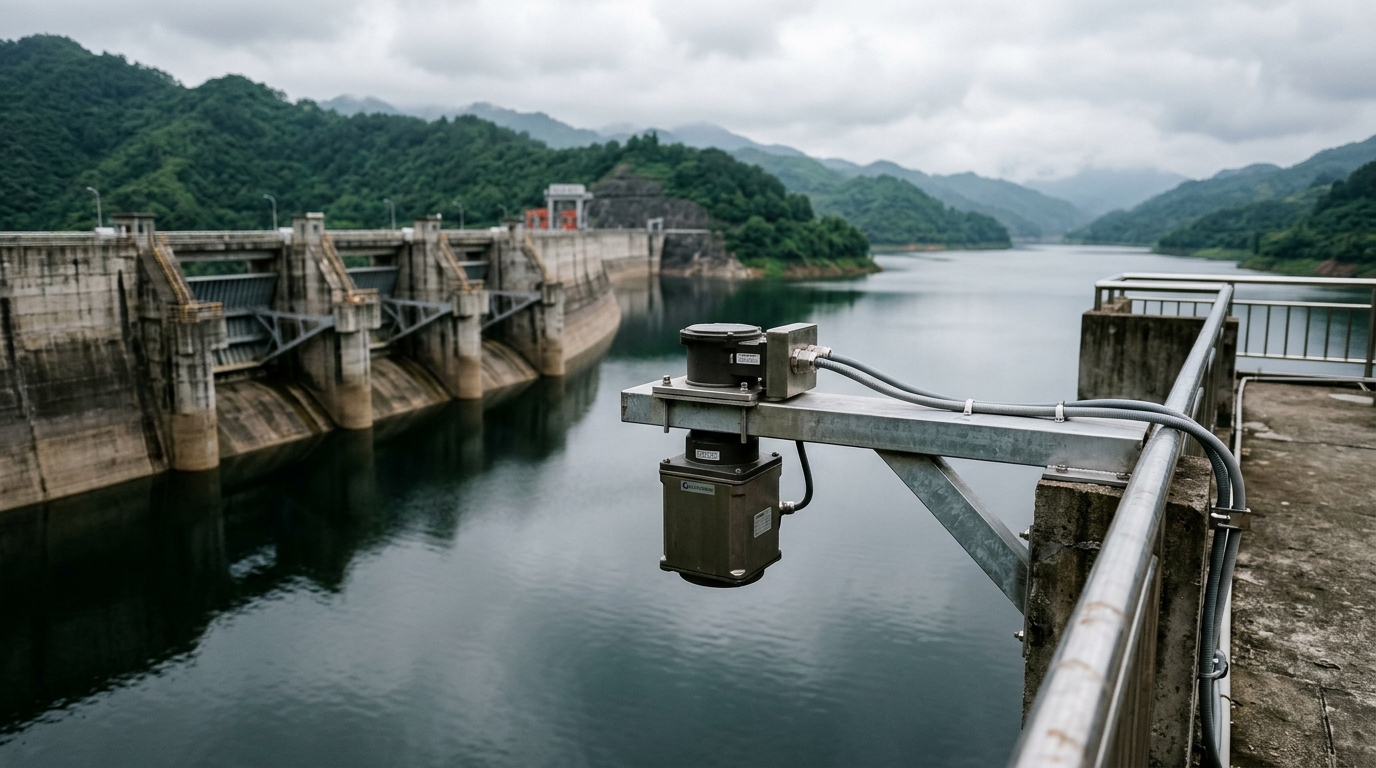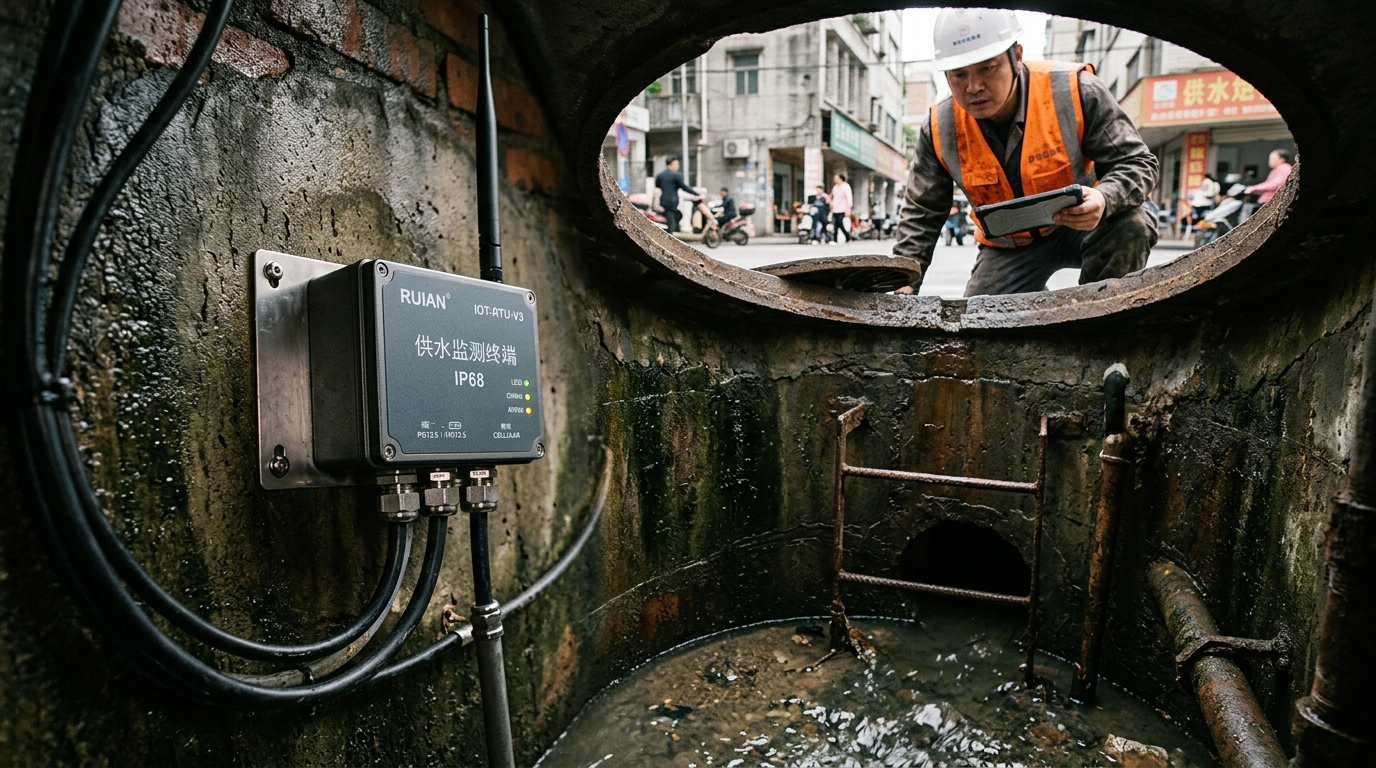
In urban water networks, most monitoring points are not at grade level: they sit inside manholes, valve chambers and intake sumps. Compared with surface hydrological stations, below-grade deployment imposes four hard constraints on an IoT RTU — periodic immersion, corrosive gases such as hydrogen sulphide (H2S), RF shielding by manhole covers and reinforced concrete, and a complete absence of mains power. Field experience shows that most failed smart water projects fail not on sensor accuracy, but because the telemetry terminal did not survive its first storm season. This article walks through the engineering decisions in deployment order.
1. Ingress protection: IP68 is the floor, not the spec
Storm sewers can be fully submerged for 24–72 hours during design rainfall events. The IP68 rating under IEC 60529 only certifies "continuous immersion under conditions declared by the manufacturer", so procurement must pin down two numbers: rated immersion depth (specify ≥3 m) and rated immersion duration (specify ≥72 h), backed by a third-party test report. Prefer fully potted electronics or double O-ring end caps over screw-clamped gasket faces. Cable entries must use metal glands or potted tails — field-applied tape fails within months. For internally mounted antennas, verify that the potting compound does not degrade RF performance: potting materials with a dielectric constant near that of water can cost 2–3 dB of gain in the sub-GHz bands.
2. Communications: ranking link options by real below-grade performance
Manhole covers and shaft walls introduce 10–25 dB of path loss, so link choice directly determines network availability:
- NB-IoT (700/850/900 MHz): lowest penetration loss of the cellular options and usually viable from inside the chamber with a decent antenna. Measure RSRP below the actual cover before committing (target ≥ −110 dBm); NB-IoT coverage is not uniformly dense even inside city limits.
- Private LoRaWAN: well suited to dense pipe-network telemetry where NB-IoT coverage is weak or the utility wants autonomous control. Rooftop or pole-mounted gateways cover 1–3 km in urban terrain, at the cost of operating your own network.
- LTE Cat.1/Cat.4: an order of magnitude more power-hungry; reserve it for pumped stations and retention tanks with mains power, not for battery nodes in manholes.
A proven field technique is the "under-cover antenna": keep the RTU on its wall bracket but route a 1.5–2 m low-loss pigtail so the antenna sits within 5 cm below the cover. This typically improves uplink success by 15–30 percentage points.
3. Power: size the battery for the worst month, not the average
Solar is not an option below grade, so Li-SOCl2 primary cells are the standard. Budget against the worst-case duty cycle: storm-season reporting intervals (e.g. 15 min), 8 s of RF transmission at ~120 mA per report, plus sensor excitation and a quiescent current below 20 μA. A typical 19 Ah pack delivers 3–4 years at a 15-minute interval, aligning with a 3-year maintenance round. In cold climates, derate Li-SOCl2 capacity by roughly 20% at winter temperatures.
4. Corrosion and installation practice
H2S in sewer atmospheres attacks copper, silver and standard stainless grades. For level measurement inside sewers, prefer titanium electrodes or move to non-contact radar/ultrasonic sensing. Specify 316L stainless or glass-filled polycarbonate enclosures, 304-grade brackets with isolation pads to prevent galvanic coupling, and mount hardware at least 50 cm above the highest recorded silt line, clear of falling-water impact zones. All in-manhole work must follow confined-space procedures: ventilate and test for H2S, CH4 and O2, and work in pairs.
Summary
Urban pipe-network RTU deployment is an exercise in balancing a hostile below-grade environment against multi-year maintenance-free operation. Fix four decisions — IP68 selected against real immersion profiles, link technology validated by in-chamber RSRP measurements, batteries budgeted for the worst month, and materials chosen for H2S service — and annual node failure rates below 3% are achievable, providing a dependable sensing layer for urban lifeline and sewer flow monitoring programmes.