Smart Water Management Trend Outlook: Smart Irrigation Reshaping Smart Water Management
China's per capita water resources are approximately 35% of the global average. The uneven spatiotemporal distribution of water resources, compounded by extreme climate events, has led to diminishing marginal returns for the traditional water conservancy construction model focused primarily on engineering expansion. Under the water governance philosophy of "prioritizing water conservation, balancing spatial allocation, implementing systematic governance, and leveraging both government and market forces," smart water management is transitioning from filling informational gaps to restructuring production methods.
A technological system centered on intelligent irrigation, water conservation, water measurement, and informatization is transforming agricultural water use, urban water supply, basin dispatch, and water asset management. Industry observations indicate that smart water management is no longer just a showcase for demonstration projects; it has become a crucial driver for the modernization of irrigation districts, the construction of the National Water Network, the integration of urban and rural water supply, and the upgrading of flood control and disaster reduction systems.
I From Engineering-Based to Data-Driven Water Governance
China possesses a massive scale of water conservancy infrastructure. Public data shows that approximately 95,000 reservoirs of various types and over 7,000 large and medium-sized irrigation districts have been built nationwide, with an effective irrigation area exceeding 1 billion mu. The past construction model, focused mainly on engineering expansion, solved fundamental issues in flood control, water supply, and irrigation, but also created a path dependency characterized by an overemphasis on engineering over sensing, and construction over operation and maintenance. Inaccurate channel water measurement, gate dispatch relying on experience, and the disconnect between irrigation district water allocation plans and actual water use have gradually created bottlenecks in improving engineering benefits.
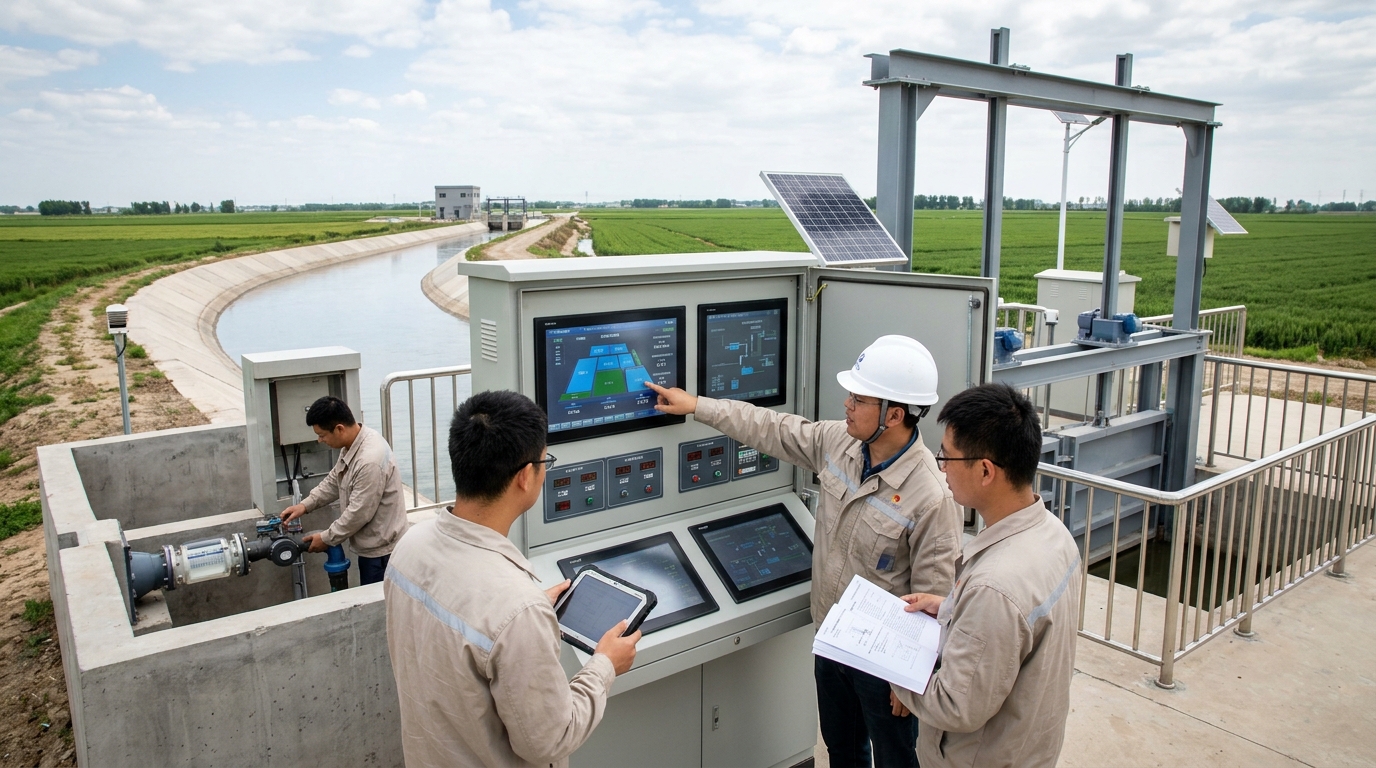
The value of smart water management lies in restructuring business flows with data flows. Through the monitoring of water levels, flow rates, rainfall, soil moisture, video, and engineering conditions, water conservancy objects are integrated into a unified sensing network. Through IoT, cloud platforms, model algorithms, and dispatch systems, monitoring data is transformed into capabilities for forecasting, early warning, rehearsal, and contingency planning. Informatization practices in irrigation districts such as Dujiangyan in Sichuan, Hetao in Inner Mongolia, and Qingtongxia in Ningxia demonstrate that combining water measurement with remote control significantly improves the transparency of water allocation and the speed of dispatch response. Smart water management is moving from point-specific demonstrations to regional-level applications.
II Continuous Strengthening of the Policy Framework
Policy is the primary variable driving the development of smart water management. Documents such as the "14th Five-Year Plan for Water Security," the "Guiding Opinions on Vigorously Promoting the Construction of Smart Water Conservancy," and the "Technical Outline for the Construction of Digital Twin River Basins (Trial)" explicitly identify digitalization, networking, and intelligentization as the directions for water conservancy modernization. The National Water Conservation Action Plan and the rigid constraint system for water resources further strengthen the management of total water use, water use intensity, and ecological flow. Public targets indicate that by 2025, total national water use will be controlled within 670 billion cubic meters, water consumption per 10,000 RMB of GDP will decrease by about 16% compared to 2020, and the effective utilization coefficient of farmland irrigation water will increase to 0.583.
The target to control the leakage rate of urban public water supply networks to within 9% by 2025 further promotes the digital transformation of existing facilities. The more specific the policies, the more the industry shifts from conceptual competition to indicator-based competition.
III Market Trends: Modernization of Irrigation Districts
The first main thread of the smart water management market is the modernization of irrigation districts. China's large and medium-sized irrigation districts undertake the critical task of water conservancy support for grain production, but some districts suffer from aging canal systems, insufficient measurement, and extensive dispatch. With the advancement of continued construction, supporting facilities, and modernization of large and medium-sized irrigation districts, and the maintenance of an annual construction intensity of about 100 million mu for high-standard farmland, informatization of irrigation districts, water measurement, intelligent gates, soil moisture monitoring, and smart irrigation systems have become key procurement directions. The individual project amounts are also increasing; informatization projects for county-level irrigation districts commonly range from several million to tens of millions of RMB, while comprehensive platform projects for large irrigation districts can reach the hundred-million-RMB level.
Urban-Rural Integration
Scaling up rural water supply and achieving the same source, same network, and same services for urban and rural water supply require water source monitoring, water plant automation, pipeline network pressure monitoring, DMA zoning measurement, and leakage analysis platforms.
Funding Models
Special bonds, ultra-long-term special treasury bonds, policy finance, EOD, and contract water conservation management are expanding the sources of funding. The industry expects that from 2024 to 2030, the market for smart irrigation, water measurement, and water conservancy informatization is likely to maintain an average annual growth rate of 10% to 15%.
IV Technological Evolution: Sensing Foundation
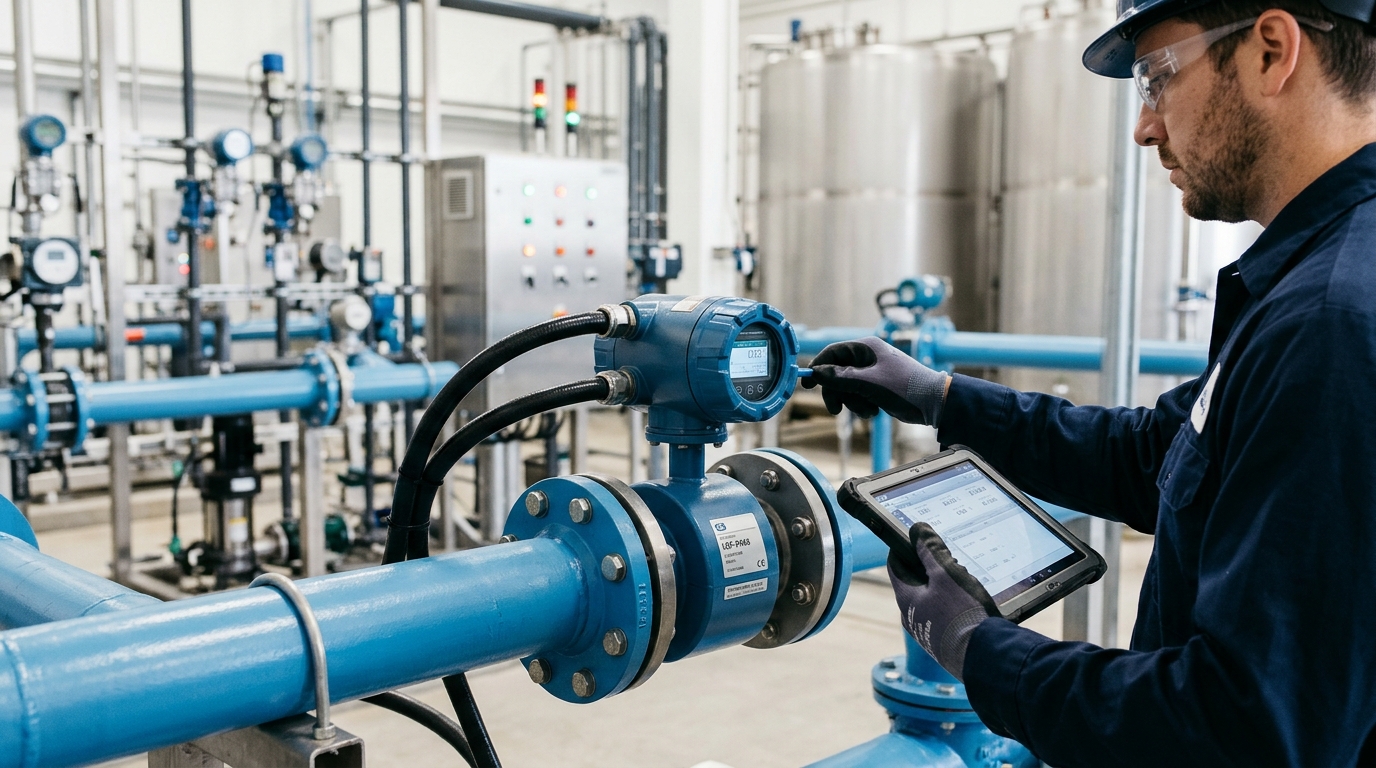
The foundation of smart water management is sensing, and water measurement is the most critical link in the sensing system. Without accurate water volume data, water conservation, allocation, billing, and assessment cannot be effectively implemented. Open channel measurement commonly uses radar water level gauges, ultrasonic water level gauges, Doppler flow meters, and cross-section methods; pipeline measurement typically employs electromagnetic flowmeters and ultrasonic flowmeters; gate water measurement is trending towards the integration of gate opening, water level, and flow rate.
- Radar Water Level Gauges: Resolution can reach the millimeter level.
- Electromagnetic Flowmeters: Accuracy can reach about ±0.5%.
- Ultrasonic Open Channel Flowmeters: Error under standard conditions is usually controlled between ±1% and ±3%.
The actual environment is far more complex than the laboratory. Northern sandy rivers face siltation, southern river networks are affected by tides and aquatic weeds, northwestern irrigation districts experience winter freezing, and mountainous stations face difficulties in power and communication. Therefore, equipment selection must consider protection ratings, anti-siltation capabilities, lightning and frost protection, self-cleaning capabilities, and low-power design. The industry generally requires field equipment to have an IP68 protection rating, solar power combined with lithium battery supply, and data collection frequencies upgraded from the conventional once every 5 minutes to once every 1 minute at key cross-sections. After deploying over 300 water measurement terminals and 150 gate control nodes in a medium-sized irrigation district, the measurement error of main canal water volume was reduced from over 10% to about 5%, and the execution rate of water allocation plans increased by more than 20%.
V Smart Irrigation: Synergistic Optimization
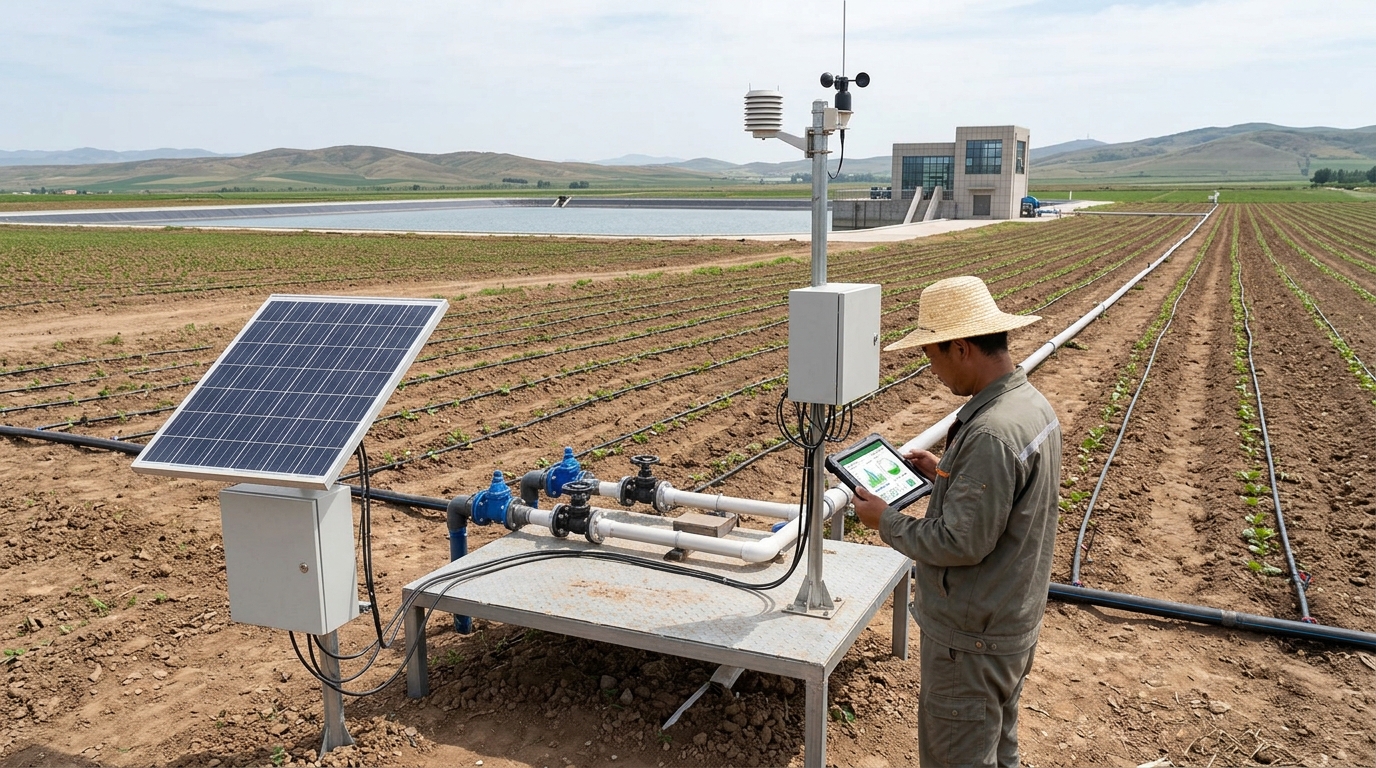
Agriculture is the main battlefield for water conservation. National agricultural water use accounts for over 60% of total water use, and the effective utilization coefficient of irrigation water has increased from 0.516 in 2012 to about 0.576 in 2023, but there is still room for improvement. Traditional flood irrigation and per-mu billing often lead to over-irrigation, deep percolation, and fertilizer loss. Smart irrigation transforms "watering the land" into "watering the crops" through soil moisture, meteorological data, crop water requirement models, and irrigation schedules. In typical designs, soil moisture collection depths are set at three layers: 20 cm, 40 cm, and 60 cm. Irrigation decisions combine evapotranspiration and future rainfall forecasts to generate recommendations for irrigation timing and volume.
Efficiency Gains
- High-efficiency water-saving irrigation typically saves 20% to 50% more water compared to traditional flood irrigation.
- Fertigation can save 10% to 30% in fertilizer.
- In Xinjiang, combining drip irrigation under mulch with automatic rotational irrigation for cotton reduces the per-mu irrigation water use from the traditional over 400 cubic meters to about 250 to 320 cubic meters.
- In the North China winter wheat region, adopting sprinkler irrigation combined with soil moisture monitoring can reduce irrigation by 1 to 2 times, saving about 30 to 60 cubic meters per mu.
In the future, smart irrigation will evolve from point-specific equipment to the synergistic optimization of water, fertilizer, and grain, targeting yield, quality, water footprint, and carbon footprint, thereby shifting agricultural water conservation from administrative requirements to an operational mechanism that is quantifiable, tradable, and replicable.
VI Informatization Platforms: Digital Twins and AI
Informatization platforms solve the challenges of effective dispatch and reliable management. Smart water management platforms are upgrading from GIS displays to digital twin systems, with core components including the data foundation, model platform, knowledge platform, and dispatch interface. The data foundation integrates remote sensing imagery, topographic data, BIM models, monitoring stations, video, and water user information. The model platform includes hydrological models, hydrodynamic models, water resource allocation models, crop water requirement models, and water supply network models. The platform must support the access of millions of measurement points, with key data update frequencies reaching the minute level, and model computation times compressed from the hour level to the minute level.
AI is transforming water conservancy decision-making. In flood control scenarios, when rainfall forecasts, radar echoes, river water levels, and reservoir capacities are fed into the models, the lead time for flood forecasting can be extended from hours to several days, and the rehearsal time for dispatch plans is significantly shortened. In irrigation district scenarios, canal hydrodynamic models can predict water level and flow changes over the next few hours, assisting in gate coordination and reducing water abandonment and conveyance losses. In urban scenarios, pipeline network pressure models and minimum night flow analysis can identify leakage zones. Practices such as the Yellow River water and sediment regulation and the automated dispatch of the Middle Route of the South-to-North Water Diversion Project demonstrate that the platform's value depends on data continuity, model credibility, and closed-loop dispatch capabilities.
VII Business Models and Competitive Landscape
Early smart water management projects primarily focused on equipment sales and system integration, with owners paying attention to hardware parameters and software functions. As projects enter the operational phase, the industry has gradually recognized that sensors age, canals silt up, models drift, and platforms require iteration. Without O&M, system online rates and data accuracy will decline rapidly. Business models are shifting from one-time delivery to EPC+O, franchising, government purchase of services, and contract water conservation management. The proportion of O&M service costs in the total life cycle cost continues to rise, and in some projects, O&M expenditures during the operational phase have already approached a significant proportion of construction investment.
The competitive landscape is also changing accordingly. Traditional water conservancy informatization enterprises, sensor manufacturers, automation equipment suppliers, cloud service providers, design institutes, water affairs groups, and local water investment companies are all participating. A single product can hardly meet the needs of complex scenarios; the industry requires comprehensive capabilities in industry knowledge, algorithmic models, engineering adaptation, and local O&M. Procurement standards are shifting from feature lists to performance indicators, with owners paying more attention to measurement accuracy, equipment online rate, data qualification rate, fault response time, water conservation rate, and leakage reduction rate. Enterprises that can provide standardized interfaces, modular architectures, verifiable data, and long-term O&M commitments will possess a greater competitive advantage.
VIII Forward-Looking Outlook
Looking ahead, smart water management will enter a phase of deep integration with the National Water Network, digital infrastructure, and green low-carbon goals. The construction of the National Water Network is accelerating the implementation of cross-basin and cross-regional water resource allocation projects, and the Digital Twin Water Network will be planned and constructed synchronously with the physical water network. Large-scale water conveyance projects, storage reservoirs, pump station groups, and irrigation district canal systems will no longer operate in isolation but will achieve joint optimization through unified data platforms and dispatch models. The water conservancy industry will also integrate into the computing power network, forming an integrated space-air-ground-water sensing system with remote sensing, drones, video, IoT, and AI models.
At the technical level, large water conservancy models, hyperspectral remote sensing, InSAR deformation monitoring, acoustic leak detection, robot inspection, and autonomous gate control will gradually mature. Platforms will shift from humans reviewing data to systems assisting in decision-making, and achieve automatic dispatch within safety boundaries. At the institutional level, water rights trading, water pricing reforms, water resource taxes, and carbon accounting will further enhance the economic value of water conservation, potentially turning water conservation into a quantifiable, tradable, and financeable asset. Industry observations suggest that the next chapter of smart water management will shift from project construction to water asset operation, and from the stacking of informatization to the long-term value creation of water conservation, water measurement, smart irrigation, and dispatch services.