Electromagnetic Flowmeter Selection and Maintenance: How Much Does the LGF-PA66 Cost?
A comprehensive guide to DN50 electromagnetic flowmeters, market trends, material innovations like LGF-PA66, and full-lifecycle cost analysis for industrial applications.
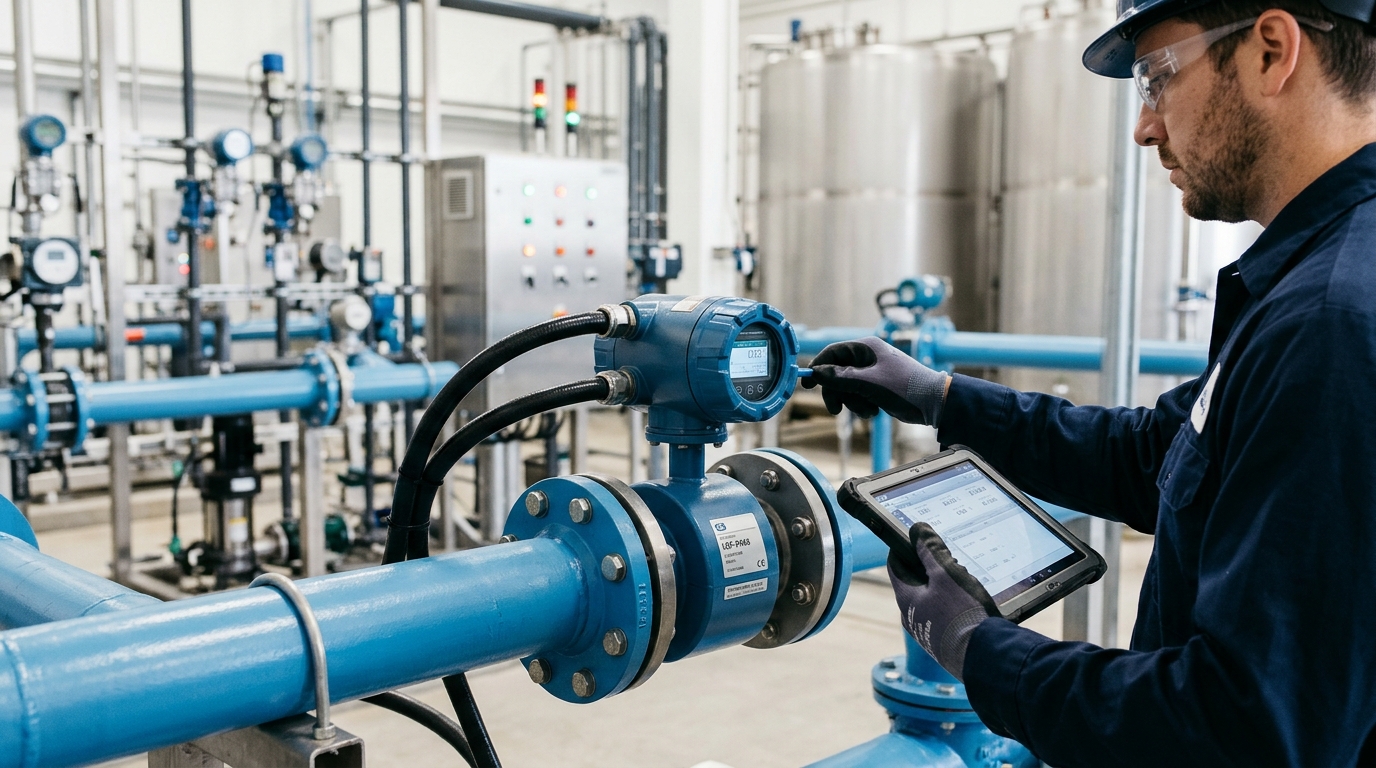
Electromagnetic flowmeters are critical instruments in industrial flow measurement systems, widely used in water treatment, chemical industry, metallurgy, papermaking, food, pharmaceuticals, environmental discharge, and industrial park energy management. In recent years, as environmental regulations tighten and process control accuracy requirements increase, market attention has shifted from merely "whether flow can be measured" to "whether stable long-term measurement is possible, whether complex media can be accommodated, and whether downtime and maintenance costs can be reduced."
In small- and medium-bore applications, specifications such as DN50 are common choices in municipal, industrial wastewater, process batching, and circulating water systems due to flexible installation, moderate flow coverage, and relatively balanced cost-performance. This article explores the electromagnetic flowmeter market through material structure, anti-corrosion configuration, price ranges, selection logic, and maintenance costs, highlighting the shift from single-equipment procurement to systematic selection and long-term operational evaluation.
1. Market Background and Changes in Demand
The core principle of an electromagnetic flowmeter relies on Faraday's law of electromagnetic induction: the induced electromotive force generated by conductive liquid flowing through a magnetic field is measured and converted into velocity and flow rate. Key advantages include no obstruction in the measuring tube, low pressure loss, good adaptability to media containing particles and fibers, and bidirectional flow measurement. Compared with turbine, vortex shedding, and orifice plate meters, electromagnetic flowmeters excel in low-flow velocity, dirty media, corrosive liquids, and slurry applications. However, they require medium conductivity typically greater than 5 μS/cm, making them unsuitable for pure water, oils, gases, or steam.
Process Control Shift
Environmental protection and energy consumption management are pushing measurement from “end-point statistics” to “process control.” Wastewater treatment plants, industrial discharge, and chemical batching now require more reliable real-time data.
Lifecycle Cost Focus
Procurement departments increasingly focus on calibration intervals, spare part prices, failure rates, downtime losses, and labor maintenance costs over three to five years rather than just initial purchase price.
Complex Media Challenges
Acids, alkalis, salt solutions, plating solutions, solids-containing slurries, and high-temperature liquids coexist, placing higher demands on liners, electrodes, enclosure protection, and grounding design.
Therefore, competition in the electromagnetic flowmeter market is no longer just price competition, but comprehensive competition in material compatibility, structural reliability, installation services, and full-lifecycle cost.
2. Price Ranges of DN50 and Other Small- and Medium-Bore Electromagnetic Flowmeters
The price of an electromagnetic flowmeter is strongly influenced by bore size, liner, electrodes, protection rating, signal output, explosion-proof requirements, communication protocol, installation method, and brand positioning. Taking DN50 (nominal diameter 50 mm) as an example, under full-pipe conditions, a flow velocity of 0.5 m/s corresponds to approximately 3.5 m³/h; 1 m/s is ~7.1 m³/h; 3 m/s is ~21.2 m³/h; and 5 m/s is ~35.4 m³/h. DN50 is commonly used for branch-line metering, chemical dosing, circulating water, wastewater reuse, and small process pipelines.
"If users compare only the unit price of the instrument, they may underestimate the actual investment, especially when considering large-bore projects where total installation cost often exceeds the instrument price."
| Application / Type | Price Range (CNY) | Key Features |
|---|---|---|
| Standard Municipal/Industrial Water | 2,500 - 7,000 | Rubber/PTFE liner, 316L electrodes, IP68, 4-20mA + Pulse |
| Enhanced Standard (Empty Pipe Det., RS485) | 6,000 - 12,000 | Wider rangeability, higher accuracy, special grounding |
| Anti-Corrosion DN50 | 8,000 - 25,000 | PFA/PTFE/Ceramic liners, Special alloy electrodes |
| High-End / Imported Brands | 15,000 - 45,000+ | Sanitary, Explosion-proof, High-accuracy, Premium support |
As bore size increases, price does not necessarily rise linearly, but installation risk and transportation cost increase significantly:
- DN15 - DN25: ~1,500 - 5,000 CNY
- DN80 - DN150: ~3,000 - 12,000 CNY
- DN200 - DN400: ~8,000 - 30,000 CNY
- Above DN500: 20,000 - 80,000+ CNY (plus flanges, supports, grounding rings, pipe stress considerations)
3. Material and Process Changes: LGF-PA66 and Injection-Molded Integral Structures
In electromagnetic flowmeter structures, the enclosure, terminal box, brackets, and local insulating components significantly impact long-term reliability. Recently, some small- and medium-bore integral designs have begun using LGF-PA66 (Long-Glass-Fiber-Reinforced Polyamide 66). Compared to ordinary nylon 66, LGF-PA66 offers higher rigidity, dimensional stability, and creep resistance, maintaining structural stability in humid, vibrating, and temperature-changing environments.
Injection-Molded Integral Structure
Traditional metal enclosures use multiple sheet-metal parts and fasteners, creating many sealing points prone to water ingress and corrosion. Injection-molded integral enclosures reduce assembly steps, improve sealing-face consistency, and facilitate integration of cable entries and grounding posts. For DN50 products, this helps achieve IP67/IP68 protection more easily and reduces production cycle time.
Application Boundaries
LGF-PA66 is suitable for structural components not directly exposed to wet process media (enclosures, covers, brackets). It cannot replace anti-corrosion liner (PTFE, PFA, Rubber) and electrode (316L, Hastelloy, Tantalum) design. Users must distinguish between "enclosure corrosion protection" and "process medium corrosion protection."
Many field failures are not caused by water ingress into the housing, but by liner swelling, electrode passivation, terminal corrosion, or poor grounding leading to signal drift. While injection-molded integral structures offer weight reduction and improved insulation, material limits regarding high temperature, strong UV exposure, and mechanical impact must still be evaluated.
4. Selection Boundaries for Anti-Corrosion Electromagnetic Flowmeters
Anti-corrosion flowmeters are essential in chemical, electroplating, pharmaceutical, dyeing, metallurgical pickling, seawater desalination, and desulfurization slurry applications. Corrosion protection is a system composed of liner, electrodes, flange seals, grounding rings, and enclosure protection.
Liner Material Guide
- Natural Rubber: General water, weakly corrosive media, good wear resistance.
- Neoprene: Wastewater containing particles.
- PTFE: Broad chemical resistance, low friction, suitable for most acids/alkalis/solvents.
- PFA: Better temp/chemical resistance than PTFE, higher cost.
- Ceramic: Combined high-wear and strong-corrosion conditions.
Electrode Material Guide
- 316L: General water, sewage, weakly corrosive liquids (Cost-effective).
- Hastelloy: Strongly corrosive media (HCl, chloride ions).
- Titanium: Chlorine-containing media (Avoid dry chlorine/strong oxidizers).
- Tantalum: Strong acids and some organic acids.
- Platinum-Iridium: High-purity, sanitary, strongly corrosive apps.
The price of anti-corrosion DN50 products is usually higher (approx. 12,000 - 28,000 CNY for small-flow strong corrosion lines) due to material costs and manufacturing precision. The core of anti-corrosion selection is not "the more expensive, the safer," but "matching the material combination to the medium." Incorrect selection can cause electrode failure within months, while correct selection ensures stable operation for years.
5. Selection Advice: Operating Conditions, Accuracy, Installation & Usability
Step 1: Confirm Medium Conductivity
Generally requires > 5 μS/cm. Pure water, deionized water, alcohol, oils, and gases are not suitable for conventional electromagnetic flowmeters. Low-conductivity conditions may require special excitation designs.
Step 2: Analyze Physical Parameters
Confirm temperature, pressure, solids content, and flow velocity. DN50 is ideal for small flows. If velocity is consistently below 0.3 m/s, signals may be weak; above 5 m/s or with particles, wear risks increase. Ensure full-pipe conditions; air pockets or half-full flow require different solutions.
Step 3: Accuracy & Output Signals
Look at "rangeability" and "minimum measurable velocity," not just nominal accuracy (±0.5%, ±0.3%). For trade metering, choose wider rangeability. Outputs: 4-20 mA (DCS), Pulse (Totalizing), RS485 (Fieldbus/Remote), HART/Wireless (Retrofit). Evaluate shielding and surge protection if VFDs or lightning risks exist.
Step 4: Installation Best Practices
- Straight pipes: Upstream 5D-10D, Downstream 2D-5D.
- Grounding: Resistance < 10 Ω for metal pipes; use grounding rings for insulating pipes.
- Avoid pump outlet vibration zones and high points where air accumulates.
- Outdoor: Implement shading, condensation prevention, and rodent protection even with IP68 enclosures.
6. Maintenance Cost Analysis: Spare Parts, Calibration, Downtime & Risk
Maintenance costs are often underestimated. Annual accuracy checks are recommended (every 6 months for critical metering). Typical items include zero/full-scale checks, liner inspection, electrode cleaning, grounding measurement, and cable insulation testing.
The Hidden Cost of Downtime
Example: A DN50 flowmeter failure causing 4 hours of line stoppage with a process loss of 5,000 CNY/hour results in a direct loss of ~20,000 CNY. If batch scrapping or safety interlocks are involved, losses escalate rapidly.
Spare Part Economics
Liner replacement: 15-35% of meter price.
Electrode replacement: 10-25%.
Converter main board: 20-40%.
Special alloys/PFA liners have higher lead times and costs.
For critical points, consider redundant installation, quick-change flanges, or remote diagnostics. Non-critical points can be managed via condition monitoring and periodic inspections. Maintenance cost analysis should cover a 3-5 year cycle.
7. Case Observations: Municipal, Chemical, and Electroplating Scenarios
Case 1: Industrial Park Wastewater Reuse (DN50)
Medium: Reclaimed water, ~800 μS/cm, ambient-45°C, suspended solids.
Config: PTFE liner, 316L electrodes, IP68, 4-20mA + RS485.
Outcome: Initial quote ~4,800 CNY. After 6 months, output was high by 2-3% due to biofilm. Cleaning restored error to <0.5%. Adjusted to quarterly cleaning. Annual maintenance cost: 800-1,500 CNY. Lesson: Maintenance here is primarily cleaning/calibration, not part replacement.
Case 2: Chemical Acid Batching Line (DN50)
Medium: Acidic salt solution, Cl- ions, intermittent, ambient-60°C.
Initial Fail: PTFE/316L failed after 3 months (passivation/corrosion).
Improved Config: PFA liner, Hastelloy electrodes, anti-corrosion terminal box. Cost rose to ~18,000 CNY.
Outcome: Continuous operation extended. Annual maintenance dropped from 6,000 to 2,500 CNY. Lesson: Higher material cost buys lower downtime risk.
Case 3: Electroplating Wastewater Station (DN50)
Medium: Heavy metals, acids/alkalis, fine particles.
Initial Fail: Rubber/316L worn out in 6 months (error >5%). Cost ~3,200 CNY.
Improved Config: Polyurethane wear-resistant liner. Cost rose to ~7,000 CNY.
Outcome: Cleaning cycle extended from monthly to quarterly. Lesson: For solids-containing wastewater, wear control is often more critical than corrosion control.
8. Outlook: Intelligentization, Compliance, and Full-Lifecycle Cost
The future electromagnetic flowmeter market will develop toward intelligentization, standardization, and full-lifecycle cost optimization. Instruments are integrating self-diagnosis, empty-pipe alarms, excitation anomaly detection, and electrode fouling recognition. For DN50 applications, intelligent converters can detect zero drift and signal noise in advance, reducing manual inspection blind spots.
Material innovations like LGF-PA66 and injection-molded enclosures provide balance between cost and reliability. However, innovation must be based on verification under real operating conditions. Concepts like "corrosion resistance" cannot replace systematic evaluation of medium concentration, temperature, and redox potential.
Strategic Procurement Advice
Enterprises should establish rational evaluation models. Initial price is only part of the cost. Calibration intervals, spare part availability, failure downtime, and data reliability are equally important. For critical process points, recommend redundant configuration or quick-change designs. For general monitoring, select economical configurations with established inspection regimes. The market is shifting from "selling instruments" to "providing reliable measurement data," where value is reflected in long-term stable operation and process management efficiency.