Radar Level Meter Selection Guide: Installation & Commissioning for Reservoir Environments
Monitoring water levels in reservoir environments requires precise radar level meter selection to overcome unique challenges like wind waves, ice cover, and large surface areas. Unlike traditional sensors, modern radar technology offers non-contact measurement and high reliability, making it the preferred solution for dam safety assessments and flood control operations. This guide details the optimal frequency band choice, installation strategies, and commissioning protocols for accurate long-term performance.
Unique Challenges of Reservoir Water Level Monitoring
Reservoirs serve as critical nodes for flood control and water resource allocation, where monitoring accuracy directly impacts dam safety. Unlike rivers or open channels, these environments feature vast water surfaces, significant level fluctuations, and strong wind-wave interference. Remote locations often lack stable power and communication infrastructure, complicating data transmission.
Traditional float-type gauges suffer from mechanical wear and freeze-lock issues, while submersible sensors face errors from thermal stratification. In recent years, radar level meters have emerged as the superior alternative due to their maintenance-free operation and ability to handle harsh conditions without physical contact with the water.
26 GHz Radar Level Meters
Operating with a beam angle of approximately 6°–8°, these meters illuminate a diameter of 3–4 m at a 30 m range. The mature technology offers a lower cost, making them suitable for small to medium reservoirs with limited budgets. However, the wider beam may struggle with multipath reflections in complex structures.
80 GHz Radar Level Meters
With a narrow beam angle of only 3°–4°, the illumination diameter shrinks to 1.5–2 m at 30 m. This precision provides superior performance in confined spaces like stilling wells and offers stronger immunity to wave interference. They are recommended for large reservoirs requiring ±2 mm accuracy.
Engineering Recommendation for Frequency Bands
For reservoir applications, 80 GHz radar level meters are strongly preferred despite a 30%–50% higher unit cost. The narrow beam angle effectively mitigates multipath reflections from dam structures, gate hoists, and other metallic installations that plague lower-frequency models.
This configuration delivers superior long-term data quality, which is essential for high-fluctuation scenarios and large capacity reservoirs exceeding 100 million m³. The investment ensures reliable measurements even under extreme weather conditions.
Installation Position Optimization
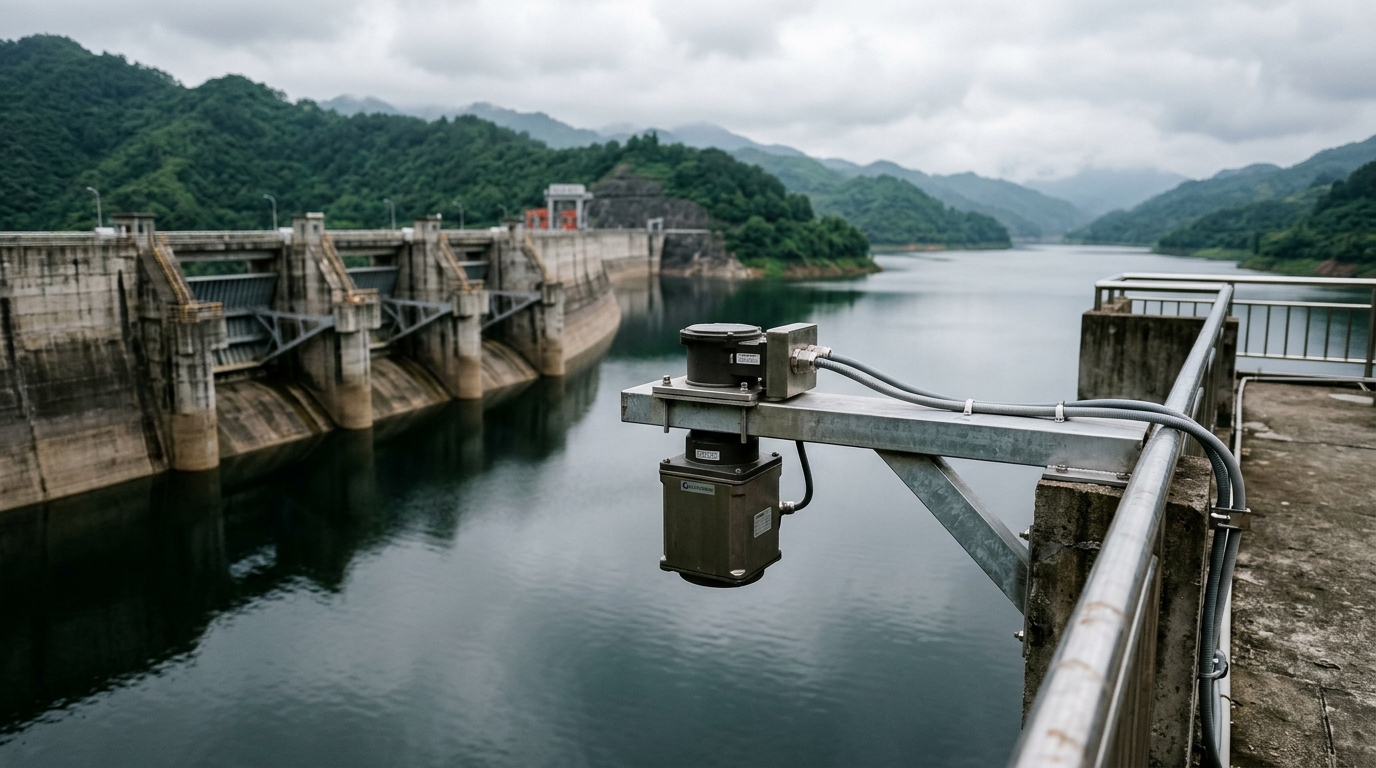
The installation position of a reservoir radar level meter directly affects measurement accuracy and long-term reliability. Proper placement avoids turbulence zones near spillways and ensures a clear vertical beam path.
Mounting Height
Install at least 0.5 m above the historical maximum flood level to prevent submersion. Maintain a distance to the lowest water level not exceeding 80% of the instrument's maximum range.
Horizontal Position
Prioritize the upstream face or stable bank slopes. Extend the mounting bracket at least 1 m from the dam face to ensure an unobstructed signal path.
Stilling Well Installation
If used, the inner diameter must be ≥150 mm with vertical deviation ≤1°. The 80 GHz radar offers greater tolerance for inner wall roughness.
Lightning Protection
Integrate brackets and cables into the dam's grounding grid. Ensure ground resistance is ≤4 Ω to protect against lightning strikes in mountainous areas.
Field Commissioning Essentials
Accurate commissioning begins with reference height calibration using a total station or laser rangefinder. Enter the precise distance from the sensor emission surface to the current water surface and verify linearity deviation at three different levels (≤0.05%).
To address false echoes from gates or trash racks, record interference distances and program them into the suppression table. Configure damping time constants between 5–15 seconds to filter out wind-induced noise while capturing genuine trends.
Data Transmission and Power Supply Design
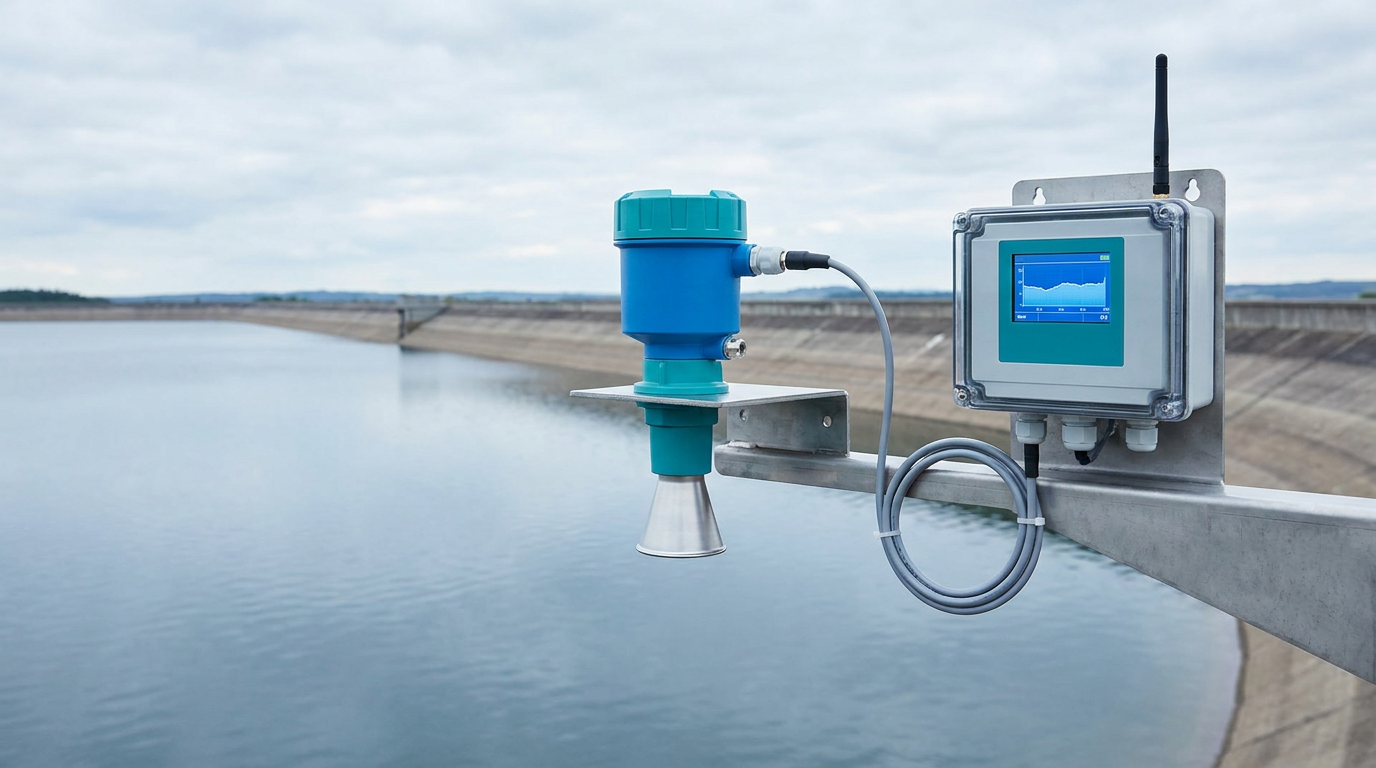
Connect the radar level meter to the RTU via RS-485 (Modbus RTU) or 4–20 mA output. Digital Modbus RTU is recommended as it simultaneously transmits water level, signal strength, and diagnostic data.
For remote sites, a solar + battery solution is ideal. A typical 80 GHz radar consumes ≤0.5 W; pairing a 30 W solar panel with a 40 Ah battery sustains over 15 consecutive days of overcast weather. Configure reporting intervals to ≥15 minutes normally, reducing to 5 minutes during floods or for events >5 cm change.
Conclusion
Selecting and installing a radar level meter for reservoir applications is a systematic engineering task spanning frequency band selection, installation optimization, and data integration. The 80 GHz model, with its narrow beam and high accuracy, is becoming the standard for large reservoir monitoring.
Adhering to proper installation design and standardized commissioning procedures ensures long-term, stable equipment operation, safeguarding dam safety and water resource management.