Urban drainage networks are the least instrumented segment of municipal water infrastructure. While distribution systems routinely reach near-full flow metering coverage, sewer monitoring coverage in most cities remains below 5%. The gap is not a sensor problem — it is a systems engineering problem driven by four hostile constraints.
The Four Constraints of Sewer Instrumentation
Corrosion and submersion. Microbially induced corrosion converts H2S into sulfuric acid on wet well surfaces, attacking concrete and carbon steel at measurable rates per year. Field equipment must be rated IP68 per IEC 60529 for prolonged immersion, with 316L stainless steel or GRP mounting hardware. Standard industrial enclosures designed for splash exposure (IP65) fail within one to two flood seasons.
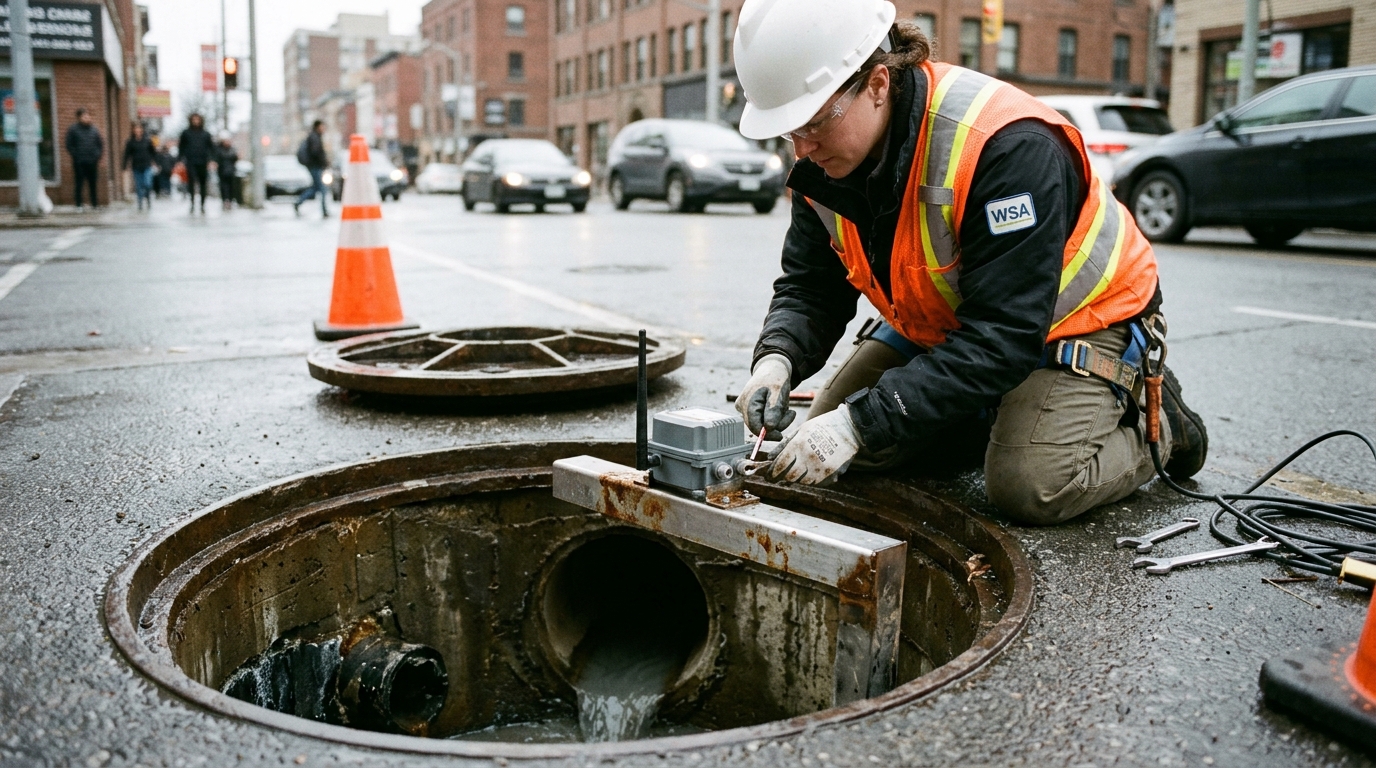
RF attenuation in manholes. Measured NB-IoT path loss under concrete manhole covers increases by 20–35 dB compared with above-ground installation. Antennas must be routed to a manhole-collar position; any design assuming in-pit transmission is unreliable. This single constraint disqualifies many "smart water" catalog products from below-grade duty.
Power. No mains supply exists at sewer nodes, and pit-level solar is both shaded and theft-prone. Lithium primary cells with device sleep current in the low microampere range remain the only dependable architecture, targeting 5-year service life at 15-minute reporting intervals.
Cost versus density. Waterlogging early warning and CSO source tracing require node spacing of 300–500 m along trunk sewers. Full water-level-plus-flow stations at every node make large-scale Urban Drainage Monitoring economically unviable.
A Tiered Deployment Framework
The practical answer is to allocate budget by hydraulic significance rather than uniformly:
- Tier A — trunk control sections (~40% of budget): Non-contact radar level plus Doppler velocity monitoring at key trunk cross-sections, establishing stage-discharge rating curves that anchor the entire district's hydraulic model.
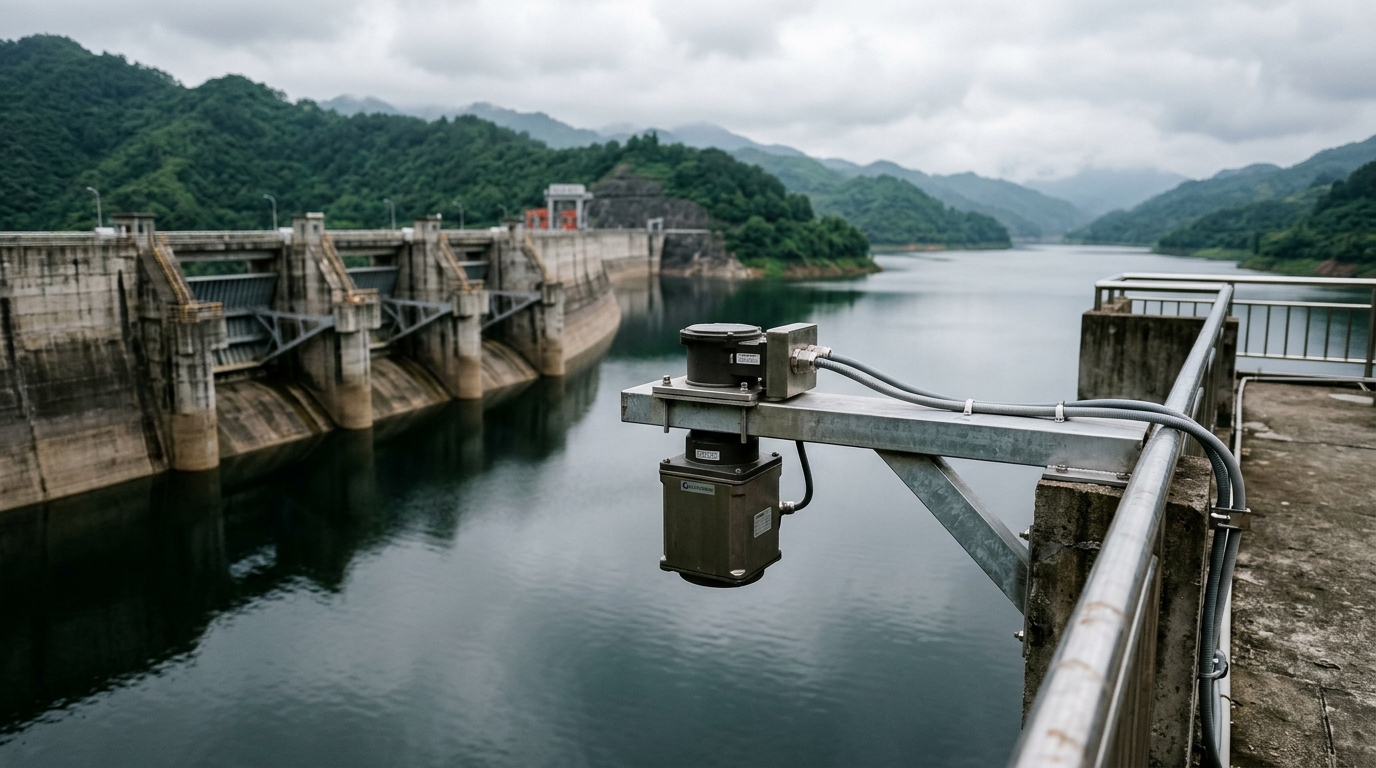
- Tier B — critical nodes (~30%): Level-only monitoring at inverted siphons, junction chambers and upstream of known flood-prone points, using 80 GHz radar level sensors (narrow beam, small blanking distance — ideal for manhole-collar mounting) with IP68 IoT RTU and NB-IoT uplink.
- Tier C — dense reconnaissance (~30%): Low-cost pressure or ultrasonic level loggers on branch sewers, accepting ±2 cm accuracy but gaining 4× node density for overflow tracing and model calibration — a core Low-cost Sensing strategy.
In a pilot district of a prefecture-level city, this framework reduced blended per-point cost from roughly ¥32,000 to ¥8,000–12,000 while quadrupling monitoring density; flood warning lead time improved from under 10 minutes to 25–40 minutes.
Link Budget and Data Quality Discipline
Before procurement, validate the radio link: with NB-IoT maximum coupling loss of 164 dB, subtract the measured manhole penalty and require at least 10 dB margin; where insufficient, switch to LoRa with a street-level gateway. On the data side, RTUs should perform edge-side outlier rejection and gap flagging so the platform never ingests raw spurious values — poor data quality erodes operator trust faster than sensor failure does. Quarterly review of battery voltage curves and radar echo strength predicts fouling and condensation-related degradation before it becomes an outage.
Conclusion
Scaling sewer monitoring is an exercise in engineering judgment: match sensor class to hydraulic role, prove the RF link with measured attenuation data, and design for a five-year unattended battery life. Done correctly, tiered radar-based networks deliver Urban Lifeline-grade observability at a cost profile municipal budgets can actually sustain.