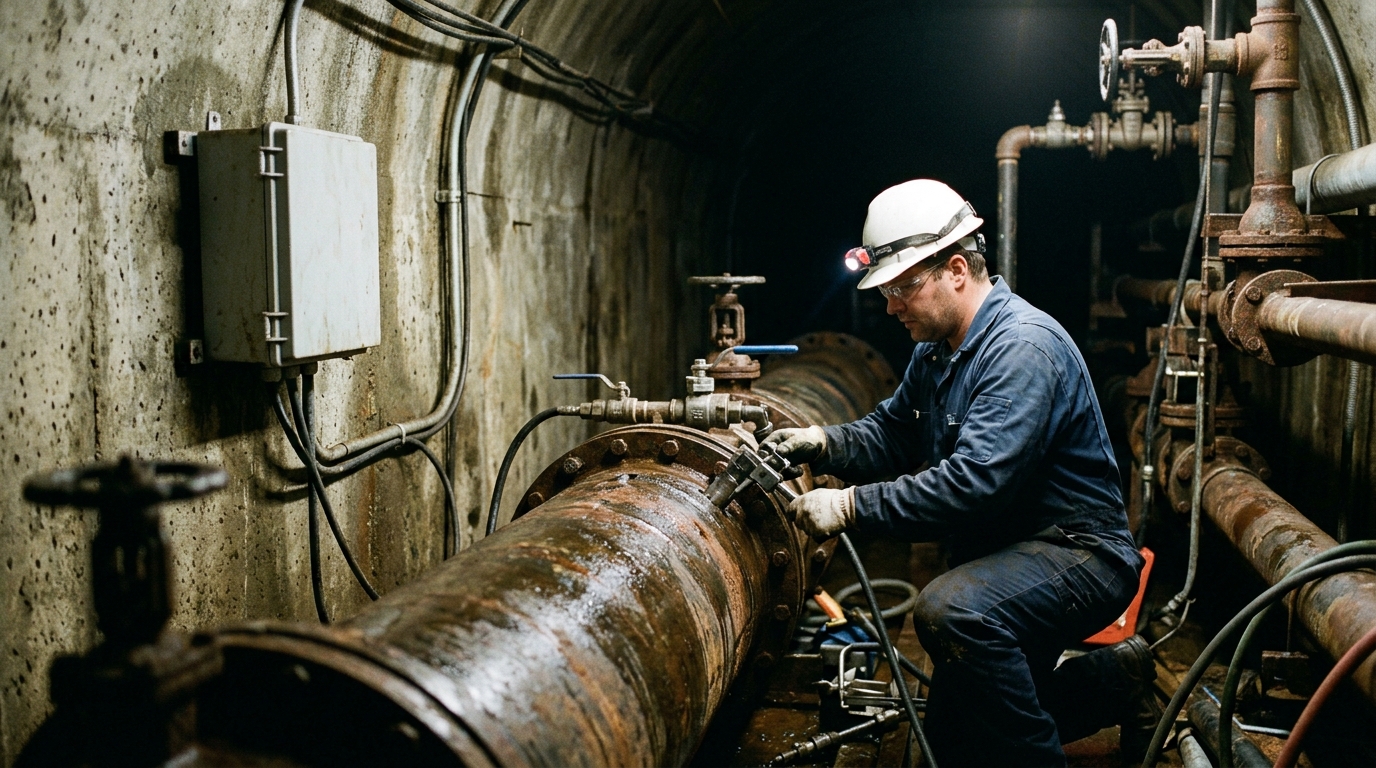
Insertion Ultrasonic Flow Meter Solution for Low-Cost Metering of Large-Diameter Water Transmission Mains
Addressing the high purchase and installation cost of full-bore flow meters on large-diameter water transmission mains, long shutdown windows for pipe cutting, and the lack of metering on aging pipe sections, this solution deploys insertion ultrasonic flow meters as the core metering units. Installation only requires drilling two holes on the pipe surface, and with a dedicated tapping tool the sensors are hot-tapped under pressure without stopping the flow. With the sensor in direct contact with the fluid, measurement is stable and reliable, covering DN32-DN6000 at 1.0% accuracy. Working with RTU telemetry terminals and a flow metering management platform, it delivers low-cost online flow metering and leakage assessment data for raw water and treated water transmission mains.
Overview
Summary
Addressing the high purchase and installation cost of full-bore flow meters on large-diameter water transmission mains, long shutdown windows for pipe cutting, and the lack of metering on aging pipe sections, this solution deploys insertion ultrasonic flow meters as the core metering units. Installation only requires drilling two holes on the pipe surface, and with a dedicated tapping tool the sensors are hot-tapped under pressure without stopping the flow. With the sensor in direct contact with the fluid, measurement is stable and reliable, covering DN32-DN6000 at 1.0% accuracy. Working with RTU telemetry terminals and a flow metering management platform, it delivers low-cost online flow metering and leakage assessment data for raw water and treated water transmission mains.
Key Advantages
Challenges
- Transmission mains are mostly DN800-DN3000; flanged full-bore meters such as electromagnetic flow meters are expensive and metering investment rises linearly with diameter
- Full-bore installation requires pipe cutting, shutdown, draining and flange work; shutting down a transmission main jeopardises city water security, with long construction cycles and high coordination costs
- Aging pipe sections with internal scaling and complex linings give clamp-on meters unstable acoustic coupling and poor signal-to-noise ratio, with marked measurement errors at large diameters
- Metering points along transmission routes are remote, lacking mains power and communications, so conventional instruments cannot achieve online telemetry and remote O&M
- Trunk pipe nodes have long lacked continuous metering, leaving distribution water accounting, leakage assessment and DMA zone balance analysis without data support
Results
- Insertion measurement requires only two holes drilled on the pipe surface; with the tapping tool the sensor is installed hot under pressure - no cutting, no flange retrofit - cutting deployment time by more than 60% versus full-bore solutions
- The sensor contacts the fluid directly, immune to clamp-on acoustic coupling problems; full DN32-DN6000 coverage at accuracy up to 1.0% keeps large-bore metering stable
- Per-point insertion metering drastically lowers purchase and installation cost - a fraction of a flanged full-bore meter - fitting budget-constrained trunk metering densification
- Isolated RS485/Modbus and 4-20 mA outputs with low-power design suit solar-powered RTU telemetry, bringing remote off-grid points online
- Continuous node metering supports distribution water reconciliation, leakage assessment and DMA zone balance analysis, significantly raising the water utility management level
Solution Details
Insertion Ultrasonic Flow Meter Solution for Low-Cost Metering of Large-Diameter Water Transmission Mains
Large-diameter transmission mains are the arteries of urban water supply systems, and their flow metering directly determines water production and distribution accounting, network leakage control and dispatch optimisation. For years, metering large-bore pipelines has faced a fundamental contradiction: flanged full-bore electromagnetic flow meters above DN800 are expensive, and metering investment rises linearly with pipe size; installing a full-bore meter requires cutting the pipe, shutting down and draining the main, and flange construction - a shutdown on a transmission main jeopardises city water security, with long construction windows and high coordination costs; aging pipe sections with internal scaling and complex linings give clamp-on ultrasonic meters unstable acoustic coupling and poor signal-to-noise ratio, with marked measurement errors at large diameters; and metering points along transmission routes are often remote, lacking mains power and communications, making conventional instruments hard to bring online. As a result, most trunk pipe nodes have long lacked continuous metering, leaving water accounting, leakage assessment and DMA zone balance analysis without a data foundation.
This solution deploys insertion ultrasonic flow meters as the core metering units at key nodes of the transmission main. The system consists of a wall-mounted IP67 transmitter and insertion sensors: only two holes need to be drilled on the pipe surface, and with a dedicated tapping tool the sensors are installed under pressure - no shutdown, no pipe cutting, no draining. The sensor contacts the fluid directly and measures by the ultrasonic transit-time principle with accuracy up to 1.0%, covering pipe diameters from DN32 to DN6000 mm, suitable for steel, stainless steel, cast iron, copper, PVC, aluminium, FRP and all other dense pipes, linings permitted, with fluid temperature -30 to 160 degrees C and flow velocity 0 to +/-10 m/s supporting bidirectional measurement. Metering data are sent through isolated RS485 (Modbus), 4-20 mA, OCT pulse and relay outputs to RTU telemetry terminals, reported via 4G or Ethernet to the flow metering management platform, with solar power available at remote points without mains supply; an SD card stores parameters and measurement data on schedule as a second data channel. Continuous metering at trunk nodes supports distribution water reconciliation, leakage assessment and DMA zone balance analysis, delivering metering densification and refined management of large-bore networks at a very low per-point metering cost.
Key Specifications of the Insertion Ultrasonic Flow Meter
DN32-DN6000
Pipe Diameter Range
Up to 1.0%
Measurement Accuracy
-30 to 160°C
Fluid Temperature
0 to ±10 m/s
Flow Velocity (Bidirectional)
IP67
Transmitter Protection
DC 8-36 V / AC 10-30 V
Power Supply
Product Features of the Insertion Ultrasonic Flow Meter
- Hot-tap insertion installation: only two holes on the pipe surface; with the dedicated tapping tool the insertion sensor is mounted under pressure - no shutdown, no draining, no pipe cutting, minimal construction
- Direct-contact stable measurement: the sensor touches the fluid directly and uses the ultrasonic transit-time principle with accuracy up to 1.0%, strong anti-interference, stable and reliable operation
- Full-diameter adaptability: DN32-DN6000 mm pipe diameters; steel, stainless steel, cast iron, copper, PVC, aluminium, FRP and all dense pipes permitted, linings allowed; fluid temperature -30 to 160 degrees C
- Bidirectional flow measurement: 0 to +/-10 m/s velocity range with forward and reverse measurement, suited to transmission mains where flow direction may change
- Rich interfaces, easy networking: isolated RS485 (Modbus), 4-20 mA, OCT pulse and relay outputs; IP67 wall-mounted transmitter integrates seamlessly with RTU telemetry terminals, SCADA and metering management platforms
- Low-power flexible supply: DC 8-36 V or AC 10-30 V, SD card scheduled storage of parameters and measurement data, suited to solar-powered remote telemetry deployment
Applications and Benefits of Insertion Ultrasonic Flow Metering
This insertion ultrasonic flow meter solution is designed for low-cost metering of large-diameter water transmission mains. By deploying insertion sensors at key trunk nodes, it enables continuous metering that supports distribution water reconciliation, leakage assessment and DMA zone balance analysis. The hot-tap installation method eliminates the need for shutdown, pipe cutting or draining, dramatically reducing construction time and coordination costs. With a wide diameter range, broad pipe material compatibility and flexible power options including solar, this solution delivers metering densification and refined management of large-bore networks at a very low per-point metering cost.
? References
- Insertion Ultrasonic Flow Meter Solution for Low-Cost Metering of Large-Diameter Water Transmission Mains
Approach
How we implement intelligence into your infrastructure step by step.
Trunk metering point survey and selection design
Survey the diameter, pipe material, wall thickness and lining condition of the large-bore transmission main; determine insertion metering points and installation positions, avoiding upstream flow disturbances, verify straight-run requirements, calculate sensor insertion depth, and produce the trunk metering point design and selection plan.
Hot-tap drilling and sensor installation
Using the dedicated tapping tool, drill two holes on the pipe under pressure, install ball valves and insertion sensors with no shutdown or draining; verify sensor insertion depth and orientation to align the ultrasonic path, and complete sealing and fastening checks.
Transmitter configuration and data networking
Configure pipe diameter, wall thickness, lining and other parameters in the IP67 wall-mounted transmitter; verify zero-flow and operating readings on site. Metering signals go through RS485/4-20 mA to RTU telemetry terminals, reported via 4G or Ethernet to the flow metering management platform; solar power is configured at remote points.
Metering comparison and leakage baseline
During commissioning, run parallel comparisons against portable ultrasonic meters or existing full-bore meters to verify insertion metering accuracy; establish continuous metering baselines at trunk nodes, and configure distribution water reconciliation rules and minimum night flow leakage alarm thresholds.
Long-term operation and data application
Establish sensor inspection and cleaning logs; periodically download SD card data and cross-check against platform data. Continuous metering keeps supporting DMA zone balance analysis, network leakage control assessment and distribution dispatch optimisation, ensuring stable and reliable trunk metering over the long term.
Recommended Hardware
Essential components for this solution.
❓ Related FAQs
Related Solutions
Split-Type Electromagnetic Flow Meter Solution for Pump Stations with High Humidity and Heavy Vibration
Inline Ultrasonic Flow Meter Solution for Pump Station Discharge Metering and Pump Efficiency Testing
Doppler Ultrasonic Flow Meter Solution for Flow Monitoring in Partially Filled Municipal Drainage Conduits

Ready to Optimize Your Business?
Contact us, and our professional team will provide customized solutions to help your business achieve digital transformation.
Get In Touch