2026 Development Opportunities for Low-Carbon Parks in the Context of the Dual Carbon Goals
Driven by the "dual carbon" goals, the green transformation of manufacturing, energy price fluctuations, and increasingly stringent international trade carbon rules, low-carbon parks are evolving from isolated energy-saving and carbon-reduction demonstration projects into critical infrastructure for industrial space governance, energy system optimization, carbon asset management, and supply chain compliance. In the past, parks focused on energy consumption indicators, energy costs, and environmental compliance; today, carbon emission intensity, the proportion of green electricity, product carbon footprints, online monitoring of greenhouse gases, and carbon accounting capabilities are becoming new dimensions to measure park competitiveness.
Yicai Technology Industry Observation believes that the core change in low-carbon park construction lies in the shift from "engineering renovation" to "systematic operation." Parks are no longer just about installing photovoltaics, energy storage, heat pumps, or replacing high-efficiency motors; rather, they must establish a full-process data system covering energy input, conversion, transmission, consumption, and emissions, forming a carbon management capability that is accountable, monitorable, traceable, and optimizable. This shift means that low-carbon parks are becoming complex scenarios where energy systems, industrial organization, digital governance, and financial tools converge.
From a market perspective, the demand subjects for low-carbon parks are expanding. Local governments and park management committees are promoting green upgrades, while manufacturing enterprises are actively participating to meet customer carbon requirements, export compliance, and green supply chain audits. Particularly in industries such as electronics, automotive, chemicals, building materials, textiles, and equipment manufacturing, carbon management at the park level has shifted from a "bonus item" to a "mandatory requirement." In the coming years, low-carbon parks will enter a new phase shaped jointly by policy, market, and data drivers.
I. Market Trends: Shifting from Point-Specific Energy Saving to Systematic Carbon Reduction, Making Parks the Main Battlefield for Green Transformation
The first trend in the low-carbon park market is the shift from point-specific energy-saving renovations to systematic carbon reduction. Early park energy-saving projects mostly focused on localized aspects such as lighting retrofits, boiler retrofits, air compressor energy savings, and motor system optimization, with benefits mainly derived from reduced electricity bills. As carbon emission constraints tighten, parks are beginning to conduct holistic designs across five dimensions: energy structure, industrial structure, energy consumption patterns, resource recycling, and carbon management. Technologies such as distributed photovoltaics, behind-the-meter energy storage, waste heat recovery, heat pumps, microgrids, and smart energy-carbon platforms are being integrated to form a unified "source-grid-load-storage-carbon" system.
Parks have become the main battlefield for low-carbon transformation because their energy consumption and carbon emissions are highly concentrated. Public data shows that China has over 400 national-level economic and technological development zones and national high-tech zones; if provincial and municipal-level industrial parks are included, the number reaches into the thousands. Industry estimates generally indicate that the energy consumption and carbon emissions of key industrial parks account for a high proportion of the national industrial sector, with some studies estimating that park-level carbon emissions account for about 30% of national industrial emissions. This means that the marginal effect of park carbon governance is significant, making it easier to generate scaled emission reduction assets.
The second trend is the accelerated entry of green electricity and new energy storage into parks. Data from the National Energy Administration shows that in 2023, China added approximately 216.9 GW of new photovoltaic capacity, with commercial and industrial distributed PV maintaining rapid growth; in the same year, new installations of new energy storage in China reached about 22.6 GW / 48.7 GWh, rapidly expanding the market scale. For parks, rooftop PV, carport PV, energy storage stations, and charging infrastructure can form multi-scenario synergy, reducing electricity costs while increasing the proportion of green electricity used. Some eastern industrial parks have increased their green electricity share to over 30% through rooftop PV, green power trading, and energy storage dispatch.
The third trend is the rise of integrated energy services and carbon asset management. Park operators are no longer satisfied with one-off engineering construction but are focusing on long-term operational revenues. Models such as energy trusteeship, energy management contracts, virtual power plants, demand response, green power and green certificate trading, carbon allowance management, and carbon emission reduction development are gradually entering parks. The park energy system is shifting from a "cost center" to a "value center," generating composite returns through peak-valley price arbitrage, demand management, ancillary services, green power premiums, and carbon asset revenues.
The fourth trend is that supply chain carbon requirements are driving parks from "self-emission reduction" to "chain-wide emission reduction." Multinational corporations and leading brands are successively setting supply chain carbon neutrality goals, requiring suppliers to provide organizational carbon emissions, product carbon footprints, and emission reduction pathways. Enterprises within parks that can provide credible carbon data will find it easier to enter green supply chains. In the future, low-carbon parks will not only be physical spaces but also become part of the supply chain carbon data infrastructure.
II. Policy Impact: Shifting from Dual Control of Energy Consumption to Dual Control of Carbon Emissions, Accelerating the Closed-Loop Rule System
Policy is a key variable in the development of low-carbon parks. In recent years, China's "dual carbon" policy system has been gradually improved, evolving from top-level design to industry implementation plans, from dual control of energy consumption to dual control of carbon emissions, and from enterprise carbon accounting to product carbon footprints, with policy tools continuously enriched. The "Opinions of the CPC Central Committee and the State Council on Accelerating the Comprehensive Green Transition of Economic and Social Development" released in 2024 proposes that by 2030, the scale of the energy conservation and environmental protection industry will reach about 11 trillion yuan, and clearly promotes the green transition in fields such as energy, industry, transportation, and urban-rural construction. This provides long-term policy expectations for low-carbon park construction.
Among these, the shift from dual control of energy consumption to dual control of carbon emissions is of landmark significance. In the past, parks and enterprises focused more on comprehensive energy consumption, energy consumption per unit of output, and energy-saving indicators; in the future, total carbon emissions, carbon emission intensity, the proportion of green electricity consumption, and carbon asset management capabilities will become more critical management indicators. This shift will drive parks to upgrade from "energy consumption management" to "carbon emission management," and will also make carbon accounting, carbon footprints, and online monitoring the foundational capabilities for policy implementation.
The expansion of the national carbon emissions trading market is equally far-reaching. Since the launch of the national carbon market in 2021, the first compliance cycle has included 2,162 key emission units in the power generation industry, covering approximately 4.5 billion tons of carbon dioxide emissions. As expectations strengthen for the gradual inclusion of industries such as steel, building materials, and non-ferrous metals, the carbon costs for key emission enterprises within parks will become more explicit. Carbon price fluctuations, allowance allocation, and compliance requirements will directly affect corporate investment decisions and will also force parks to establish a unified carbon data foundation.
Product carbon footprint policies are completing another piece of the puzzle for park carbon management. Relevant documents on the product carbon footprint management system issued by the National Development and Reform Commission and other departments promote the establishment of accounting rules, databases, and labeling systems for the carbon footprints of key products. The EU Carbon Border Adjustment Mechanism entered a transitional phase in October 2023 and plans to formally implement collection in 2026; the EU Battery Regulation also proposes carbon footprint declaration requirements in phases. These rules require export-oriented manufacturing enterprises to provide product carbon data from raw materials, production, and transportation to recycling. If parks can help enterprises complete carbon footprint accounting and certification, it will significantly enhance their investment attraction.
Local policies are also accelerating in refinement. Multiple provinces and cities have proposed pilots for zero-carbon, near-zero-carbon, and green low-carbon parks, providing financial support around distributed PV, energy storage, green power trading, energy-carbon management platforms, green buildings, and circular economy. The policy impact is mainly reflected in three aspects: first, clarifying the boundaries and responsible entities for park carbon management; second, improving data credibility and reporting standardization requirements; third, gradually incorporating carbon emission costs into enterprise operational decisions. In the future, policies will shift from "encouraging pilots" to "normalized management," and low-carbon parks will enter an institutionalized phase.
III. Carbon Accounting and Carbon Footprints: From "Clear Calculation" to "Traceable, Comparable, and Tradable"
Carbon accounting is the foundational engineering of low-carbon parks. Without accurate accounting, emission reduction targets, energy optimization, and carbon asset trading lack a basis. Park carbon accounting generally includes two categories: organizational-level carbon emission accounting and product-level carbon footprint accounting. Organizational carbon accounting is mainly based on frameworks such as ISO 14064-1 and national greenhouse gas emission accounting methods and reporting guidelines, identifying Scope 1, Scope 2, and Scope 3 emissions. Scope 1 includes direct emissions from boilers, kilns, vehicles, and industrial processes; Scope 2 includes indirect emissions from purchased electricity and heat; Scope 3 involves broader emissions such as upstream and downstream supply chains, employee commuting, and waste disposal.
The difficulty in park carbon accounting lies in the complexity of boundaries. Parks contain both production enterprises and public facilities such as office buildings, logistics warehouses, wastewater treatment plants, heating stations, and charging stations; they have both enterprise-owned equipment and park-unified energy stations, wastewater treatment, and lighting systems. If the accounting boundaries are not clearly defined, it is easy to encounter double counting, omissions, or unclear responsibilities. For example, whether emissions from centralized park heating should be allocated between the energy supplier and the heat-consuming enterprises, how rooftop PV green electricity deductions correspond to green certificates, and how public area electricity consumption is distributed all require unified rules.
Product carbon footprints focus more on the greenhouse gas emissions of a single product throughout its entire life cycle, from raw material acquisition, production and manufacturing, distribution and transportation, use, to recycling and disposal. Common standards include ISO 14067, PAS 2050, Product Category Rules (PCR), and Environmental Product Declarations (EPD). For park enterprises, product carbon footprints are not just one-off reports but data credentials for entering green supply chains, responding to customer audits, and conducting green marketing. Particularly in industries such as batteries, photovoltaic modules, electronic components, automotive parts, steel products, and chemical materials, product carbon footprints are becoming an important reference for procurement decisions.
From a technical methodology perspective, carbon accounting is evolving from the emission factor method to a combination of "factor method + actual measurement method + digital ledger." The traditional emission factor method relies on activity data and emission factors, which is suitable for macro-statistics and annual accounting but struggles to reflect real-time operating conditions and process differences. With the integration of online monitoring, smart metering, and process data, parks can obtain finer-grained emission information. For example, through smart meters for electricity, steam, and gas, flow meters, and CEMS continuous flue gas monitoring systems, parks can shorten the carbon emission accounting cycle from annual to monthly, daily, or even hourly.
In the future, the value of carbon accounting and carbon footprints will go beyond compliance reporting and become part of the park credit system. Credible carbon data can support green credit, transition finance, carbon asset development, green power trading, and supply chain finance. The industry will gradually establish unified factor libraries, product carbon footprint databases, and third-party verification mechanisms, enhancing data credibility through blockchain, data certification, and permission management. The competition among low-carbon parks will shift from who owns more green equipment to who possesses higher-quality, more traceable, and more comparable carbon data.
IV. Online Monitoring: MRV Moves from Annual Reports to Real-Time, Refined, and Credible Systems
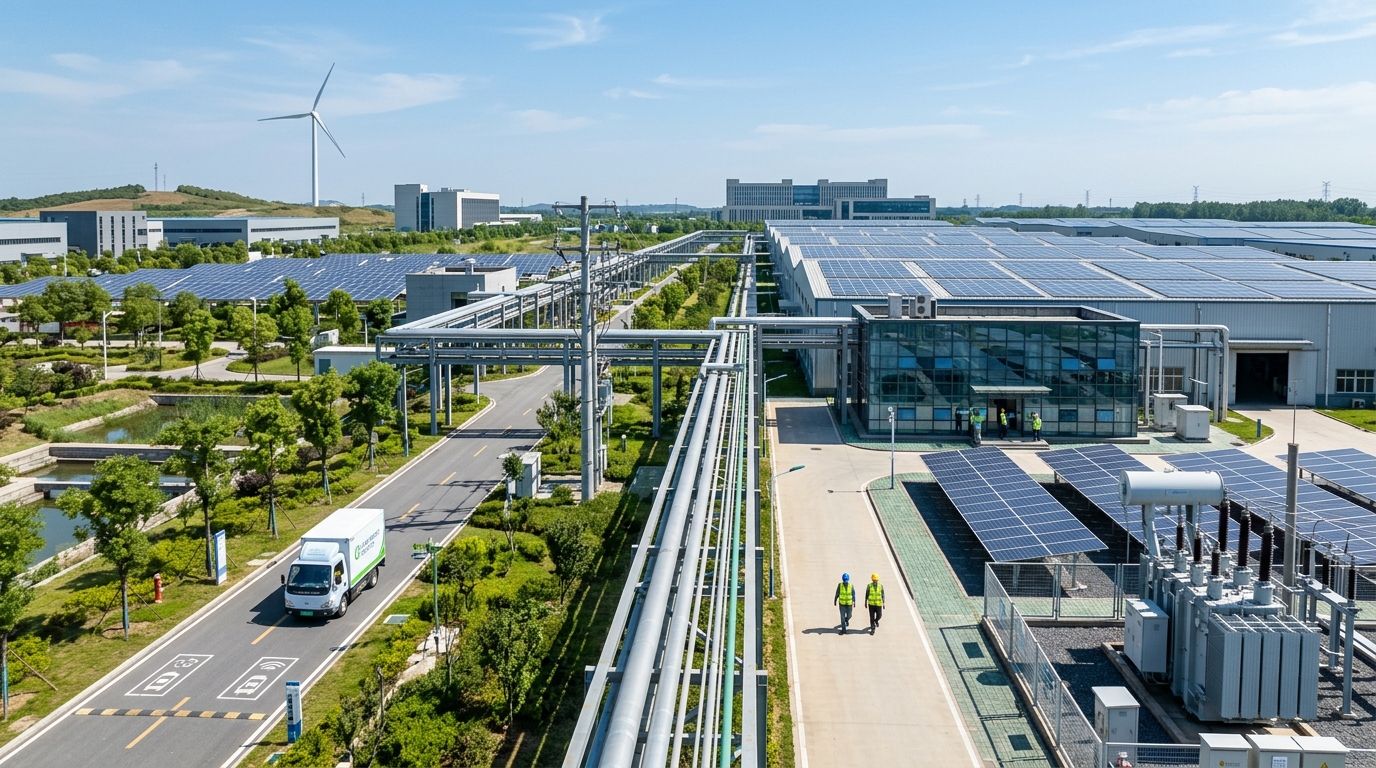
Online monitoring is the key to low-carbon parks transitioning from "experience-based management" to "digital governance." Traditional park carbon management relies on manual meter reading, monthly statistics, and annual reports, resulting in delayed data, inconsistent calibers, and slow anomaly detection. With the maturation of sensors, edge computing, the Industrial Internet of Things, and carbon management platforms, online monitoring of greenhouse gases is becoming critical infrastructure for park energy and carbon management. Its goal is not only to "see emissions" but also to achieve a Measurable, Reportable, and Verifiable (MRV) system.
Regarding monitoring targets, parks need to cover multiple types of greenhouse gases. Carbon dioxide is the primary target, especially from fossil fuel combustion, indirect emissions from purchased electricity and heat, and certain industrial processes. Chemical, fertilizer, waste disposal, and wastewater treatment scenarios may also involve methane and nitrous oxide. Industries such as electronics manufacturing, semiconductors, and power equipment may involve strong greenhouse gases like sulfur hexafluoride, perfluorocarbons, and hydrofluorocarbons. Different gases require different monitoring methods, sensor accuracies, and accounting models, necessitating classified design.
In terms of monitoring methods, parks typically form a three-tier system. The first tier is smart metering, including smart electricity, gas, steam, heat, and water meters, as well as flow meters, used to collect energy and material activity data. The second tier is emission monitoring, including CEMS continuous flue gas monitoring systems, volatile organic compound monitoring, methane leak detection, and plant boundary monitoring. The third tier is the platform layer, which correlates energy consumption, production, process parameters, and emission data through edge gateways, Industrial Internet platforms, data mid-ends, and carbon accounting models to form a dynamic carbon emission profile.
Take a typical industrial park as an example: if enterprise electricity, gas, and steam meters, along with equipment data from air compressors, boilers, and kilns, are integrated, the collection frequency can reach once every 15 minutes; if flue gas online monitoring is further deployed, parameters such as carbon dioxide concentration, flue gas flow rate, temperature, and pressure can be collected at the minute level. Through data cleaning and anomaly identification, the platform can detect issues such as sudden energy consumption spikes, equipment idling, steam leaks, and pollution control facility anomalies. Practices in some projects show that combining online monitoring with refined operational management can improve the park's comprehensive energy efficiency by 5% to 10%, and achieve a carbon emission data completeness rate of over 95%.
The challenges of online monitoring are equally apparent. First is data quality, including sensor drift, calibration cycles, communication interruptions, and missing value handling. Second is the unification of methodologies, requiring standardization of data calibers across different enterprises, equipment, and processes. Third is security and privacy, as enterprises worry about the leakage of production data, necessitating tiered authorization and desensitization mechanisms. In the future, online monitoring will integrate with carbon accounting, carbon footprints, green power tracking, and carbon trading data, becoming the "digital foundation" for park carbon management. Whoever masters high-quality real-time data will hold the discourse power in low-carbon parks.
V. Technological Directions: Deep Integration of Energy Systems, Industrial Processes, and Digital Platforms
The technological roadmap for low-carbon parks is shifting from single-equipment upgrades to multi-system synergy. The first main line is the clean transformation of energy systems. Distributed PV, wind power, biomass energy, geothermal energy, air-source heat pumps, industrial heat pumps, energy storage, and microgrids collectively constitute the park's new energy system. Currently, the conversion efficiency of mainstream PV modules generally exceeds 22%, and the cycle efficiency of commercial and industrial energy storage systems is mostly between 85% and 92%. Through peak-valley arbitrage, demand control, backup power, and PV-storage synergy, parks can reduce electricity costs and enhance power supply resilience.
The second main line is the electrification of industrial processes and the resource utilization of waste heat. A large amount of heat demand in parks still relies on gas or coal-fired boilers, while industrial heat pumps, electric boilers, electrode boilers, Mechanical Vapor Recompression (MVR), waste heat recovery, and heat network optimization can significantly reduce fossil energy consumption. Generally, the Coefficient of Performance (COP) for industrial heat pumps can reach 3 to 5, meaning that consuming 1 kWh of electricity can generate 3 to 5 kWh of heat; waste heat recovery projects in industries such as chemicals, textiles, food processing, and building materials typically bring comprehensive energy-saving effects of 5% to 15%. For high-energy-consuming parks, process waste heat, flue gas waste heat, and cooling water waste heat are important sources of emission reduction.
The third main line is the digital energy-carbon platform. Low-carbon parks need to integrate energy data, production data, equipment status, carbon emission factors, and carbon asset information into a unified platform. Platform functions typically include energy consumption monitoring, carbon emission accounting, carbon footprint management, green power and green certificate tracking, equipment efficiency analysis, anomaly alarming, energy-saving diagnosis, and report generation. Advanced platforms can use artificial intelligence for load forecasting, PV output forecasting, energy storage strategy optimization, and equipment health management. In some projects, AI load forecasting errors can be controlled within 5%, and energy storage dispatch revenues can increase by over 10% compared to fixed strategies.
The fourth main line is the piloting of deep decarbonization technologies such as hydrogen energy and CCUS. For industries like steel, chemicals, and cement that are difficult to fully electrify, green hydrogen, hydrogen metallurgy, biomass substitution, and Carbon Capture, Utilization, and Storage (CCUS) will become long-term options. Currently, the costs of these technologies remain high, but against the backdrop of policy support and declining green power costs, they are expected to form demonstrations in specific parks over the next five years. For example, chemical parks can explore green hydrogen for ammonia and methanol production, and purification of by-product hydrogen; building material parks can pilot kiln carbon capture and mineralization utilization; steel parks can promote the synergy of electric arc furnace short processes and waste heat power generation.
The key to technological development is not to stack advanced technologies, but to match the industrial characteristics of the park. Electronics manufacturing parks are suitable for PV, energy storage, cleanroom energy efficiency optimization, and supply chain carbon data platforms; chemical parks are suitable for waste heat utilization, process gas monitoring, safety control, and carbon capture; logistics parks are suitable for rooftop PV, electric heavy trucks, charging and battery swapping facilities, and green warehousing; data center parks are suitable for liquid cooling, natural cold sources, waste heat recovery, and green power trading. In the future, low-carbon park technologies will move from "generic solutions" to refined configurations of "one policy per park, one policy per enterprise."
VI. Business Models and Investment & Financing: Moving from Cost Centers to Asset Operations and Green Value Realization
Whether low-carbon parks can be sustainable hinges on their business models. In the past, energy-saving and carbon-reduction projects were often viewed as cost investments, relying on fiscal subsidies or corporate social responsibility. With changes in energy prices, carbon prices, and green finance, low-carbon parks are beginning to form an asset logic that is calculable, recoverable, and financeable. PV, energy storage, heat pumps, waste heat recovery, smart lighting, charging facilities, and energy-carbon platforms can all be invested in, operated, and have their revenues distributed as independent or combined assets.
Take "PV + energy storage" as an example: in parks with high commercial and industrial electricity prices, obvious peak-valley price differences, and stable electricity loads, the investment payback period for projects can typically be shortened to 6 to 8 years, with some favorable projects achieving internal rates of return of 8% to 12%. Revenue sources include savings from self-generation and self-consumption, peak-valley price arbitrage, reduced demand charges, green power and green certificate revenues, and carbon emission reduction value. If park loads fluctuate significantly, revenue stability needs to be improved through load forecasting, energy storage strategies, and demand response.
Energy trusteeship and energy management contracts remain important models. Park management committees or owners entrust the energy system to professional operators, who invest in construction and are responsible for operation and maintenance, with both parties sharing profits based on energy savings, energy cost reductions, or carbon emission reduction revenues. This model can reduce the pressure of one-time investments for enterprises and improve the professionalism of system operations. In the future, energy management contracts will further upgrade to "energy + carbon + data" comprehensive services, where operators manage not only electricity, heat, cooling, and gas but also carbon allowances, green certificates, and carbon footprint data.
Green finance will amplify the investment capacity of low-carbon parks. Green credit, green bonds, transition finance, infrastructure REITs, and carbon finance tools are entering park scenarios. Financial institutions focus not only on project technology but also on whether emission reductions are measurable, data is verifiable, and revenues are sustainable. Therefore, online monitoring and carbon accounting capabilities will become crucial prerequisites for financing. A park with complete energy and carbon data is more likely to obtain low-cost funds, whereas projects with opaque data and unclear boundaries face financing difficulties.
Business model innovation also requires risk prevention. First is data risk; inaccurate carbon accounting may affect carbon asset certification and green finance compliance. Second is the risk of duplicate declarations; double counting must be avoided among green power, green certificates, carbon allowances, and voluntary emission reductions. Third is technology adaptation risk; load structures vary greatly across different parks, and solutions cannot be simply copied. Fourth is policy change risk; electricity prices, carbon prices, subsidies, and green power trading rules will all affect revenue models. In the future, low-carbon park investment will shift from "looking at equipment" to "looking at data, operations, and long-term carbon value."
VII. Forward Outlook: Three Main Lines for Low-Carbon Parks in the Next Five Years
Looking ahead to the next five years, low-carbon parks will present three main lines. The first main line is that carbon budgets and carbon performance will become the core of park governance. Park management committees will manage carbon emissions just as they manage land, energy consumption, and investment intensity, establishing systems for carbon budgeting, carbon accounts, carbon evaluation, and carbon assessment. Before new projects enter the park, carbon emission assessments may be required; existing enterprises will need to submit annual carbon reports, emission reduction plans, and energy efficiency improvement pathways. Low-carbon parks will transform from "green labels" into "management tools."
The second main line is that online monitoring and carbon footprints will become supply chain infrastructure. As domestic and international carbon rules tighten, enterprises need not only their own compliance but also to provide credible data to customers, financial institutions, and regulatory authorities. If parks can uniformly build carbon data platforms to help enterprises complete organizational carbon accounting, product carbon footprints, green power tracking, and third-party verification, it will significantly reduce compliance costs for individual enterprises. In the future, park carbon data may become a basic service for industrial spaces, just like water, electricity, gas, and networks.
The third main line is that parks will transform from energy consumers to "prosumers." Traditional parks are energy load centers; future parks will simultaneously assume multiple functions such as power generation, energy storage, peak shaving, charging, heating, and carbon sinks. Distributed PV, energy storage, virtual power plants, Vehicle-to-Grid (V2G), heat pumps, and flexible loads will enable parks to participate in power system regulation. Parks will not only consume energy but also produce green electricity, provide flexibility resources, form carbon emission reduction assets, and operate in synergy with urban energy systems.
From a longer-term perspective, zero-carbon and near-zero-carbon parks will move from pilots to scale. Around 2030, with the increase in the proportion of non-fossil energy consumption, the improvement of green power trading mechanisms, the maturation of product carbon footprint databases, and the expansion of carbon market coverage, park carbon management will enter a phase of normalization, standardization, and digitalization. At that time, truly competitive low-carbon parks will not simply own a few PV panels or a large display screen, but will possess clear carbon boundaries, credible data systems, stable operational mechanisms, and sustainable business models.
Conclusion: The Next Stop for Low-Carbon Parks is Credible Data and Long-Term Operations
Low-carbon park construction is moving from proof of concept into deep waters. Market trends indicate that park carbon reduction has shifted from point-specific energy saving to systematic operations; the policy environment shows that dual control of carbon emissions, carbon markets, product carbon footprints, and green power and certificate systems are forming a closed loop; technological directions indicate that energy systems, industrial processes, and digital platforms will be deeply integrated; and business models show that carbon data, green power assets, and operational capabilities will become new sources of value.
For park managers, the next step should prioritize completing three things: first, clarify the park's carbon emission boundaries and establish unified accounting rules; second, improve smart metering and online monitoring to enhance data quality; third, embed carbon management into investment attraction, operations, assessments, and financial services to form long-term mechanisms. For park enterprises, they should establish carbon ledgers, product carbon footprints, and supply chain carbon data capabilities as soon as possible to cope with customer audits and changes in trade rules.
Yicai Technology Industry Observation believes that the ultimate goal of low-carbon parks is not "display-oriented carbon reduction" but "verifiable carbon reduction." Only when carbon accounting is accurate, carbon footprints are traceable, greenhouse gas online monitoring is credible, and emission reduction revenues are quantifiable can low-carbon parks truly become a solid foundation for the green transformation of manufacturing. Over the next five years, the industry will enter a new phase defined jointly by data, standards, operations, and finance. Whoever completes the transition from engineering thinking to operational thinking first will seize the initiative in low-carbon competition.