Background: An Ageing 420 km Network Losing 29% of Its Water
The utility serves a county town of roughly 80,000 m³/day demand over 420 km of mains, a mix of ductile and grey cast iron, with about 35% of pipes older than 15 years. Non-revenue water (NRW) had stagnated near 29%, burst frequency peaked around the heating season, and minimum night flow (MNF) readings pointed to substantial real losses. A DMA-based leakage reduction programme delivered between early 2025 and mid-2026 brought NRW down to 10.4%.
Technical Analysis: Four Decisive Elements
1. Three-tier zoning with verified isolation. The network was divided into metering districts feeding level-1 and level-2 zones, ending with 19 level-2 DMAs of 500–3,000 connections each — small enough for leak localisation to remain practical, large enough to keep metering costs per connection reasonable. Before any meter was commissioned, every boundary valve underwent a closure test; isolation integrity of 100% was treated as a hard acceptance criterion, because a leaking boundary valve corrupts the entire water balance of a zone.
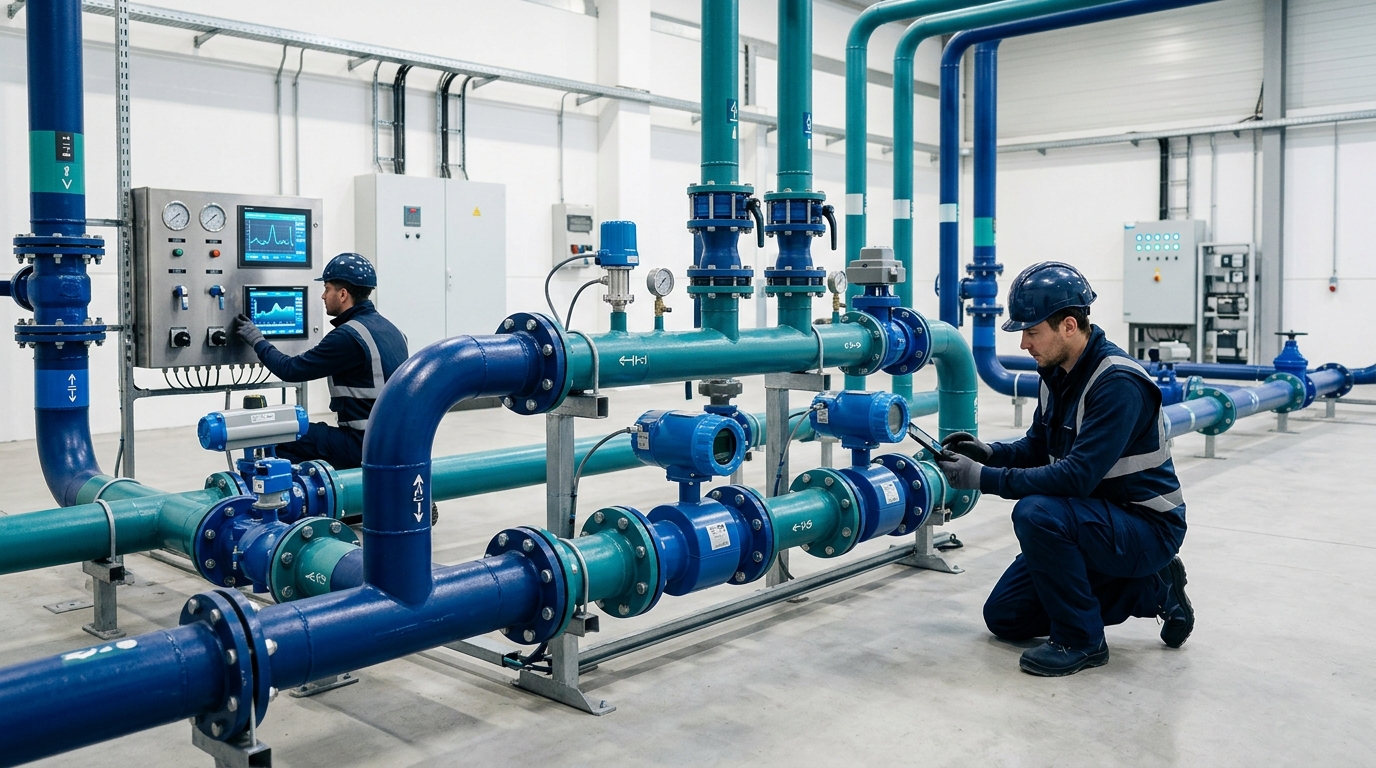
2. Minimum night flow as the primary triage metric. Each DMA inlet was fitted with an electromagnetic flowmeter (DN200–DN600, ±0.5% accuracy, selected per ISO 4064 / OIML R49 metrology classes where revenue metering applies) polled at one-minute intervals by an IoT RTU over 4G. The 02:00–04:00 MNF was normalised per connection to produce a leakage intensity ranking; field acoustic teams were then dispatched to the five worst DMAs first. Two engineering caveats proved important: metering points must avoid operating below roughly 10% of rated flow (oversized meters silently destroy MNF resolution — use a parallel small-meter bypass where needed), and raw MNF must be corrected for legitimate night consumption such as hospitals and continuous-process users, typically by sampling 5–10% of customers with logged meters.
3. Grid-based acoustic leak detection. Noise loggers were deployed across all 19 DMAs for continuous screening; alarms were confirmed with correlators before excavation. The first survey pass located 47 leaks, including three on trunk mains DN300 and above, each losing more than 20 m³/h — the classic profile of an ageing cast-iron network where background leakage dominates reported bursts.
4. Pressure management as the cheapest lever. Six high-pressure DMAs received PRVs operating in FAVAD (fixed outlet, time-modulated) mode, cutting night pressure from 0.38 MPa to 0.25 MPa. With an N1 exponent of approximately 1.15 in the leakage–pressure relationship, this single measure contributed about 2.5 percentage points of NRW reduction at the lowest capital cost per point.
Recommendations: The Loop Matters More Than the Build
- Run a closed meter–analyse–repair–verify loop: leak work orders closed within 72 hours, and MNF tracked for seven consecutive days after each repair to verify effectiveness before signing off.
- Make the SCADA platform compute, not just store: automated MNF trend reports and monthly zone-level water balances, with NRW accountability assigned per zone.
- Plan for AMI synergy: as household meters migrate to NB-IoT ultrasonic or electromagnetic meters, customer-level night use can be subtracted from MNF directly, materially improving triage accuracy — a natural low-cost sensing upgrade path.
Conclusion
Annual water savings reached approximately 3.65 million m³, with a simple payback of about 2.3 years at local tariffs and production cost. The lesson for utilities with similar ageing infrastructure: DMA success is decided not by the zoning map but by isolation verification discipline, MNF analysis as a routine operational metric, and a sustained combination of acoustic detection with night-time pressure management.