Background
The utility serves a county-level city in southern China with a demand of roughly 60,000 m³/day over 480 km of mains, mostly DN100–DN600 ductile iron and steel, with grey cast iron pipes older than 20 years still in service in the old town. Before the project, non-revenue water (NRW) stood at about 31%, dominated by real losses. The consequences were familiar: wasted treatment capacity, high production cost and low pressure at customer taps. In late 2024 the utility launched a district metered area (DMA) programme targeting NRW below 12% within 18 months.
Technical Analysis
1. District topology: three tiers, 500–3,000 connections per DMA. The network was restructured into a three-tier metering hierarchy — bulk metering at treatment works, 14 transmission districts, and 86 third-tier DMAs. District boundaries were derived from a hydraulic model built on GIS and SCADA history, then verified by valve-closure tests to confirm that each DMA has no bypass paths around its inlet meter. Oversized districts dilute the minimum night flow (MNF) signal; undersized districts multiply metering investment and maintenance. The 500–3,000 connection band proved the right balance between sensitivity and unit cost.
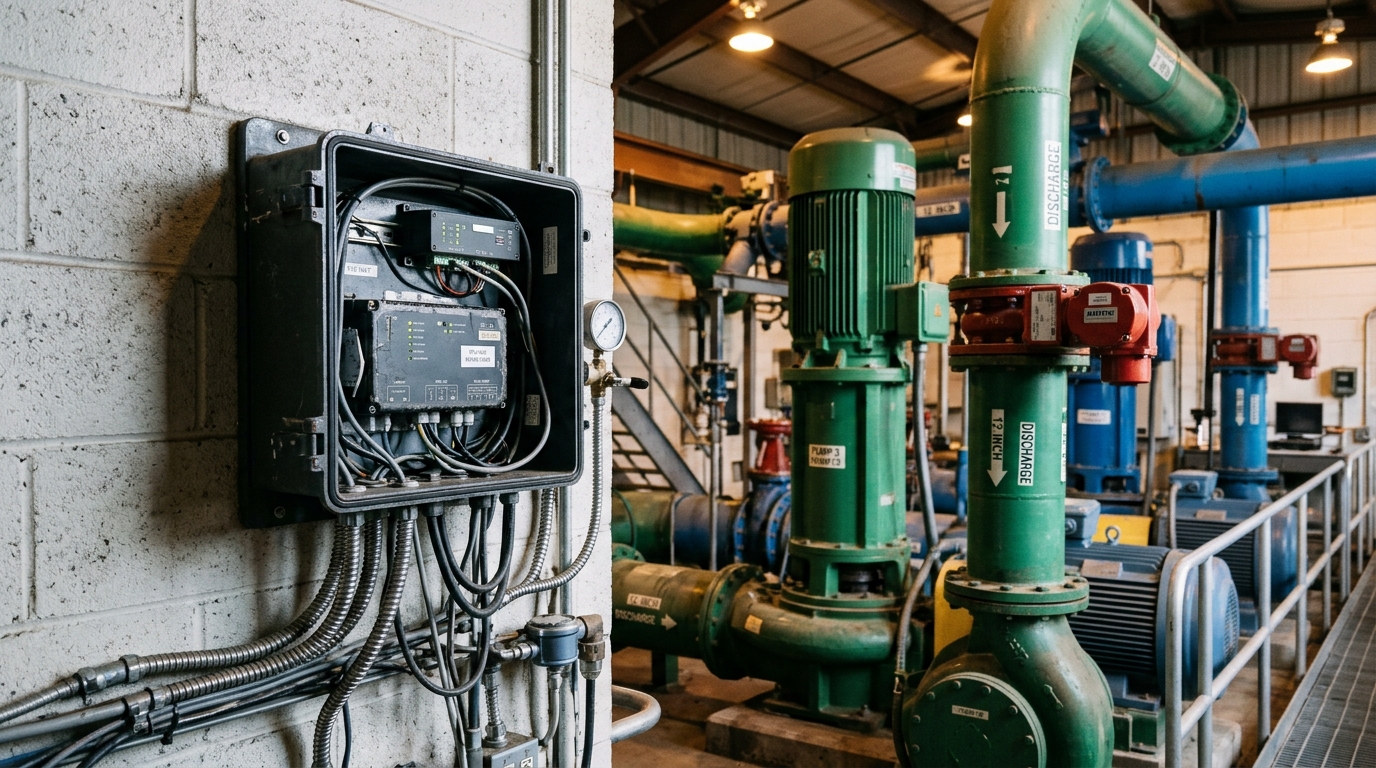
2. Metering chain: class 0.5 electromagnetic meters plus IoT RTUs. District inlets use DN300–DN600 electromagnetic flow meters (accuracy class R per ISO 4064 / OIML R49 principles applied to bulk metering, class 0.5 overall); DMA inlets use DN80–DN200 units. Because MNF occurs at velocities well below 0.1 m/s, low-flow linearity — not nominal accuracy — was the primary selection criterion. Every metering point reports through an IoT RTU over 4G with NB-IoT fallback, sampling at 15-minute intervals by day and 2-minute intervals between 00:00 and 05:00. RTUs installed in underground valve chambers were specified to IP68 (IEC 60529) with a battery design life of at least five years.
3. Leak localisation: MNF baselines, district noise logging, active detection. Each DMA maintains an MNF baseline from 14 consecutive nights (02:00–04:00 average). A drift beyond 15% triggers an alert; alerted districts are screened with acoustic noise loggers — 120 units deployed across high-risk grey cast iron segments — and confirmed with correlators before excavation.
Recommendations
- Model before construction. Validate every district boundary with valve-closure testing; a single undocumented bypass invalidates the whole DMA's water balance.
- Do not economise on inlet metering. Each additional 0.5% metering error materially degrades MNF confidence. Specify class 0.5 electromagnetic meters with proper earthing rings to suppress stray-current drift.
- Treat data governance and field crews as one system. Run an alert-to-repair-to-verification workflow, and re-check MNF seven days after every repair to close the evidence loop.
- DMAs need customer-side metering too. Without AMI/AMR on household meters, billed-volume error can mask the very leakage signal the districts were built to expose.
Conclusion
Over 18 months the programme located and repaired more than 340 leaks, including 21 major bursts on DN300 and above that had never surfaced. NRW fell from 31% to 12%, saving roughly 4.1 million m³ per year — more than CNY 12 million in direct annual benefit at local tariffs, with a payback period of about 2.5 years. The lesson for utilities of similar scale: DMA success is determined not by meter count, but by the systemic combination of closed district topology, low-flow metering accuracy, and a disciplined data-to-work-order operations loop. Phased rollout starting with ageing high-risk mains is the recommended path.