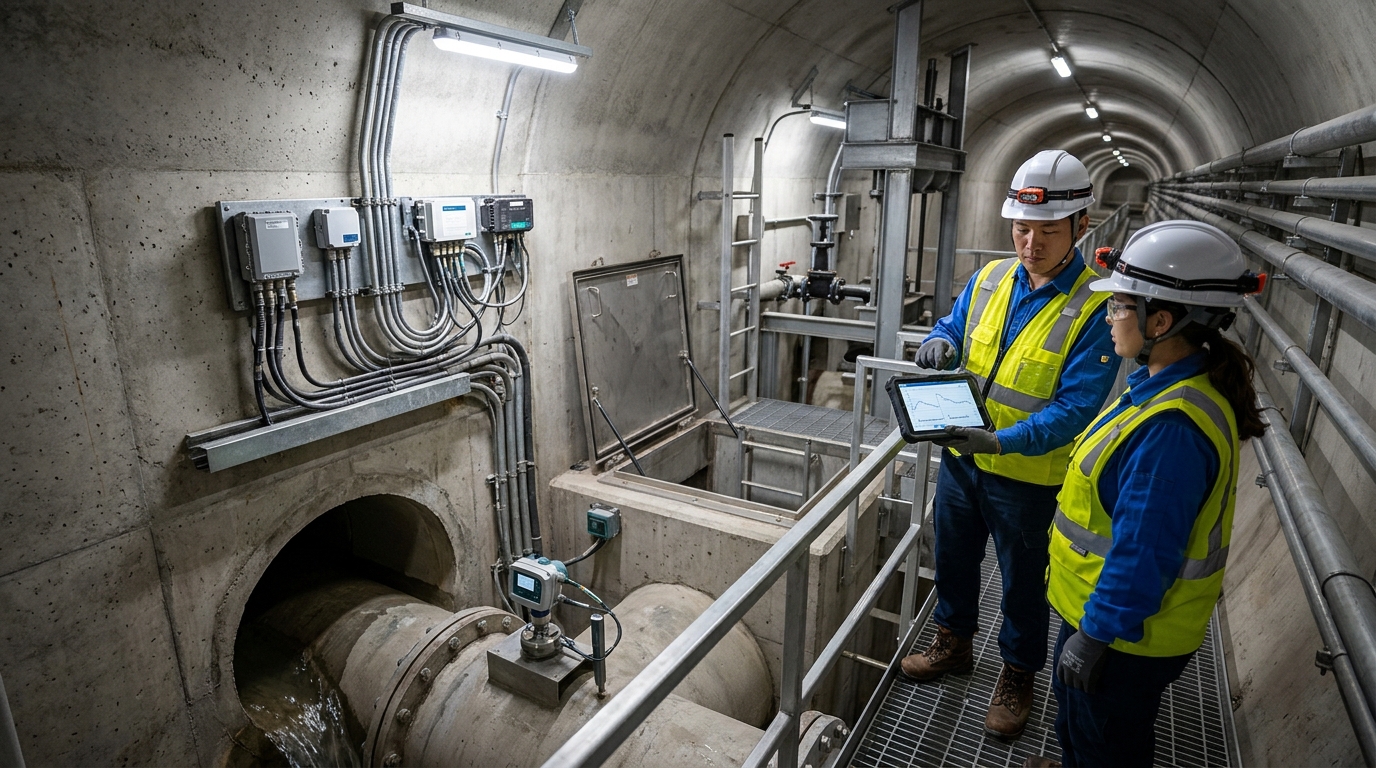
Digital Transformation of Urban Pipeline Networks: Data Silos and IoT Platforms
Urban water supply, drainage, gas, and heating networks are typical hidden infrastructure. Their operational status is often not directly visible, yet it determines urban safety, public service quality, and resource utilization efficiency.
Introduction: From "Ensuring Supply" to "Precision Control"
Over the past decade, industry construction has focused on "availability" and "sufficiency." As urban development intensity stabilizes, the pipeline network industry is shifting towards "accuracy, leak-tightness, and stability." Among these, water supply network leakage management has become the first sub-sector to enter the refined management stage, serving as a crucial window to observe the transformation of the entire urban pipeline network industry.
Public policy targets indicate that by 2025, the leakage rate of urban public water supply networks nationwide will strive to be controlled within 9%; by 2035, it aims to be kept below 7%. For cities with a leakage rate exceeding 12%, competent authorities require the formulation of systematic leakage control plans. This means the leakage rate is no longer just an internal operational indicator for water supply enterprises, but a hard constraint jointly targeted by urban water conservation, price regulation, fiscal investment, and performance evaluation.
Yicai Technology's Industry Observation believes that over the next five years, the urban pipeline network industry will present three main themes: first, the accelerated renewal and renovation of existing assets; second, district metering and smart metering becoming foundational capabilities; and third, data-driven leakage management platforms becoming the core of operations. The past model of relying on empirical judgment and manual inspection is being replaced by a closed-loop system of "metering—district zoning—pressure—modeling—O&M."
Market Trends: Shifting from Incremental Construction to Existing Asset O&M
The urban pipeline network industry is transitioning from a phase of large-scale new construction to one of existing asset optimization. According to public statistics, the total length of urban water supply pipelines nationwide has exceeded 1.1 million kilometers. Meanwhile, a significant portion of urban water supply pipelines has been in service for over 20 years. In some older urban areas, pipelines suffer from aging materials, joint leakage, coating failure, and valve malfunctions, leading to continuous pressure on leakage management.
Taking a city with an annual water supply of approximately 500 million cubic meters as an example, if the leakage rate drops from 12% to 9%, theoretically, about 15 million cubic meters of leaked water can be reduced annually.
This is equivalent to the annual domestic water consumption of about 300,000 residents, with direct annual economic benefits of about 45 million RMB.
Market boundaries are also expanding. In the past, leakage management was mostly understood as "leak detection" and "pipe replacement." Today, it has expanded into a comprehensive market encompassing old pipeline renovation, DMA district metering, smart water meters, electromagnetic flowmeters, ultrasonic flowmeters, pressure monitoring, acoustic monitoring, digital twin platforms, leakage analysis software, and O&M services.
It is worth noting that the methodology for water supply network leakage management is spilling over into drainage, gas, and heating networks. Drainage networks focus on misconnections, cross-connections, leakage, and external water infiltration; gas networks focus on micro-leakages and safety risks; heating networks focus on insulation failure and heat loss. Although the media and regulatory logics differ, the underlying methods of zoning, metering, monitoring, model analysis, and performance evaluation are common.
Policy Impact: Target Assessment, Price Constraints, and Fiscal Tools
Policy is the core variable accelerating leakage management in this round. In 2022, the National Development and Reform Commission and the Ministry of Housing and Urban-Rural Development issued a notice on strengthening leakage control in public water supply networks, explicitly proposing to control the national urban public water supply network leakage rate within 9% by 2025.
- Price Regulation: Cost supervision and audits have gradually incorporated the network leakage rate and non-revenue water rate as binding indicators.
- Fiscal Support: Tools such as local government special-purpose bonds and ultra-long-term special treasury bonds are incorporating water supply network renovation into their scope of support.
- Carbon Goals: Leaked water implies energy consumption for abstraction, treatment, and pumping. Reducing leakage is a cross-cutting lever for urban water conservation, energy saving, and carbon reduction.
District Metering (DMA): From "Construction" to "Operation"
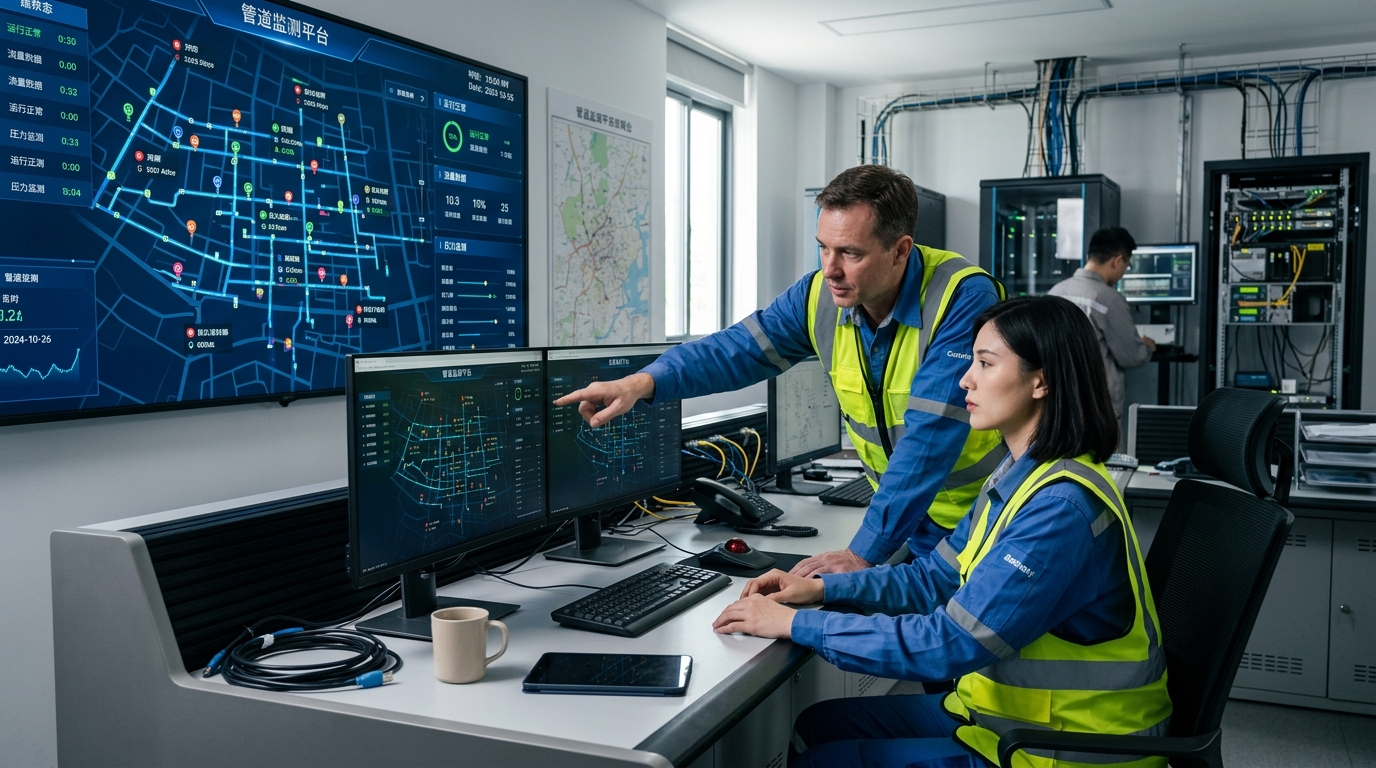
District metering is the foundational methodology for leakage management. DMA, or District Metered Area, typically divides a continuous pipeline network into several units that can be independently monitored, analyzed, and assessed by closing boundary valves and installing boundary flowmeters.
Minimum Nightly Flow Analysis
Minimum Nightly Flow analysis is the most commonly used leak identification method in DMA operations. The analysis window is typically chosen between 2:00 AM and 4:00 AM, when residential, commercial, and industrial water consumption are at their lowest. If the Minimum Nightly Flow of a certain DMA remains significantly high, it often indicates the presence of physical leakage.
A water supply group in a prefecture-level city in East China built 156 DMAs and deployed electromagnetic flowmeters and pressure monitoring points. After the project commenced, the city's public water supply network leakage rate dropped from 11.8% to 8.6%, reducing leaked water by approximately 12 million cubic meters annually.
Metering System Upgrade: Smart Meters and Data Quality
Pipeline network leakage is generally divided into physical losses and apparent losses. If the metering system is inaccurate, district analysis will be distorted, and leakage rate assessment will lose its foundation. Therefore, metering system upgrade is the first threshold for leakage management.
At the user end, smart water meters are becoming an important lever. Technologies such as NB-IoT, LoRa, and wireless remote transmission are shifting water meter data from "manual reading" to "automatic collection." The practice of a county-level city in South China showed that replacing mechanical water meters with NB-IoT smart water meters increased the meter reading success rate from about 91% to 99.2%, dropping the non-revenue water rate by about 4.3 percentage points within two years.
Technical Direction: Acoustics, Pressure Management, and Digital Twins
Acoustic Monitoring
Noise loggers and correlators locate leaks through signal propagation time differences. For metal pipelines, localization error can be controlled to the meter level.
Pressure Management
A 10% reduction in average network pressure can reduce physical leakage by approximately 5% to 12%, offering a short payback period.
Digital Twins
Integrating GIS, SCADA, and hydraulic models to achieve dynamic mapping of network topology, pressure, flow, and leakage risks.
AI Prediction
Driving leakage management from "post-event leak detection" to "pre-event early warning" by scoring high-risk pipe sections.
Typical Cases and Business Models
Leakage management projects feature long investment cycles and implicit returns. Models such as water conservation contract management and performance contracts are gradually increasing. The core change is that project payments are no longer based solely on the quantity of equipment installed, but are linked to leakage rate reduction, DMA compliance rate, and water savings.
A city in Northern China carried out a water conservation contract project, investing about 260 million RMB to implement pipeline renovation and build DMAs. The project set a target to reduce the leakage rate to within 9.5% after three years, alleviating one-time fiscal pressure and binding technical service provider returns to long-term operational outcomes.
Forward-Looking Outlook: Computable and Tradable Assets
Looking ahead to 2030, urban pipeline network leakage management will enter a higher-standard phase. The leakage rate of public water supply networks in key cities is expected to stabilize below 8%. New residential and municipal projects will increasingly adopt remote metering, online monitoring, and digital delivery.
Pipeline network leakage management will be more closely integrated with carbon management, green finance, and ESG evaluation. A 1 percentage point drop in the leakage rate implies reductions in water treatment power consumption, chemical consumption, emergency repair costs, and carbon emissions.
Yicai Technology believes that the urban pipeline network industry is undergoing an "invisible infrastructure revolution." As policy targets, price mechanisms, digital technologies, and performance contracts gradually mature, pipeline networks will transform from traditional underground assets into computable, assessable, and tradable urban data assets.