How a Water Group Achieved Cost Reduction and Efficiency with Doppler Flow Meters
Engineering Practice of Yicai Technology's Non-Contact Doppler Flow Meter in Urban Drainage Trunk Monitoring
Against the backdrop of continuously growing demand for refined monitoring of urban drainage systems, Yicai Technology has participated in the implementation of a non-contact Doppler flow monitoring project. Addressing the requirements for flow velocity, water level, flow rate, and on-site image acquisition under complex drainage conditions, the project has developed an engineering application solution integrating non-contact measurement, video verification, and remote data transmission. This provides continuous data support for the operational assessment of drainage networks and flood control dispatching.
The Challenge: Complex Urban Drainage Conditions
The project is located at a critical node of the combined sewer trunk in the central urban area of a certain city, serving an area of approximately 18.6 square kilometers. The main section of the trunk has a pipe diameter of DN1800, with dry-season flow rates ranging from 0.18 to 0.35 cubic meters per second, and peak instantaneous flow rates reaching up to 2.6 cubic meters per second during heavy rainfall.
Previous Pain Points:
- Pipeline operated in a partially filled state for long periods.
- Issues with sedimentation, floating debris, oil pollution, and fluctuating inflows.
- Contact flow measurement equipment required frequent maintenance.
- Suffered from insufficient data continuity, making it difficult to meet dispatch management requirements.
Technical Challenges
The technical challenges of the project are mainly concentrated in four aspects:
-
•
Significant Water Level Fluctuation: Operating water levels varied between 0.20 and 3.65 meters, necessitating accommodation for both low and high water level conditions.
-
•
Wide Flow Velocity Range: Surface flow velocity dropped as low as 0.04 m/s in the dry season and reached up to 3.20 m/s in the rainy season, posing high requirements for low-flow velocity identification.
-
•
Deep Manhole Constraints: With a depth of approximately 6.5 meters, installation had to avoid disrupting normal drainage operations.
-
•
Debris and Anomalies: Accumulation of floating debris and overflow risks made it difficult to assess operational status relying solely on flow data.
The Solution: Yicai Technology’s Non-Contact System
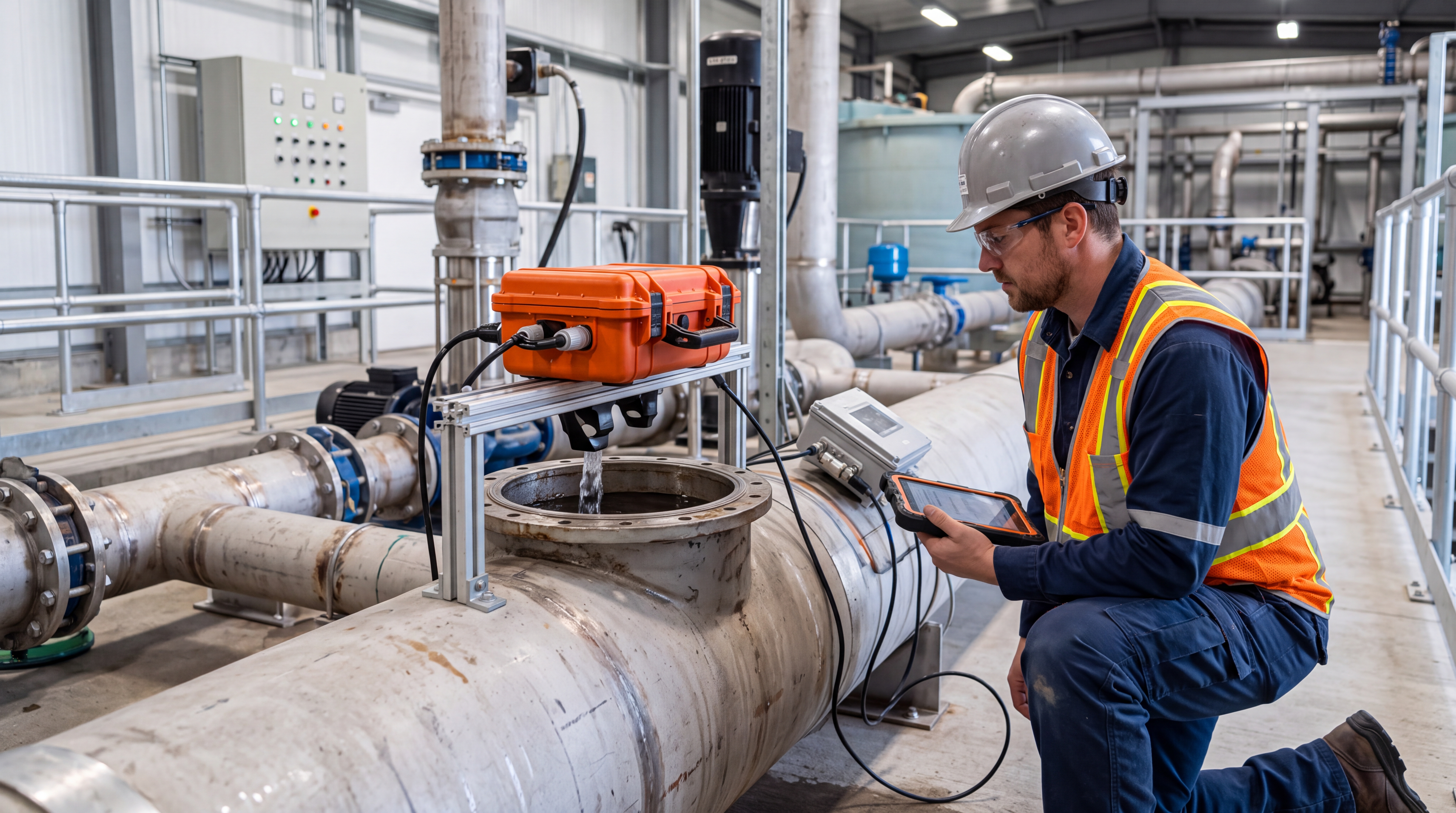
To address these issues, the project adopts Yicai Technology's non-contact Doppler flow monitoring station. The system comprises a 24GHz Doppler surface flow velocity unit, a radar water level unit, an edge computing gateway, and an integrated camera unit.
Doppler Velocity Unit
Measures surface water flow velocity non-contact style.
- Range: 0.03 – 8.00 m/s
- Resolution: 0.01 m/s
Radar Water Level Unit
High-precision level detection.
- Range: 0 – 5 meters
- Accuracy: ±0.01 meters
Combining on-site cross-section dimensions, water level variations, and flow velocity correction coefficients, the system calculates instantaneous and cumulative flow rates using the velocity-area method. The integrated camera unit is equipped with a 2-megapixel starlight-level camera for image evidence retention, water surface anomaly identification, and operational status verification.
Implementation & Calibration
During implementation, the project team prioritized relatively straight pipe sections with stable flow regimes, maintaining a flow stabilization distance of no less than five times the pipe diameter upstream and downstream of the installation location to avoid interference from bend backflow and drop structures.
"Equipment was installed via a crossarm bracket at the manhole opening, with the radar flow velocity module set at a downward viewing angle of approximately 25 degrees."
Prior to system commissioning, the project organizer conducted three on-site calibrations under different operating conditions—low flow velocity in the dry season, initial rainfall, and peak rainfall. Technicians performed synchronous comparisons using a mobile ADCP and manual flow meters, correcting surface flow velocity coefficients based on cross-section flow regimes (ranging from 0.85 to 0.92).
Operational Results: Data-Driven Success
From its commissioning in April 2025 to October, the system operated continuously for six months, accumulating 41,280 sets of valid data with a valid data acquisition rate of 99.2%.
| Metric | Performance / Result |
|---|---|
| Flow Rate Deviation (vs. Mobile ADCP) | Average: 4.2% | Max: 6.8% (Requirement: ±8%) |
| Water Level Deviation | Within ±0.01 meters |
| Low-Flow Sensitivity | Stably identifies changes of ~0.05 m/s |
| Maintenance Workload Reduction | ~60% Reduction |
Due to the non-contact measurement approach, the on-site maintenance cycle was adjusted from once a week to once a month. Furthermore, the video linkage function played a crucial auxiliary role, triggering 17 anomaly event records (including debris accumulation and overflow risks) with an average alert time of just 28 minutes.
Conclusion
The operational results demonstrate that in complex environments characterized by partially filled pipes, high fluctuations, and multiple impurities, non-contact Doppler flow monitoring can simultaneously acquire flow velocity, water level, and on-site image information. This enhances the traceability of flow data and the completeness of operational monitoring, providing foundational data support for network load assessment, overflow warning, and refined dispatching in urban drainage trunks, pump station forebays, and stormwater outfalls.