Smart Water Management Market Trends: 2026 Doppler Flow Meter Price Trends and Selection Recommendations
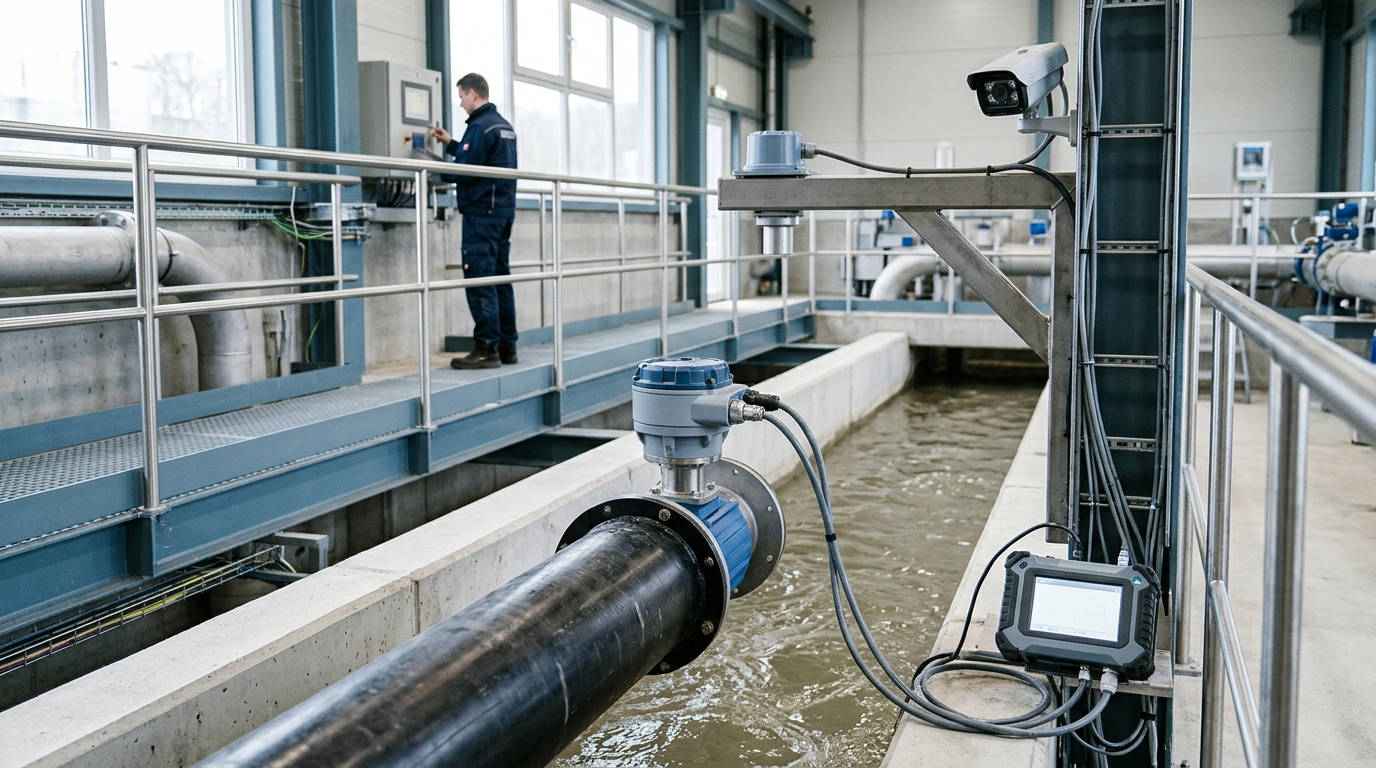
Introduction: Doppler Flowmeters Enter the “Velocity + Water Level + Video” Composite Monitoring Stage
Doppler flowmeters previously mainly performed single-point velocity measurement, relying on frequency shifts generated by ultrasonic waves in media containing particles or bubbles to estimate velocity, and then combining cross-sectional area to convert flow rate. With increasing demand for urban waterlogging monitoring, river and lake cross-section flow assessment, industrial drainage metering, and irrigation-district water-use management, single velocity data alone can no longer meet operational decision-making. Devices are evolving toward simultaneous acquisition of velocity, water level, cross-section geometry, and video evidence. The maturity of non-contact measurement and integrated camera technology has shifted flow monitoring from “reading a value” to “reconstructing a state of the water body.”
From an industry procurement trend perspective, users no longer focus only on accuracy and range; they also consider installation safety, data traceability, availability under abnormal weather, and long-term maintenance costs. Traditional contact Doppler solutions still have advantages in channels and pipelines with stable solids content, but in scenarios with high floating debris, strong corrosion, sediment scouring, or high risk of personnel entering manholes, non-contact measurement is more readily accepted. Integrated cameras provide auxiliary information such as surface flow patterns, floating debris, overflow, and nighttime illumination, improving data review efficiency.
Therefore, current market analysis needs to observe Doppler flowmeters within a composite sensing system. Price, specifications, and maintenance costs cannot be assessed based only on the device body; they must also consider water level sensors, cross-section calibration, communications, cameras, edge computing, mounting brackets, and O&M services. For end users, what ultimately determines return on investment is the continuous valid data rate, false-alarm control capability, and full lifecycle cost.
Market Structure: From Pipelines and Open Channels to Non-Contact Measurement, Demand Is Clearly Differentiated
Demand for Doppler flowmeters can be roughly divided into four categories: urban drainage networks, river and lake cross-sections, industrial processes and discharge outlets, and agricultural irrigation districts and open channels. Pipeline network scenarios are usually space-constrained; equipment must adapt to manholes, half-full flow, periodic high water levels, and sludge coverage. River scenarios have wide cross-sections and large water-level variations, requiring coordination of water level, velocity distribution, and video. Industrial scenarios prioritize corrosion resistance, explosion protection, continuous metering, and stable interfaces. Irrigation-district scenarios emphasize flow settlement, low maintenance, convenient power supply, and field comparison-test conditions.
The supply side is also layered. Contact Doppler is suitable for environments where enough scatterers exist in the medium, generally requiring solids or bubble content to reach a certain level; common engineering experience indicates roughly above 50–100 mg/L, while clean water or low-solids media may lead to weak signal. Non-contact radar and ultrasonic solutions do not directly immerse in water, making them suitable for scenarios with lots of floating debris, strong corrosion, and poor access for maintenance. Video-based solutions estimate flow from surface velocity and cross-section calibration, but are significantly affected by illumination, rain and fog, water-surface reflection, and lens contamination.
Market differentiation is also reflected in data value. In the past, procurement aimed at “device availability”; now more projects require data to be auditable, alarmable, and platform-accessible. Integrated cameras provide intuitive evidence for discharge-outlet overflow, river floating debris, and flood-season water-level changes, but introduce higher bandwidth, storage, and edge-computing costs. Users need to balance measurement accuracy, evidence completeness, network conditions, and budget, rather than simply pursuing feature stacking.
Product Price Ranges: Entry-Level, Industrial-Grade, and High-End Integrated Systems Are Layered
Based on public procurement and engineering quotations, entry-level handheld or portable Doppler flowmeters typically cost RMB 3,000–12,000 per unit, suitable for inspection, temporary comparison tests, and small-scale open-channel surveys. Fixed contact Doppler flowmeters typically cost RMB 12,000–45,000 per unit, covering common pipe diameters, channels, and discharge-outlet monitoring. If explosion-proofing, corrosion resistance, special mounting brackets, high-precision water level, or large-diameter cross-section adaptation are required, per-unit price may rise to RMB 50,000–150,000.
Price differences are more pronounced for non-contact measurement devices. Integrated radar velocity-water-level devices commonly range from RMB 20,000–80,000 per set, depending on range, accuracy, protection rating, and communication method. Integrated camera flow-measurement systems usually include camera, supplemental lighting, edge computing, protective brackets, power supply, and software interfaces; entry-level systems cost about RMB 80,000–150,000 per set, while mid-to-high-end solutions can reach RMB 150,000–300,000 per set. If multiple cross-sections, high-magnification lenses, infrared night vision, and cloud platform are added, a complete river cross-section monitoring project may cost RMB 150,000–600,000.
Beyond the device body price, installation and ancillary costs cannot be ignored. Installation in manholes, channel-bottom fixing, pier brackets, shore poles, lightning-protection grounding, solar power, and communication modules typically add RMB 5,000–30,000 per monitoring point. Annual service fees for 4G, NB-IoT, LoRa, or dedicated-line communication vary widely; simple data transmission may cost several hundred yuan per year, while video streams or high-frequency acquisition may cost several thousand yuan per year. Field comparison tests, cross-section calibration, and annual calibration also often form separate costs, approximately RMB 3,000–15,000 per occurrence, with complex projects higher.
Technical Parameters and Selection Boundaries: Accuracy, Range, Medium, and Installation Determine Cost
The core parameters of Doppler flowmeters are velocity range, accuracy, and signal stability. Common engineering-grade devices cover velocity ranges of 0.05–10 m/s, while some high-range solutions can exceed 15 m/s. Accuracy is often expressed as ±0.01 m/s, ±0.1 m/s, or ±1%–3% FS, depending on installation conditions, medium state, and calibration method. For drainage networks, low-velocity stability is more important than peak accuracy; for industrial metering, repeatability and long-term drift are more critical; for river cross-sections, errors in water level and cross-sectional area significantly amplify flow errors.
Water-level measurement is usually tied to flow calculation. Pressure water-level sensors are suitable for pipe networks and open channels, but are susceptible to clogging and temperature; radar water-level sensors are suitable for non-contact installation, with common accuracy of ±1–5 mm; ultrasonic and laser solutions are affected by water-surface fluctuations, foam, and rain or fog. Integrated cameras can provide water-level gauge recognition, water-surface line observation, and overflow evidence, but usually serve as auxiliary means and should not completely replace independent water-level sensors. If cross-section geometry is complex, estimating flow from single-point velocity and simple geometric area may produce errors beyond engineering expectations.
Medium conditions define selection boundaries. Doppler relies on scatterers; too-low solids content causes weak signal, while excessive bubbles interfere with velocity judgment. High sediment, algae, oil, and floating debris accelerate probe fouling. Non-contact measurement reduces contact risk but imposes higher requirements on water-surface state and angular installation. Video flow measurement works better under sufficient illumination and clear surface texture; at night or during storms, supplemental lighting, infrared, and edge algorithms are needed. If users do not assess medium and installation conditions, even high-specification devices may not operate stably.
Purchasing Advice: Assess the Cross-Section First, Then the Device; Avoid “High Specification, Low Application”
When purchasing Doppler flowmeters or composite flow-measurement systems, the first step is not price comparison but clarifying the measurement object and operational purpose. If used for internal trend monitoring, focus on low cost, easy installation, and data continuity; if used for discharge assessment, trade settlement, or judicial evidence, higher accuracy, a complete calibration chain, and traceable video evidence are required. Pipe-network monitoring should focus on half-full flow, manhole humidity, sludge coverage, and communication stability; river monitoring should focus on cross-section width, water-level variation, floating debris, and flood-season safety; industrial scenarios should focus on medium corrosion, explosion-proof certification, and interface protocols.
The second step is to evaluate installation conditions. Contact devices require fixed points, immersion depth, and impact protection; non-contact devices require stable brackets, angular calibration, and rain shields; integrated cameras require power supply, supplemental lighting, lens cleaning, and storage bandwidth. Many projects fail not because device accuracy is insufficient, but because installation locations are unreasonable: for example, probes covered by silt, radar obscured by rain and fog, camera lenses contaminated by water droplets, solar panels shaded by trees, and 4G signal attenuated inside manholes. Site surveys and trial runs should become part of the procurement process.
The third step is to calculate full lifecycle costs. Device purchase price is only one part; installation, calibration, cleaning, spare parts, network, platform interfaces, and manual inspections continue to occur. If awarded solely on low price, subsequent maintenance may be higher. For drainage networks, prefer devices with high protection rating, easy installation, and remote diagnostics; for river cross-sections, consider combining non-contact measurement with integrated cameras to reduce personnel entering water; for irrigation districts, emphasize cross-section calibration, power reliability, and convenience of field comparison tests.
Maintenance Cost Analysis: Cleaning, Calibration, Spare Parts, and Data Quality Constitute Major Expenses
Maintenance costs for Doppler flowmeters mainly arise from probe fouling, water-level sensor anomalies, communication failures, and annual calibration. Contact probes immersed long-term are easily covered by sediment, algae, oil, and biofilm, causing signal attenuation or velocity bias. Common maintenance frequency is 1–4 times per quarter; high-pollution scenarios may require monthly maintenance. One-time manual cleaning costs range from RMB 200–1,500; if involving manhole entry, safety protection, and night work, costs may exceed RMB 2,000.
Calibration and comparison tests are another rigid expense. For general trend monitoring, annual calibration costs about RMB 5,000–12,000; for settlement-type or high-reliability projects, field comparison tests and accuracy verification may reach RMB 10,000–20,000 per occurrence. Maintenance of integrated camera systems is more complex; lens cleaning, wipers, supplemental lighting, protective covers, edge-computing device heat dissipation, and storage expansion all generate costs. If video streams are transmitted long-term, bandwidth and storage expenses may approach or exceed equipment depreciation.
From project experience, annual maintenance cost for a single-point monitoring system is usually about 10%–20% of device purchase price. In pipe-network environments with severe humidity and silt accumulation, the ratio may exceed 20%; in river non-contact solutions with stable brackets and manageable lens contamination, the ratio may remain at 10%–15%. Users should also consider data-quality maintenance, such as outlier removal, platform alarm-threshold adjustment, cross-sectional area updates, and image annotation review. What truly affects operational decisions is not whether the device is online, but whether the data is trustworthy.
Application Cases: Cost Differences Among Drainage Network, River Cross-Section, and Irrigation District Projects
Municipal Drainage Network
A municipal drainage network monitoring project once set up about 120 monitoring points, mainly using fixed Doppler flowmeters with pressure water-level sensors. Average device procurement per point was about RMB 35,000; installation, brackets, communication, and power supply added about RMB 15,000, resulting in initial investment of about RMB 50,000 per point. After one year of operation, due to manhole humidity, sludge coverage, and communication-module failures, annual maintenance costs were about RMB 6,000–9,000 per point. The project owner added remote diagnostics and regular cleaning plans, reducing data anomaly rate from about 18% to around 10%, but maintenance pressure remained evident.
River Cross-Section
A river cross-section monitoring project used a combination of non-contact radar flow measurement and integrated cameras. The cross-section width was about 18 m, water-level variation 0–3 m, and surface velocity range 0.1–4 m/s. The system included an integrated radar velocity-water-level device, edge-computing camera, supplemental lighting, pole bracket, and solar power, with investment of about RMB 280,000 per cross-section. Compared with traditional in-river installation, personnel safety risk was reduced, but lens rain and fog contamination and nighttime supplemental-lighting algorithms required continuous tuning. Annual maintenance cost was about RMB 45,000, mainly including cleaning, calibration, spare parts, and network traffic.
Irrigation District
An irrigation-district open-channel flow monitoring project placed more emphasis on settlement and field comparison tests. Channel width was about 2.5 m, water depth 0.3–1.5 m, using a channel-type Doppler flowmeter and cross-section calibration. Single-point device investment was about RMB 180,000, including flow-measurement bridge, water-level sensor, communication, and installation. Initially, channel silt accumulation caused flow deviation; after two comparison-test corrections, error was controlled at about 2%–3%. Annual calibration and dredging maintenance cost about RMB 12,000–18,000. Such projects show that the key in irrigation-district scenarios is not single-device accuracy, but cross-section stability and long-term calibration management.
Outlook: Non-Contact Measurement and Integrated Cameras Will Reshape the Cost Structure of Flow Monitoring
The future Doppler flowmeter market will continue developing toward composite sensing. Non-contact measurement will reduce the frequency of personnel entering hazardous water bodies and confined spaces; integrated cameras will improve explainability of abnormal events; water level, velocity, video, and cross-section data will jointly form a flow-trustworthiness assessment system. As edge-computing costs decline and algorithms mature, video flow measurement will no longer merely be “visible”; it will automatically identify floating debris, overflow, water-surface fluctuation, and lens occlusion, and generate quality labels.
Procurement will also become more rational. Users will not focus only on velocity accuracy, but on valid data rate, false-alarm rate, maintenance frequency, and platform interfaces. Price competition may reduce costs of entry-level devices, but competition for high-end projects will concentrate on system reliability, field adaptability, and data services. For organizations with limited budgets, basic Doppler or radar solutions can first meet monitoring needs, then cameras and edge diagnostics can be gradually added; for key cross-sections, power, brackets, communication, and calibration conditions should be planned at once to avoid later repeated modifications.
Overall, the Doppler flowmeter market is shifting from single-instrument sales to monitoring systems engineering. Non-contact measurement, velocity, water level, and integrated cameras are not simple feature combinations but new solutions formed around data trustworthiness and O&M costs. End users should choose suitable configurations based on medium conditions, installation environment, operational purpose, and budget, and convert device investment into sustainable data assets through standardized acceptance, periodic comparison tests, and remote diagnostics.