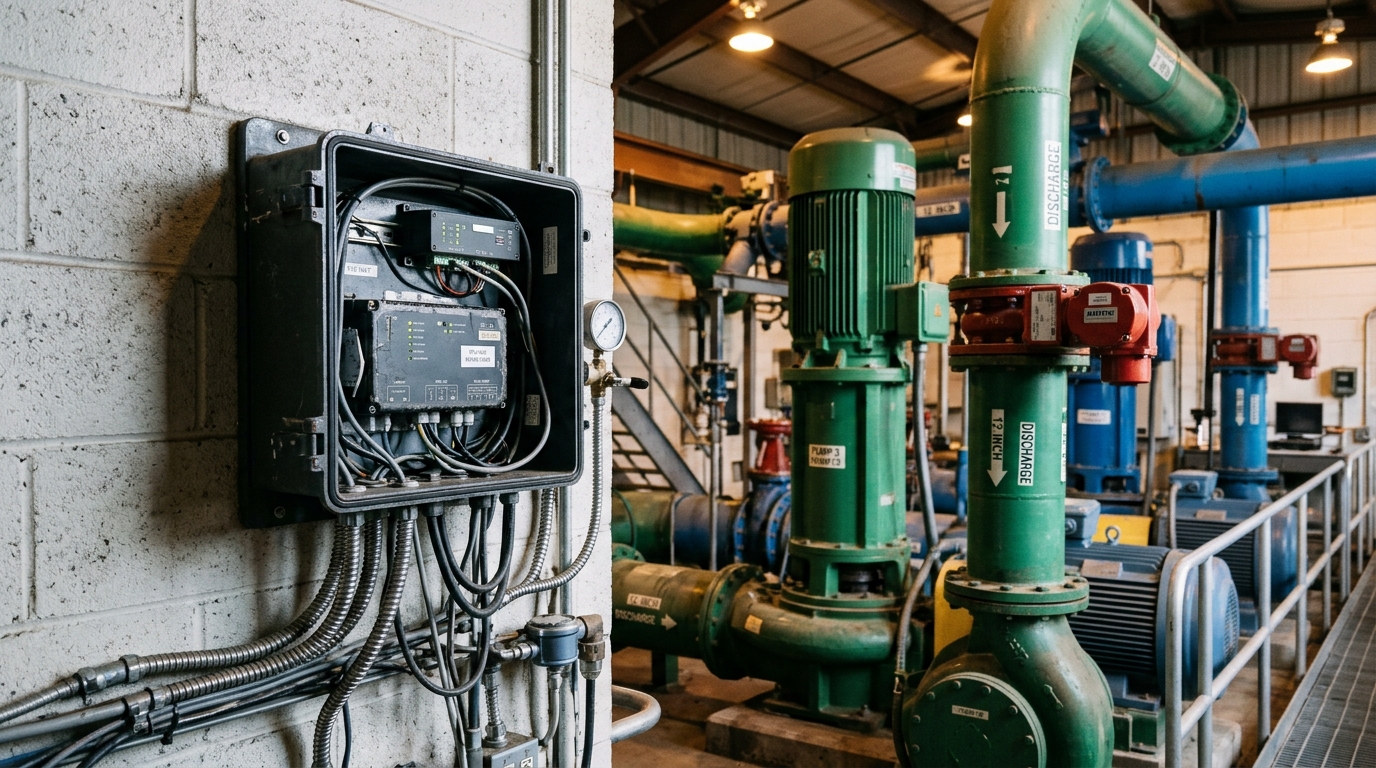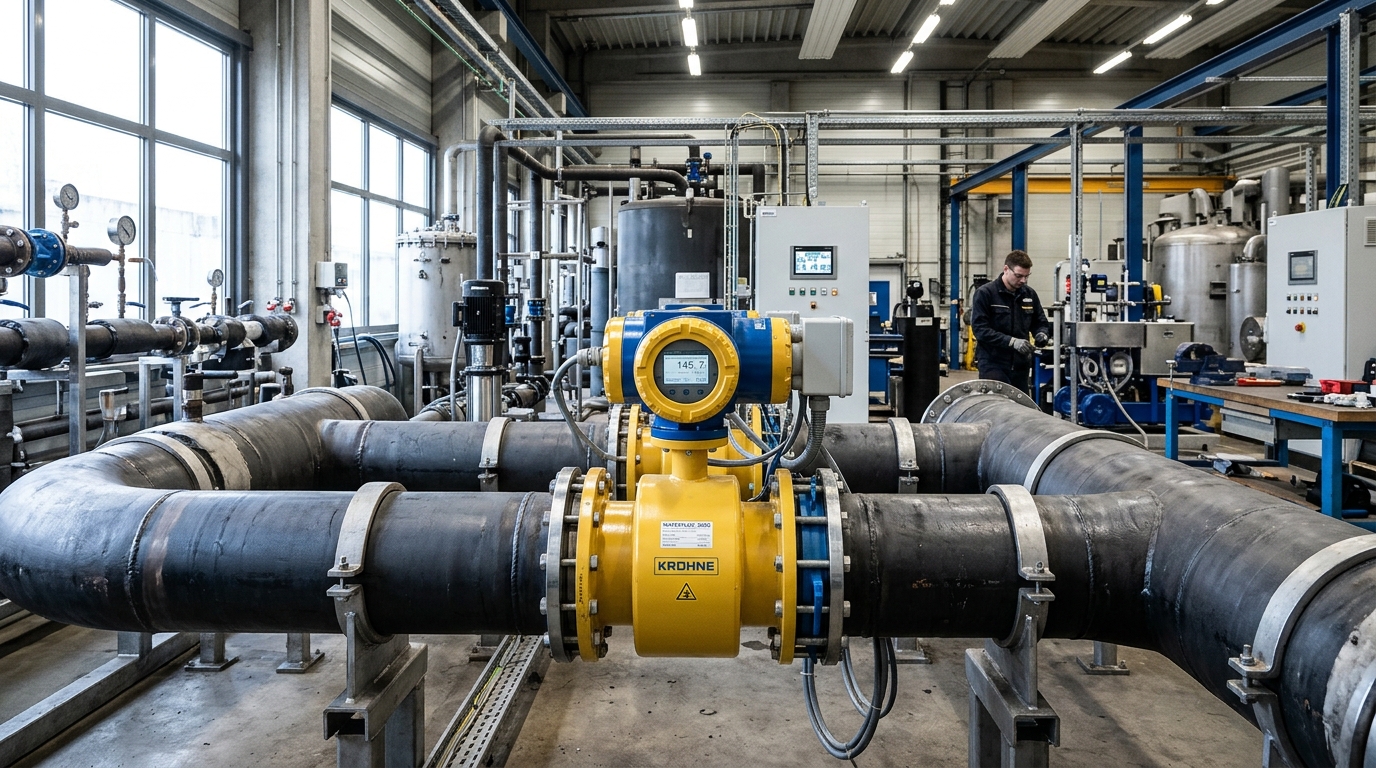
A typical municipal wastewater treatment plant hosts dozens of magnetic flow meters: influent and effluent custody transfer, internal and external recycle lines, and sludge thickening or dewatering feed. Compared with clean-water distribution, wastewater service combines high conductivity (>1000 μS/cm typically), solids loading, abrasion and chemical attack — leaving little margin for sizing or installation error. This article distils field practice from a 100,000 m³/d WWTP metering upgrade, organised by measurement duty.
1. Influent and Effluent: Custody-Transfer Grade Accuracy
Billing and discharge compliance usually require ±0.5% accuracy. Two problems dominate. First, insufficient straight-run: plant header meters often sit close to pumps or screens where only 2D–3D upstream straight pipe is available, far short of the ideal 5D upstream / 3D downstream. Specify meters with short-run compensation or flow-conditioner designs, and validate against a clamp-on ultrasonic reference during commissioning. Second, low night-time velocity: at turndown, velocity can fall below 0.3 m/s. Configure low-flow cut-off at 0.5–1% of full scale so electrical noise does not accumulate into inflated daily totals.
2. Recycle Lines: Entrained Gas and Pulsating Flow
Nitrification recycle and return activated sludge (RAS) lines are typically DN100–DN400, aerated and modulated by VFD-driven pumps. Keep three rules in mind: (1) locate the meter at least 3D downstream of the pump discharge, preferably on a flooded vertical or high point to guarantee full-pipe conditions; (2) use 316L electrodes as a minimum — for chlorinated reclaim or anaerobic streams containing H₂S, upgrade to Hastelloy C; (3) match the liner to service — rubber liners (natural or neoprene) outlast PTFE under abrasive RAS duty, while PTFE wins above 60 °C or with aggressive chemicals. After one plant replaced six DN200 RAS meters from PTFE to neoprene liners, 18 months of operation showed no liner wear-through and zero-drift tightened from ±3% to ±0.8%.
3. Sludge Lines: High-Solids Anti-Fouling Design
Thickened sludge at 4–6% dry solids, and dewatering feed above 8%, behaves close to a non-Newtonian fluid. Prefer scraper-type electrodes or meters with ultrasonic self-cleaning interfaces; size piping for ≥1 m/s to prevent settling. On intermittently operated dewatering feed lines, enable empty-pipe detection with alarm interlock to protect excitation coils and electrodes.
4. Grounding and Signal Integrity (IEC Practice)
WWTPs concentrate VFDs, blowers and dosing pumps, so common-mode interference is the leading cause of reading jitter. Implement three-point grounding: bonding rings at the meter (mandatory for plastic or lined pipe), converter housing to a dedicated earth electrode (≤4 Ω per IEC 60364/61010 practice), and double-shielded signal cable grounded at one end only. Segregate signal and power cable trays; cross at 90°. At the reference plant, night-time jitter on the influent meter dropped from ±5% to ±0.3% purely by adding bonding rings and rebuilding the earth electrode.
5. Data Integration: Feeding the Smart Water Platform
Metering only pays off when data reaches process control. Standardise on 4–20 mA plus RS485 Modbus RTU outputs, aggregate through IoT RTU telemetry units, and publish instantaneous flow, totalisers and empty-pipe/over-range alarms to the plant SCADA or a Smart Water platform. Normalising these feeds with Sewer Flow Monitoring and DMA district data enables plant-network joint analysis — a growing requirement for urban water utilities pursuing ISO 55000-style asset governance.
Takeaway: reliable magnetic metering in a WWTP = correct liner/electrode selection + guaranteed full-pipe and straight-run conditions + disciplined grounding + data integration. Prioritise custody-transfer points over process points in retrofits; corrected under-registration and chemical dosing optimisation typically recover the investment within two to three quarters.