Background
Distribution-network metering quality sets the ceiling for everything a utility does downstream: apparent-loss audits, district metered area (DMA) balancing and minimum-night-flow (MNF) analysis. For clean-water trunk lines DN300 and above, the electromagnetic (mag) flow meter remains the working horse of Smart Water programs — no moving parts, no head loss, bidirectional measurement, and accuracy independent of pressure, temperature and viscosity. Field failures, however, are rarely about the sensor principle itself. They come from low-flow truncation, stray currents and empty-pipe artifacts. This article reviews the engineering controls that separate a datasheet-accurate meter from a DMA-grade metering point.
Technical Analysis
1. Low-flow performance drives MNF analysis. Leakage signatures live in the 2–4 a.m. window, when distribution velocities collapse to 0.05–0.2 m/s. A standard mag meter with a 0.5 m/s turndown floor clips exactly this band. Boundary meters should specify a velocity lower limit of ≤0.1 m/s with ±0.5% (or better ±0.3%) accuracy, and the low-flow error curve should be verified against OIML R49 / ISO 4064 methodology. Set the low-flow cut-off at 0.08–0.1 m/s: lower invites electrical noise into the totaliser, higher discards genuine leakage signal.
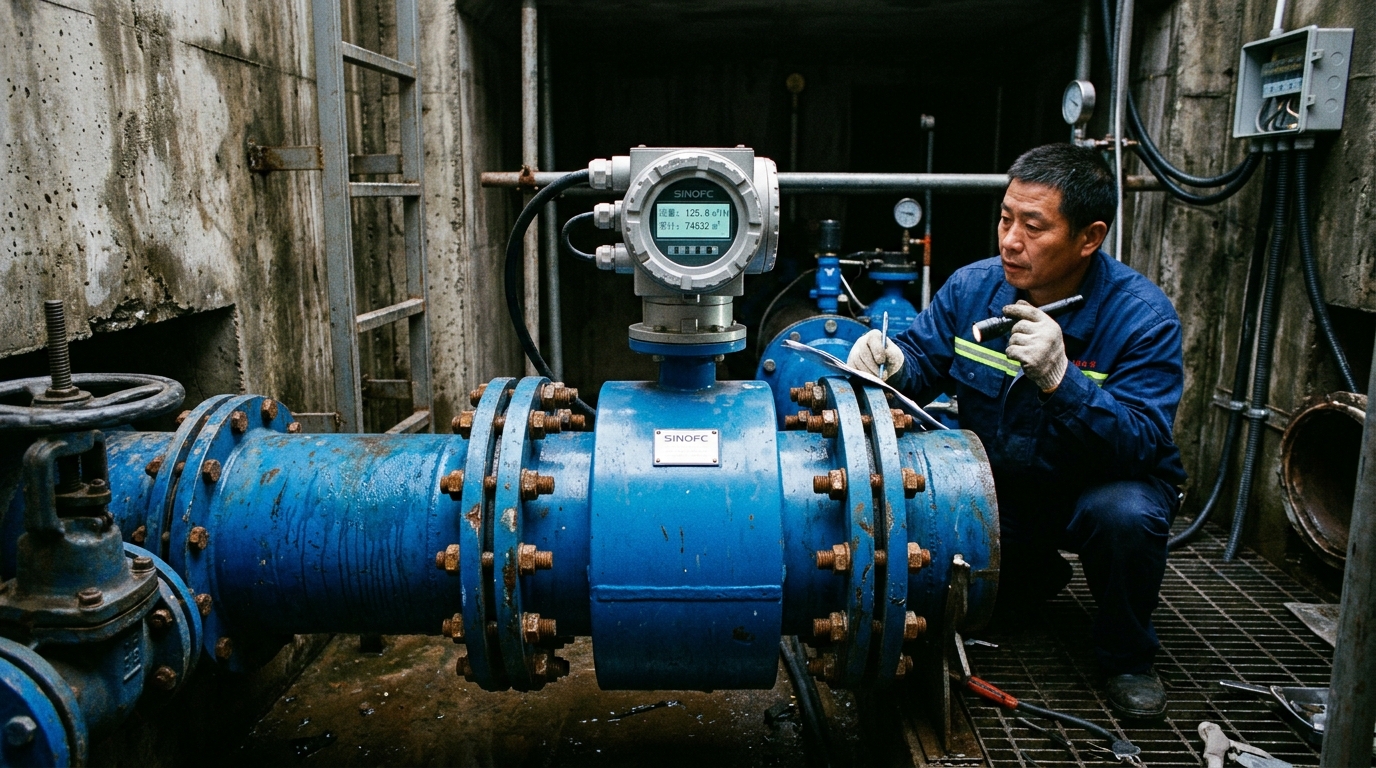
2. Straight-run and positioning. Mag meters tolerate distorted velocity profiles far better than differential-pressure devices: 5D upstream / 2–3D downstream is sufficient for full-scale accuracy in most cases (extend upstream to 10D after a single bend or reducer). Avoid the highest point of a main (air pockets) and vertical down-flow legs (partially-full pipe, electrode scour). Horizontal mounting with the electrode axis level is the reference configuration.
3. Grounding and stray-current rejection. The meter works with millivolt-level induced EMF, so cathodic-protection currents or substation leakage coupled into the measuring loop can shift readings by tens of cubic metres per hour. On lined steel or ductile-iron mains, fit grounding rings so the fluid itself is equipotential with the instrument ground; keep earth resistance ≤10 Ω (≤4 Ω in high-interference sites) and route shielded signal cables in conduit separate from power cabling. Environmental robustness of transmitter and sensor should be checked against IEC 60068 test series (damp heat, vibration, thermal cycling) and IEC 60529 IP68 for pit-mounted units.
4. Empty-pipe detection and diagnostics. Night-time valve operations can drain sections of main; the resulting phantom totals are a classic source of unexplained water balance errors. Specify meters with electrode-coverage detection and empty-pipe alarms, and add a cross-check in the IoT RTU logic — zero velocity with non-zero line pressure should flag the sample rather than accumulate it.
Recommendations
- For DMA boundary and revenue-grade points, use full-bore mag meters with dual-frequency rectangular excitation (better slurry-noise rejection and low-conductivity performance); ±0.5% accuracy, turndown ≥50:1;
- Insertion mag meters cut capital cost to roughly one third for retrofit or temporary monitoring, but expect ±1%–±2.5% accuracy and mandatory on-site comparison calibration;
- Report at 15-minute intervals normally; switch to 1–5 minute high-resolution sampling during MNF campaigns, weighing battery budget of the RTU against analysis quality;
- Commission every new meter with a full-pipe static zero calibration and a 72-hour zero-drift observation before it enters the loss-accounting chain.
Summary
The value of electromagnetic metering in distribution networks is decided not by the nameplate accuracy alone but by the whole measurement chain: low-flow cut-off discipline, a proper grounding system and empty-pipe protection. Selection, installation craft and data logic must be engineered together to deliver a trustworthy data foundation for leakage reduction.