From Technical Challenges to Successful Implementation: Case Study of a Smart Water Management Project
In modern industrial automation, the electromagnetic flowmeter is a core field instrument. Its accuracy and stability directly impact production safety. With the rise of fine chemicals and new energy materials, on-site conditions have become increasingly harsh—strong acids, high abrasion, and pressure fluctuations pose severe challenges to traditional equipment.
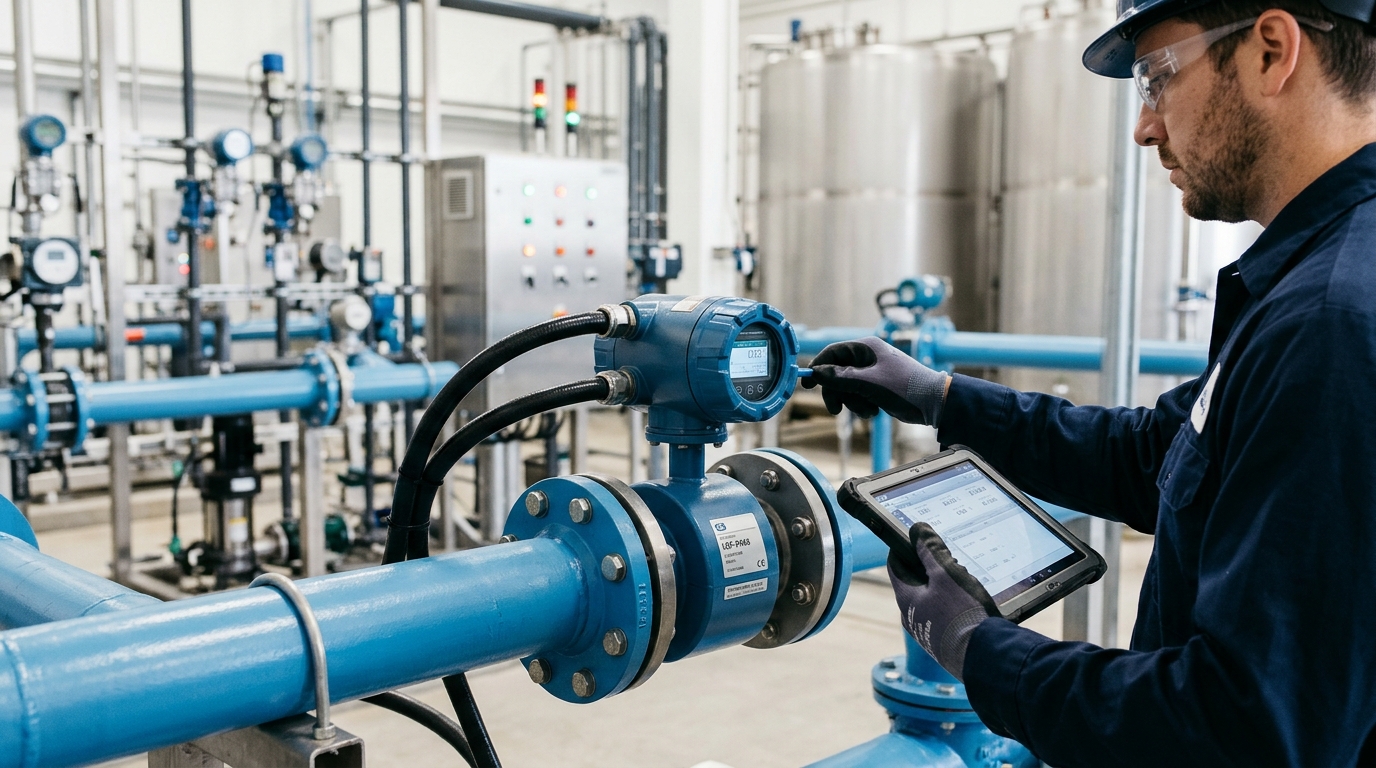
Ecolor Technology recently successfully implemented a highly challenging wastewater metering retrofit for a large domestic fluoro-silicon fine chemical industrial park. By utilizing our newly developed injection-molded integrated electromagnetic flowmeter based on LGF-PA66 polymer composite, we resolved long-standing issues like pipeline leakage and lining detachment. This article analyzes the engineering case of a DN50 strong corrosive wastewater measurement pipeline, providing objective data support for similar industry applications.
I. Project Background: Strict On-Site Requirements
The project involves a large fluoro-silicon fine chemical enterprise in East China. The measurement node handles mixed acidic wastewater containing fluorine and chlorine (pH 1.5–2.5) with 5%–8% fine silicon dioxide solid particles.
- High Velocity: 2.5 m/s to 3.5 m/s.
- Pressure Fluctuations: Operating between 0.4 MPa and 0.8 MPa, with transient negative pressure (-0.05 to -0.08 MPa) due to downstream vacuum extraction.
- Pain Points: Traditional carbon steel flowmeters with PTFE linings suffered from rapid rusting, lining detachment, and coil burnout. Mean Time Between Failures (MTBF) was only 4.5 months.
II. Bottlenecks of Traditional Technologies
Traditional "metal tube + insulating lining" structures face insurmountable physical bottlenecks under extreme conditions:
The Lining Detachment Effect
PTFE has low surface energy and cannot bond firmly to metal tubes. Under negative pressure, the lining concaves inward, causing micro-cracks at stress points and leading to catastrophic leakage.
Corrosion vs. Strength Contradiction
Pure PTFE is too soft for abrasive slurries. Special alloys solve corrosion but are prohibitively expensive for small diameters like DN50, violating techno-economic principles.
Furthermore, slight lining deformation can cause electrode deviation or insulation loss, introducing common-mode interference that distorts measurement signals. Eliminating the gap between lining and tube body is key to breaking this deadlock.
III. Ecolor's Innovative Solution: LGF-PA66 Integration
Ecolor Technology abandoned the traditional assembly structure in favor of an "Injection-Molded Integrated" solution based on LGF-PA66 (Long Glass Fiber reinforced Polyamide 66).
Material Breakthrough
Through a special pultrusion process, continuous glass fibers (10mm–12mm length) are uniformly distributed in the PA66 matrix. This creates a three-dimensional network skeleton providing mechanical strength comparable to die-cast aluminum, while maintaining excellent chemical resistance.
Manufacturing Leap
Using ultra-large precision injection molding machines, Ecolor molds the measuring tube, flanges, and electrode seats in one go. This "lining-free" single-phase homogeneous structure fundamentally eliminates lining detachment risks. Additionally, the interior surface roughness is controlled below Ra 0.4 micrometers, reducing fluid resistance and particle adhesion. Tantalum electrodes are encapsulated via in-situ injection molding, creating an absolute physical seal.
IV. Core Technical Parameters & Data Support
The customized LGF-PA66 flowmeter has passed strict certification by national metrology institutions. Key performance data includes:
Mechanical Strength
Tensile strength reaches 220 MPa; Burst pressure >4.8 MPa (Safety factor >3x). Heat deflection temperature up to 255℃. Deformation under -0.1 MPa vacuum is <0.01%.
Corrosion & Abrasion Resistance
In 1000-hour acid immersion tests, weight change was <0.2%. Shore D hardness ≥85. Taber Abrasion value is 1/4th of traditional PTFE.
Measurement Accuracy
Accuracy stable at ±0.5% R across 0.5–10 m/s flow rates. Excellent volume resistivity (>10^14 Ω·cm) ensures signal integrity.
V. Implementation & Commissioning Record
Ecolor's engineering team executed a rigorous SOP involving four stages: pretreatment, installation, grounding, and commissioning.
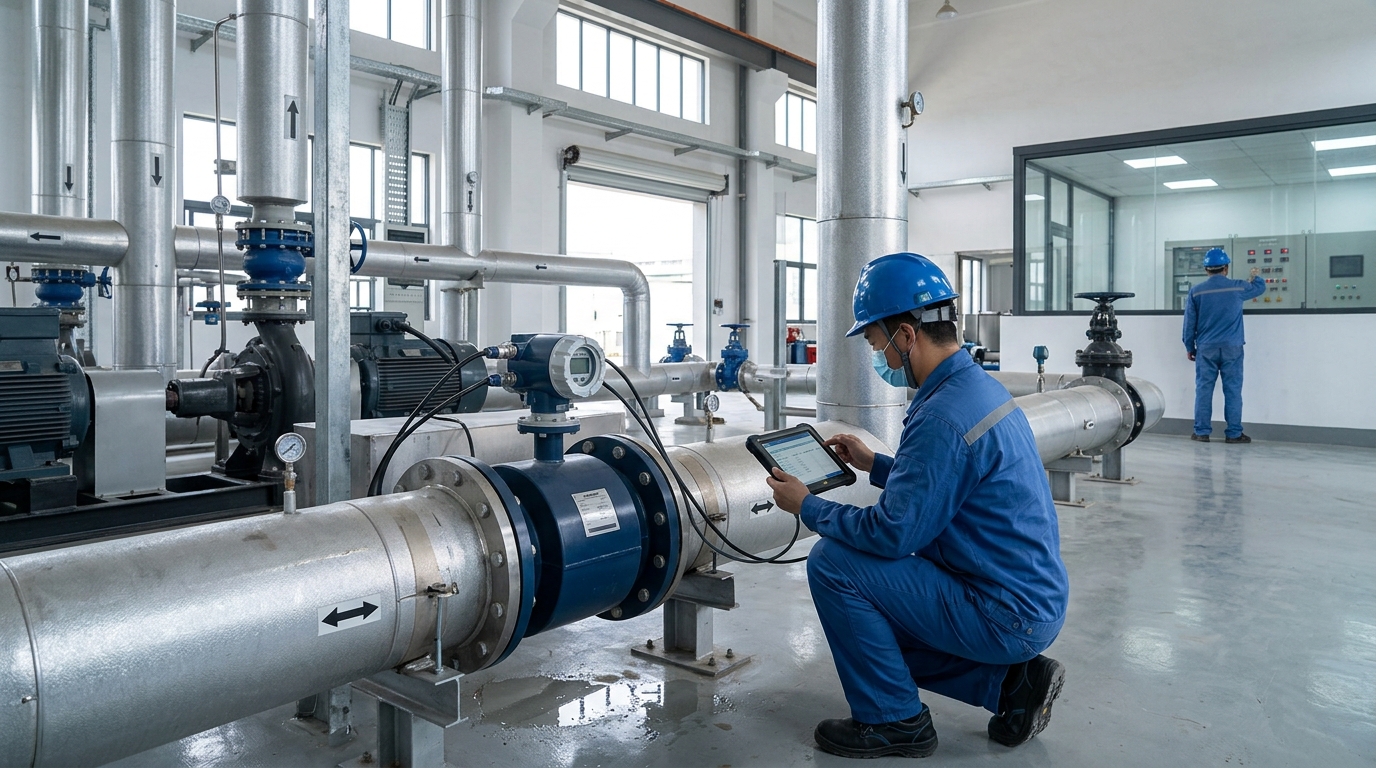
- Installation: The lightweight design (35% of traditional steel units) allowed single-person handling. Diagonal cross-tightening with FKM gaskets ensured zero leakage.
- Grounding: To address the insulating nature of plastic pipes, Hastelloy C-276 grounding rings were installed, achieving grounding resistance <1.5 ohms to prevent static interference.
- Commissioning: Initial signal fluctuations caused by air bubbles were resolved by adjusting damping time to 8 seconds and enabling empty-pipe detection logic. The system achieved a measurement error of just 0.8%, passing acceptance in one go.
VI. Final Effect Evaluation
After 24 months (730 days) of continuous operation without failure, the results exceeded expectations:
Significant Cost Reduction
MTBF increased from 4.5 months to over 24 months. Direct spare parts costs saved ~28,000 RMB per year, with comprehensive maintenance costs reduced by over 85%.
Long-Term Stability
After 24 months, error drift was only +0.12%, well within the ±0.5% requirement. No electrode polarization or tube abrasion observed.
Environmental Compliance
Accurate flow data improved dosing control, reducing neutralization agent consumption by 6.5% YoY and ensuring discharge pH remained strictly within 6.0–9.0.
VII. Industry Outlook
This successful retrofit demonstrates the potential of LGF-PA66 composite materials and injection molding integration technology. It breaks the mindset of traditional metal-plus-lining structures, offering a new path for solving "strong corrosion, high abrasion, and negative pressure" challenges in chemical and environmental industries.
Looking ahead, Ecolor Technology will continue to expand its product line and integrate Industrial Internet of Things (IIoT) technology. Next-generation products will feature built-in micro-sensors for real-time monitoring of stress, temperature, and impedance, evolving from passive measurement to intelligent fluid perception nodes with self-diagnosis capabilities.