Background: Why Chemical Duty Is Different
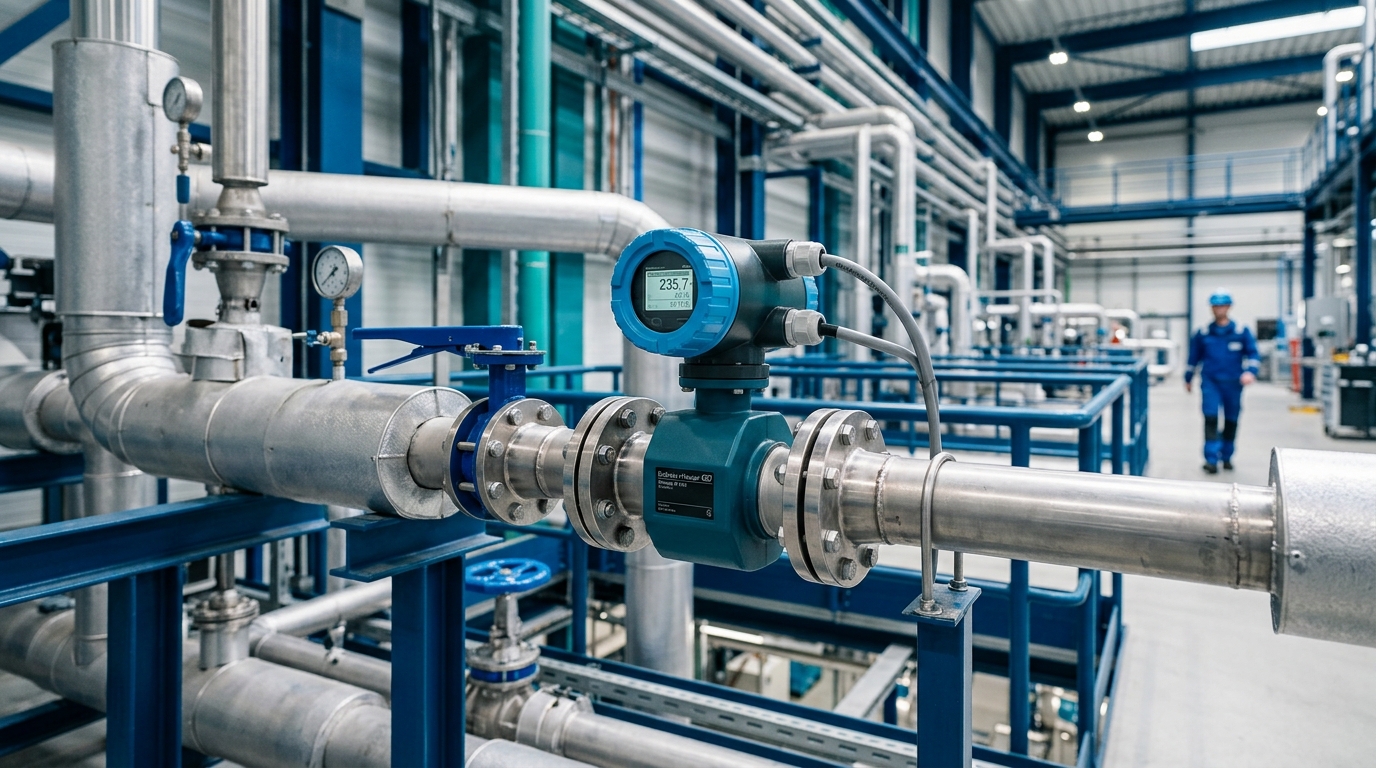
Flow measurement in chemical plants routinely involves aggressive media: 30% hydrochloric acid, 50% caustic soda, sodium hypochlorite, ferric chloride and abrasive slurries. Electromagnetic flowmeters are the default choice because the measuring tube has no moving parts, imposes no pressure loss and supports turndown ratios up to 100:1. Field experience, however, shows that the majority of failures in chemical service are not sensor defects but wrong material selection and improper grounding. Getting these two aspects right is most of the engineering work.
Technical Analysis: Matching Liner and Electrode Materials
1. Liner selection. The liner isolates the process medium from the magnetic coil assembly. Selection must cover corrosion resistance, temperature range and vacuum resistance:
- PTFE — resistant to almost all strong acids and alkalis, service range roughly –20 to +180 °C, the standard choice for HCl and H₂SO₄ duty. Its weakness is permeation resistance and poor vacuum tolerance: under negative pressure a loose PTFE liner can blister and detach.
- PFA — moulded directly onto the pipe wall, with markedly better permeation and vacuum resistance than PTFE; the right choice for batch-reactor feed lines that cycle under vacuum.
- Chloroprene / polyurethane rubber — economical and abrasion-resistant but limited to water and mildly corrosive media; they degrade quickly in strong acids and oxidisers.
2. Electrode materials. Electrodes wet the medium directly and must be matched to its oxidising/reducing character:
- 316L stainless steel for mildly corrosive liquids such as dilute salt solutions;
- Hastelloy C-276 (UNS N10276) for oxidising chloride environments — hydrochloric acid, ferric chloride, chlorinated effluent;
- Titanium excellent for chlorides and brine, but unsuitable for oxidising acids such as nitric acid;
- Tantalum outstanding in sulphuric and hydrochloric acid, but it corrodes rapidly in hydrofluoric acid — never specify tantalum for HF duty.
3. Grounding and signal integrity. The flow signal is only in the millivolt range, and chemical plants are dense with VFDs and large motors. Best practice: fit grounding rings at both flanges (mandatory on plastic or lined pipework), route the shielded signal cable separately in metallic conduit, and keep earth resistance ≤ 10 Ω, separated from power grounds. Roughly half of all "noisy reading" complaints trace back to missing or shared grounding.
Recommendations: Field Engineering Checklist
- Characterise the medium first: concentration, temperature swing, conductivity (magmeters need ≥ 5 µS/cm — deionised water is out of scope) and any vacuum phases. Request corrosion-rate data for liner materials; target below 0.1 mm/year.
- Installation: maintain 5D upstream / 3D downstream straight runs; avoid high points where gas accumulates; for slurries keep velocity ≥ 2 m/s to prevent sedimentation and ≤ 5 m/s to limit liner erosion.
- Telemetry: connect the 4–20 mA / RS-485 output to an IoT RTU so that built-in diagnostics — empty-pipe detection, conductivity alarms — become real-time early warnings on the SCADA or cloud platform, reducing the risk of undetected corrosive leakage.
- Calibration: annual verification is prudent in chemical duty; clean coated electrodes with water and soft cloth only — never scrape the liner.
Summary
Reliability of a magmeter in chemical service = correct material pairing + disciplined installation and grounding + continuous diagnostic monitoring. There is no universal liner/electrode combination; every medium must be evaluated individually. Grounding rings and dedicated earthing remain the highest-return, lowest-cost measure on site — and feeding diagnostics into a monitoring platform is the pragmatic first step toward digitising chemical metering.