Why Distribution Metering Is Harder Than It Looks
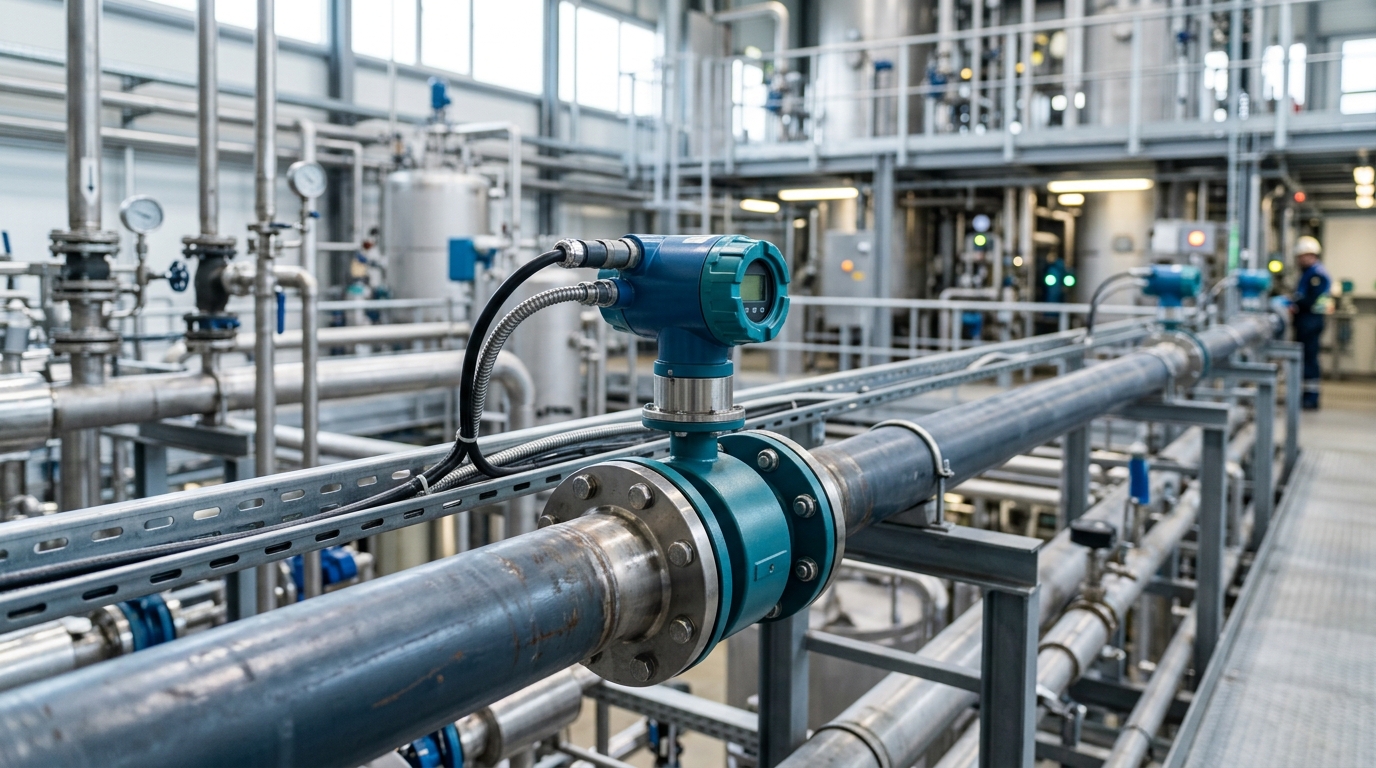
In water distribution networks, electromagnetic flowmeters (magmeters) are the default choice for DMA inlet metering, treatment plant discharge metering and transmission-main custody transfer. The water is clean and non-aggressive — yet distribution metering is, in several respects, the most demanding magmeter application. District metered areas require reliable accuracy during night-time minimum-flow conditions, when velocity in the meter often falls below 0.1 m/s. Billing-grade performance is typically required to meet or exceed ISO 4064 R400 (equivalent to OIML R49). And most meter chambers are unattended: data is uploaded by IoT RTU telemetry units, so every unscheduled shutdown for verification is disproportionately expensive.
Three engineering questions actually decide project success: low-flow accuracy, zero stability and practical field verification.
Low-Flow Performance: Read the Error Model, Not Just the Class
A magmeter's error at low flow is well approximated as a percentage of reading plus a zero offset expressed in velocity units. A typical specification of ±(0.5% of reading ± 1 mm/s) means that at 0.05 m/s the zero term alone contributes about 2% error — four times the nominal accuracy class. This is why a DN150 meter that performs flawlessly at peak demand can produce drifting readings at night.
Three selection rules:
- Turndown ratio: specify ≥ 100:1 for DMA applications so that minimum night flow stays inside the effective range;
- Zero specification: prefer instruments with zero stability ≤ 0.5 mm/s equivalent velocity and automatic zero tracking;
- Size by velocity, not by pipe diameter: verify that real minimum and maximum flows keep velocity between 0.3 and 3 m/s; a reduced bore is often cheaper than chronic low-flow error.
Zero Stability: Three Root Causes and Their Cures
- Grounding and interference. Modern networks increasingly use PE and ductile-iron pipes with insulating joints, so the measured medium lacks an equipotential reference; stray currents and VFD noise couple into the electrode circuit as common-mode interference. Use grounding rings or grounding electrodes (earth resistance ≤ 4 Ω) and route shielded twisted-pair signal cables away from power cables; verify EMC immunity per the IEC 61000-4 series at selection.
- Electrode fouling. Chlorination by-products and iron/manganese oxides form insulating films on electrodes, shifting electrode potential and producing slow, one-directional zero drift. Choose converters with electrode self-cleaning excitation and stream diagnostic values — electrode resistance and excitation current — via the RTU to the platform so drift trends trigger maintenance before accuracy is lost.
- Part-full operation. Air accumulation or throttled downstream valves cause half-pipe or empty-pipe states with violent zero jumps. Enable empty-pipe detection and alarm, and let the platform reject invalid samples so night-flow statistics stay clean.
Field Verification Without Long Shutdowns
In-service meters require periodic verification, commonly every 1–2 years. Because transmission mains allow only short isolation windows, a combined strategy works best: for DN300 and larger mains, perform on-line comparison with a transit-time clamp-on ultrasonic flowmeter at a position with at least 10 D upstream and 5 D downstream of any disturbance; exploit the early-morning low-demand window for on-site zero calibration with both isolation valves closed and the pipe confirmed full; and cross-validate with the DMA water balance — when the zone inlet/outlet discrepancy persistently exceeds tolerance, suspect the meter with the larger historical drift first.
Conclusion
The value of a magmeter in a distribution network is defined by long-term stability, not by the accuracy class on its nameplate. Design for low-flow capability, ground it properly, monitor its diagnostics through the IoT RTU, and verify it with methods that respect the network's shutdown constraints — and DMA data will genuinely support leakage control and urban lifeline safety.