1. Background: Why Irrigation Metering Is Hard
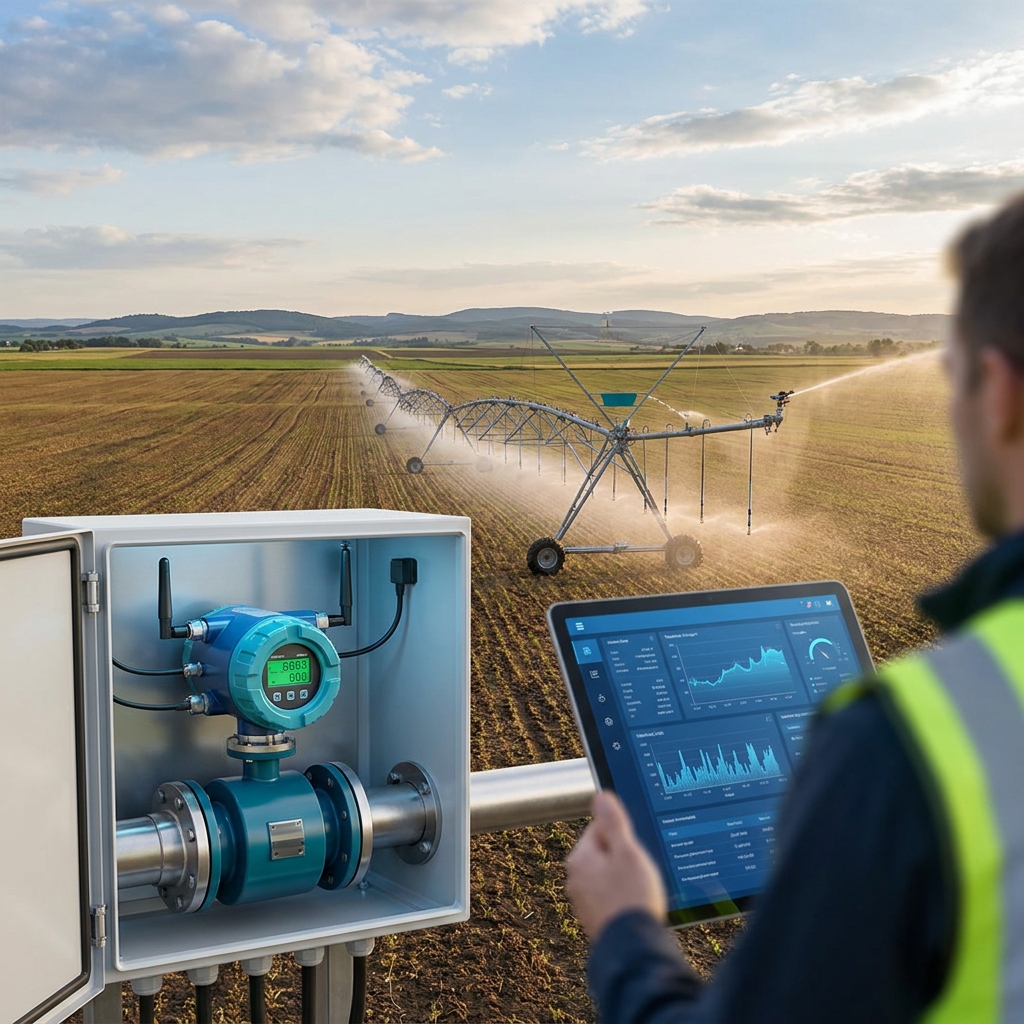
Irrigation districts are the metering backbone of agricultural water use, and their measurement points share three punishing characteristics. First, flow ranges are enormous: the ratio between dry-season and peak-irrigation flow at a headworks intake routinely exceeds 1:20. Second, sediment loads are high — headworks on silt-laden rivers can see tens of kilograms of sediment per cubic metre during flood season. Third, the readings feed water-rights trading and billing, so accuracy and auditability are contractual, not optional. Traditional open-channel velocity-area methods (ISO 748) accumulate large errors and depend on manual gauging; transit-time ultrasonic meters lose signal in sediment-heavy water. Electromagnetic flowmeters — no pressure loss, no moving parts, tolerant of solids-laden media — have become the preferred solution for intake metering.
2. Technical Analysis: Selecting for High-Sediment Service
1. Size and rangeability. Headworks mains typically run DN300–DN2000. Size the meter for 1–3 m/s at peak irrigation flow, then verify that the converter still holds 0.5 % accuracy down to 0.1 m/s so low dry-season flows remain billable. A slightly oversized line trades a little accuracy for substantially lower head loss and reduced silt deposition.
2. Liner and electrode selection against abrasion. Sediment-laden water erodes liners. For large bores, natural rubber or polyurethane liners offer the best abrasion resistance; choose PTFE for smaller sizes or where chemical cleaning is required. 316L stainless-steel electrodes suit most irrigation water chemistries, and grounding rings in the same material suppress stray-current interference. Specify IP68 (IEC 60529) enclosures for wet-pit and seasonal-flood exposure.
3. Installation and grounding. Most irrigation magmeters sit in buried valve pits. Guarantee ≥5D upstream and ≥2D downstream straight runs, and provide pit drainage so the converter is never flooded. Keep ground resistance ≤10 Ω; sandy soils often need soil replacement or extra ground rods — poor grounding is the most common cause of zero drift at field sites.
4. Low-power supply. Intake sites usually lack grid power. Choose converters with 24 V DC operation and low quiescent draw, paired with solar supply and a dual-channel (cellular plus satellite) telemetry RTU, satisfying the online monitoring requirements water authorities impose on licensed withdrawals.
3. Engineering and O&M Recommendations
- Field verification in parallel with factory calibration. After installation, perform an in-situ comparison against a master meter or calibrated pump to establish an error baseline — the arbitration reference for water-rights accounting.
- Post-flood-season inspection. Check liner wear and electrode fouling at each maintenance window; in heavily silted districts inspect every irrigation season.
- Lightning protection is mandatory. Fit surge protective devices on power and signal lines at exposed headworks, bonding to the instrument ground network (IEC 62305 principles).
- Data retention. The RTU should buffer at least one year of raw data locally with automatic store-and-forward, keeping billing cycles fully auditable.
4. Conclusion
In irrigation service, a magmeter's success is 70 % selection and installation, 30 % hardware. Match liner and electrode to the sediment load, respect straight-run and grounding rules, provide low-power supply with online regulatory uplink, and add a post-flood inspection regime — and the system will deliver water-rights-grade credibility. For district modernization projects, this is the highest-ROI metering path available.