How to Select the Right Electromagnetic Flowmeter? Accuracy and Stability Are Key
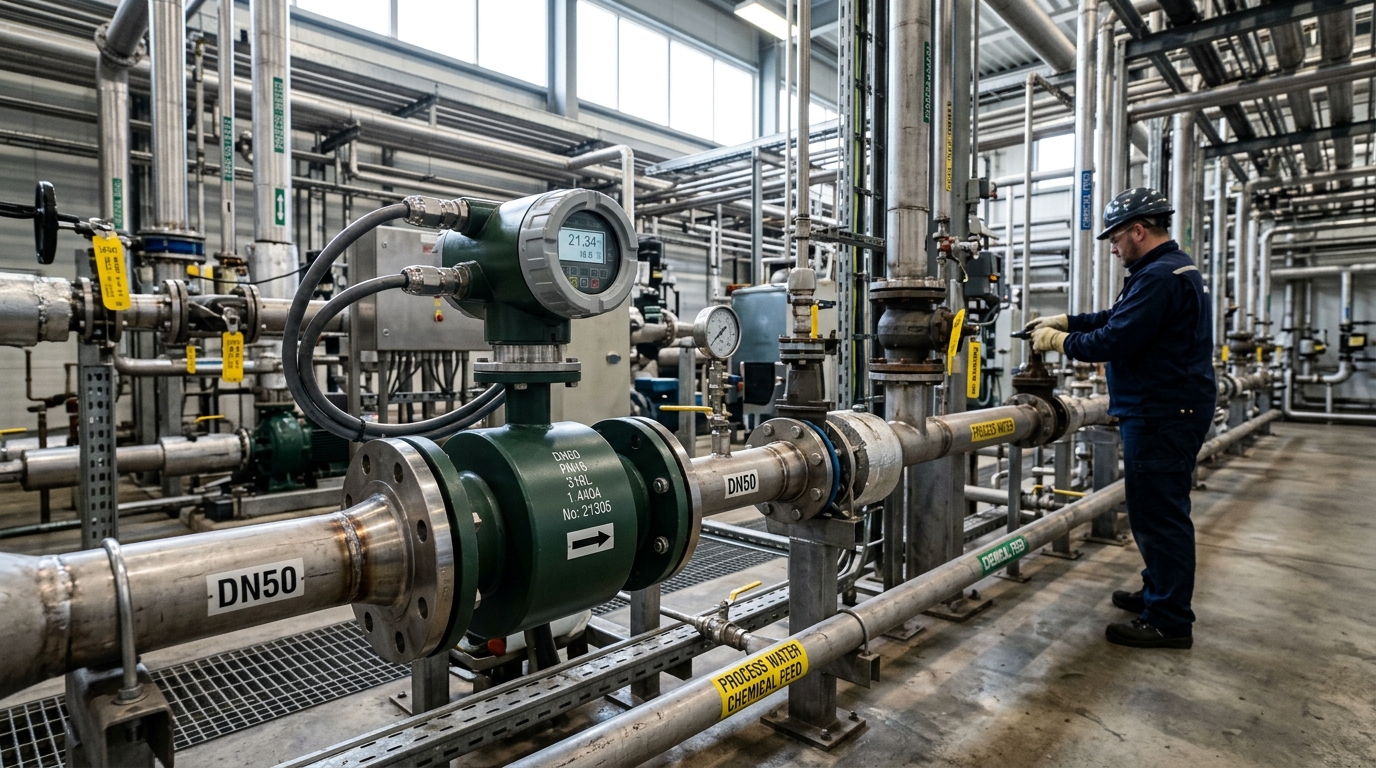
In scenarios such as chemical processing, pharmaceuticals, municipal wastewater, cooling water, and food ingredient batching, DN50 electromagnetic flowmeters are commonly used for metering conductive liquids at small to medium flow rates. The DN50 nominal diameter is 50 mm, with a flow area of approximately 0.00196 square meters; at a flow velocity of 1 m/s, the volumetric flow rate is about 7.05 m³/h, and at 3 m/s, it is approximately 21.2 m³/h. Therefore, DN50 typically covers process requirements ranging from several to dozens of cubic meters per hour, making it a typical size for acid and alkali dosing, circulating water, wastewater lifting, and ingredient transfer.
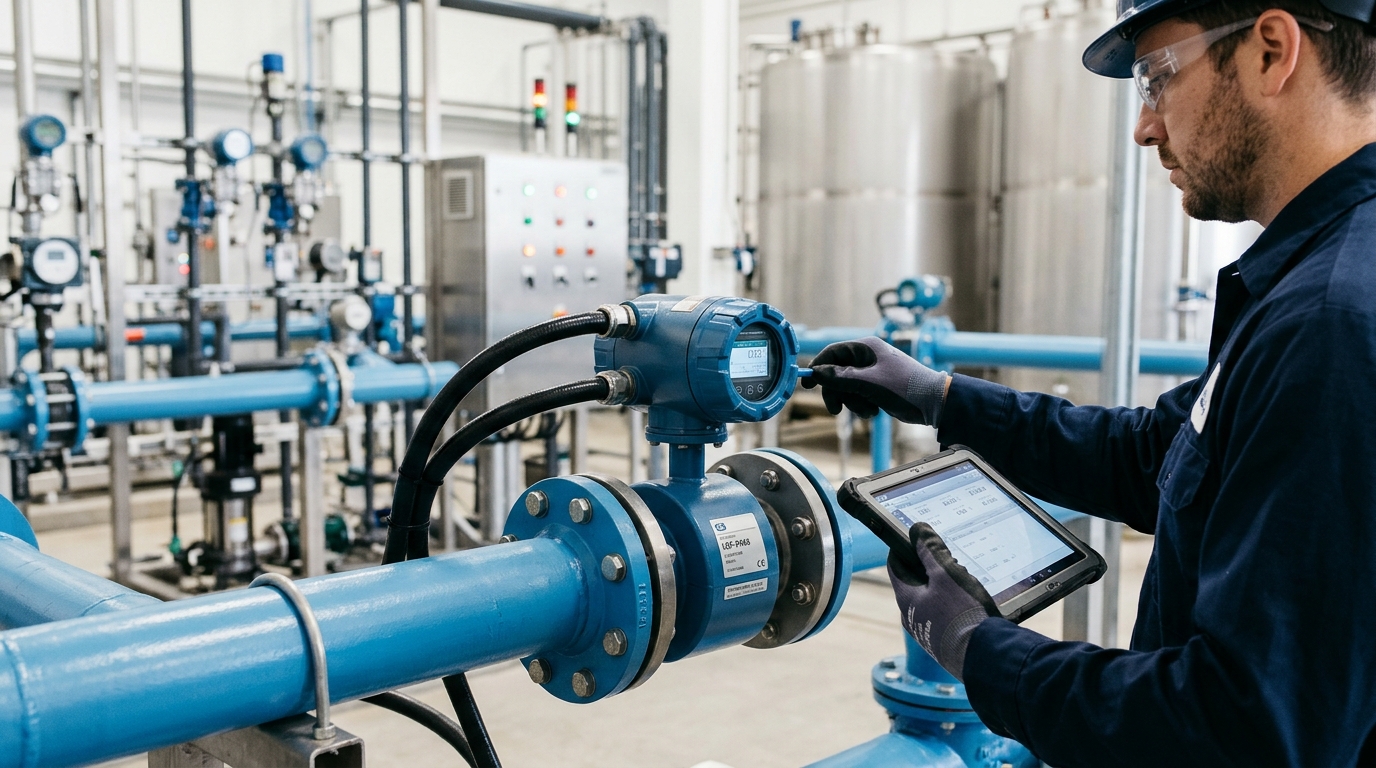
Based on Faraday's law of electromagnetic induction, the electromagnetic flowmeter features no flow obstruction in the measuring tube and low pressure loss, making it suitable for wastewater, acid and alkali solutions, slurries, and media containing solids. However, in anti-corrosion conditions, the factors that truly affect performance are the liner, electrodes, housing, excitation method, and installation configuration. In recent years, keywords such as LGF-PA66 and one-piece injection molding have frequently emerged, representing new routes in materials and structures for small and medium-sized anti-corrosion instruments. This article analyzes the advantages, disadvantages, applicable scenarios, and selection recommendations of different technical routes from a comparative perspective, providing a reference for engineering personnel.
Same Measurement Principle, Structural Routes Determine Application Boundaries
The induced electromotive force of an electromagnetic flowmeter is proportional to the average flow velocity. As long as the pipe is full, the conductivity meets the requirements, and the flow field is stable, the output exhibits good linearity. Common products can achieve an accuracy class of 0.5, with some custody transfer models reaching 0.2; the turndown ratio typically ranges from 1:20 to 1:100, depending on the converter algorithm, diameter, and site conditions. For DN50, the normal flow velocity is recommended to be controlled between 1 and 3 m/s, corresponding to a flow rate of approximately 7 to 21 m³/h; when operating below 0.3 m/s for extended periods, the signal is weak and susceptible to noise and zero drift.
Different structural routes are not simple substitutes but correspond to different installation conditions. For DN50 anti-corrosion pipelines, full-pipe integral or remote structures are generally preferred to ensure measurement repeatability and sealing reliability.
From an engineering perspective, the performance boundaries of an electromagnetic flowmeter are determined not only by the sensor but also by pipeline conditions, grounding, shielding, and converter algorithms. The same DN50 flowmeter may perform significantly differently in clean water, acid and alkali solutions, fiber-containing sludge, or low-conductivity media. Therefore, technical route comparisons should not stop at "whether it can measure," but should further evaluate "whether it can measure stably over the long term."
Liner and Housing Material Routes: Rubber, Fluoroplastics, Ceramics, and LGF-PA66
Rubber Liner
Commonly used for municipal wastewater and raw water. Natural rubber offers good elasticity and low cost but has limited resistance to high temperatures, oils, and strong oxidizers.
Fluoroplastic (PTFE/PFA)
Mainstream solution for highly corrosive conditions. High chemical stability with operating temperatures up to 180°C. Requires strict bonding processes to prevent delamination.
Ceramic Liner
Suitable for high-temperature, abrasive, and high-cleanliness scenarios (e.g., ore slurries). Brittle and sensitive to thermal shock, but offers excellent wear resistance.
LGF-PA66 One-Piece Injection Molding
Long glass-fiber reinforced polyamide 66. Integrates housing, flange support, and terminal box. Reduces assembly gaps, lowers weight, and improves external corrosion resistance for DN50 applications.
Regarding housing structure, traditional metal housings offer high strength but may suffer from external corrosion in acid mist or humid environments. The LGF-PA66 one-piece injection molding route enhances rigidity and dimensional stability. For small and medium-sized anti-corrosion applications like DN50, this solution reduces assembly gaps and metal exposure, lowering the risk of external corrosion while reducing weight. Common 30% to 50% glass fiber-reinforced PA66 can achieve a tensile strength of 180 to 260 MPa.
Excitation and Signal Processing Routes
- Low-Frequency Rectangular Wave: Mature and cost-controllable. Reduces polarization and power frequency interference. Ideal for clean water, wastewater, and weak acid/alkali media.
- Dual-Frequency Excitation: Aimed at slurries and solid-particle-containing media. High-frequency components suppress noise from particle impact, while low-frequency maintains zero-point stability.
- Low-Power Solutions: Targets pipe networks without power supplies. Extends battery life via intermittent sampling and wireless communication, though real-time performance is lower.
Converter functions are equally critical. Empty pipe detection, electrode contamination diagnosis, and excitation anomaly alarms can improve maintenance efficiency. For anti-corrosion flowmeters with LGF-PA66 one-piece injection molded housings, the grounding path and shield layer connection methods should be clearly defined, as the plastic housing reduces metal continuity.
Installation Configurations and Engineering Details
Installation conditions are often underestimated. Many electromagnetic flowmeter issues stem from insufficient straight pipe sections, pump and valve disturbances, negative pressure, air bubbles, vibration, or water immersion. It is generally recommended to have at least 5 pipe diameters upstream and 3 pipe diameters downstream; if there are elbows, tees, control valves, or pumps upstream, this should be increased to more than 10 pipe diameters.
Note: Although the DN50 diameter is small, stable flow fields must still be ensured when used for dosing metering or cost accounting. Insertion types are generally not used for DN50 due to lack of cost advantage and sensitivity to flow field variations.
Regarding installation orientation, electromagnetic flowmeters can be installed horizontally, vertically, or at an incline, but a full pipe must be ensured. Vertical installation is recommended with fluid flowing from bottom to top for easy venting; during horizontal installation, the electrode axis should be horizontal to prevent air bubbles from covering the electrodes.
Typical Application Cases
Fine Chemical Acid/Alkali Pipeline
Media: 32% HCl, 20% NaOH. Solution: PTFE/PFA liners, Tantalum/Hastelloy electrodes, LGF-PA66 IP67 housing to isolate media and reduce metal exposure.
Municipal Wastewater Dosing
Media: Sludge return, PAM dosing. Solution: Rubber/PTFE liners, 316L electrodes, remote converter. Emphasis on grounding rings and straight pipe sections after pumps.
Low Conductivity Pure Water
Issue: Conductivity 0.1–2 μS/cm (below 5 μS/cm limit). Result: Unstable signal. Recommendation: Use Ultrasonic or Coriolis mass flowmeters instead.
Food Ingredient Batching & CIP
Requirement: Hygienic standards, hot water cleaning. Solution: Sanitary design, 316L electrodes, IP69K housing. Focus on surface finish and cleanability.
Selection Recommendations: From Media to Lifecycle Cost
- Confirm Media Suitability: Core indicators include conductivity (≥5 μS/cm), corrosiveness, solid content, and temperature. Avoid deionized water, oils, gases, or steam.
- Select Diameter Based on Flow: DN50 is suitable for 1–3 m/s (7–21 m³/h). For flows <2 m³/h, consider smaller diameters; for >50 m³/h, consider DN80/DN100.
- Determine Liner and Electrode: Rubber/316L for wastewater; PTFE/PFA + Hastelloy/Titanium for strong acids; Ceramic for abrasion. Always check material compatibility tables.
- Evaluate Housing Route: Metal for high pressure/temp; LGF-PA66 for lightweight integration and corrosion resistance in DN50 applications.
- Clarify Accuracy & Maintenance: Class 0.5+ for custody transfer; Class 1.0 for process control. Establish maintenance cycles for zero-point calibration and cleaning.
- Judge Total Lifecycle Cost: Consider installation, downtime, and spare parts. Matched materials and reliable structures often prove more economical over time despite higher initial prices.
Concluding Outlook
From an industry trend perspective, electromagnetic flowmeters are evolving from single measurement instruments to process sensing nodes. The application of long glass fiber-reinforced materials like LGF-PA66 in small and medium-sized anti-corrosion products is expected to further enhance housing integration, reduce weight, and improve aesthetic consistency.
Yicai Technology believes that there are no absolute advantages or disadvantages in the technical routes of electromagnetic flowmeters, only boundary adaptation. Engineering personnel should make choices based on data: whether conductivity meets standards, whether flow velocity is reasonable, whether materials are resistant, whether installation ensures a full pipe, whether the signal is stable, and whether maintenance is controllable. Only when these conditions are confirmed item by item can electromagnetic flowmeters play their role in long-term stable and reliable metering in DN50 anti-corrosion scenarios.