Background: The Variable-Load Duty in WWTPs
Unlike the relatively steady hydraulics of a potable distribution network, a wastewater treatment plant subjects its electromagnetic flowmeters to aggressive load variation. Diurnal influent peaks typically run 3:1 to 5:1 above nighttime minima, and combined sewer systems can multiply dry-weather flow sixfold during storm events. Nighttime low flow frequently falls into the bottom 5–10% of the meter's range, pushing against the measurement floor. Influent conductivity can swing below 100 µS/cm when industrial discharges mix in, return-activated sludge carries entrained gas, and pipework alternates between full, partially full and even sub-atmospheric conditions. In practice, three failure modes dominate: insufficient turndown, empty-pipe errors and low-flow drift.
Technical Analysis
1. Turndown ratio and excitation mode
Covering both dry-weather minima and storm peaks requires a turndown of at least 100:1; units rated 150:1 or better are preferred. Under low-conductivity conditions, conventional line-frequency excitation produces weak signals and unstable zeros — dual-frequency or programmable-pulse excitation keeps low-frequency zero stability while the high-frequency component restores signal-to-noise ratio in poorly conductive media. Size the bore on the true minimum flow, not the average: maintain ≥0.3 m/s at minimum and confirm peak velocity stays within the liner limit (typically ≤10 m/s).
2. Empty-pipe and partially filled pipe handling
A magnetic meter only implements Faraday's law correctly when the pipe is full; partial filling causes systematic under-registration. Two engineering paths exist: hydraulic assurance — vertical installation with upward flow, or a back-pressure valve or raised downstream section maintaining ≥0.5 m of head — and instrument-side detection, where the converter monitors excitation-loop impedance or dedicated sensing electrodes, latching the output and raising an alarm when the pipe runs empty so that false totals never enter the water balance report.
3. VFD interference and signal integrity
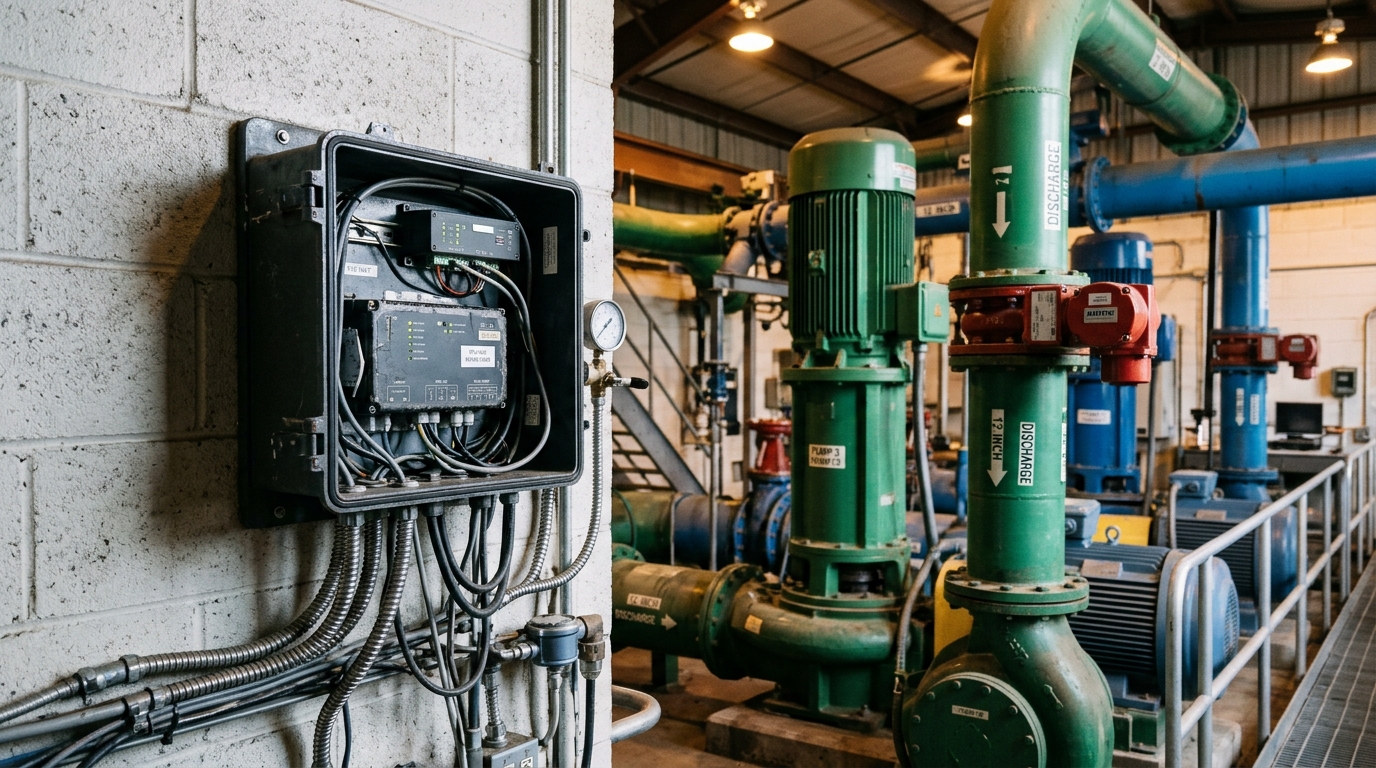
Blower and lift-pump variable-frequency drives are the dominant noise source. Countermeasures: dedicated instrument earth (≤10 Ω, never shared with VFDs), double-shielded signal cable routed ≥30 cm from power cables, and converters located ≥1.5 m from drive cabinets. For large bores (DN1000+), earth rings are preferable to earthing electrodes — lower pressure loss and easier maintenance.
Recommendations: Installation, Verification and Data Loop
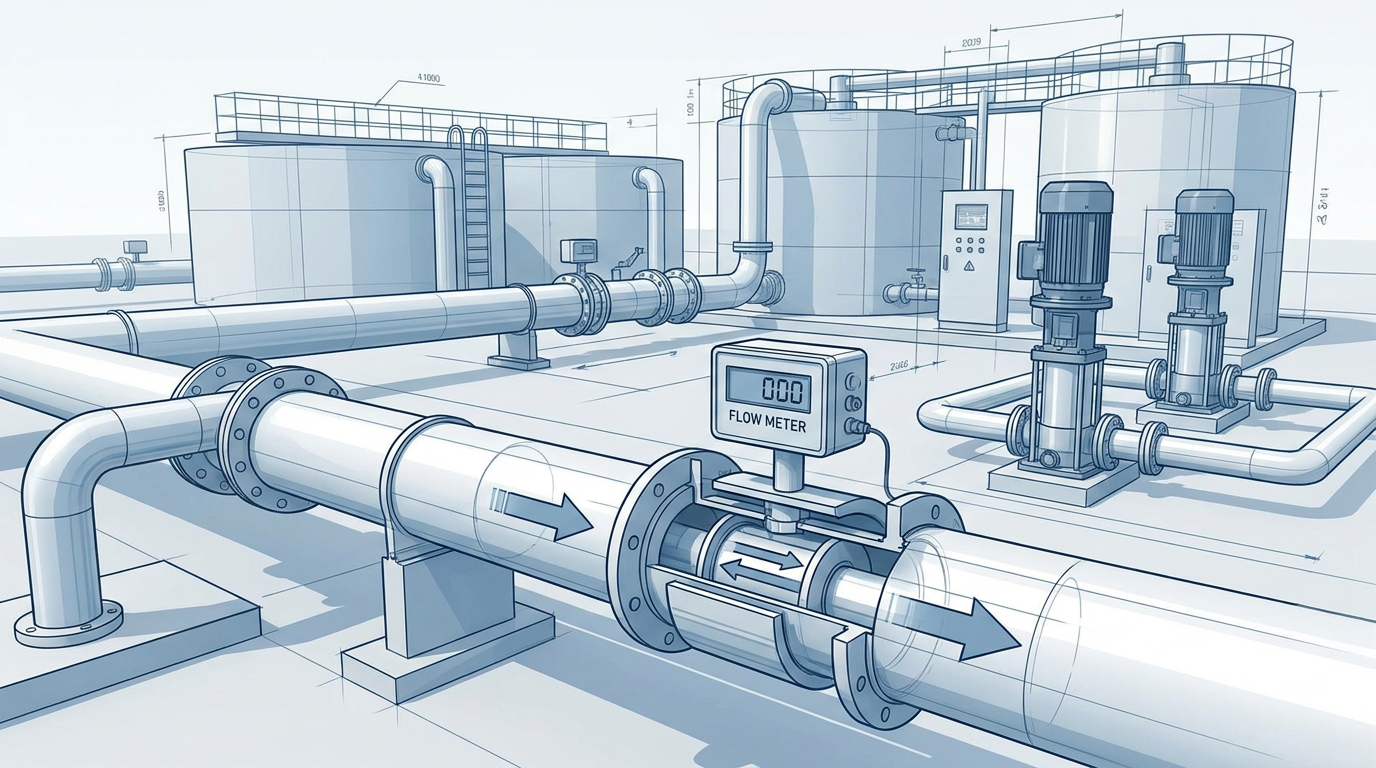
- Installation: ≥5D upstream and ≥2D downstream straight runs, preferably in the stable post-pump section. Match liner and electrode to the medium — neoprene plus 316L for municipal duty, polyurethane plus titanium for abrasive sludge, and avoid unsupported PTFE liners wherever negative pressure can occur.
- Verification: quarterly full-pipe zero checks (deviation ≤±0.5% FS) and an annual in-situ comparison against a clamp-on ultrasonic reference or gravimetric/volumetric standard, with master meters graded per ISO 6817 and OIML R49 accuracy classes as the baseline for water-balance accounting.
- Data integration: connect via 4–20 mA plus RS485 Modbus RTU to an IoT RTU and publish over 4G/NB-IoT to the smart water platform — enabling influent surge alarms, demand-based aeration control and kWh-per-m³ analysis.
Summary
Selecting magnetic flowmeters for wastewater duty reduces to three rules: size on minimum flow, choose materials for the medium, and match protection to the installation. Turndown and excitation define adaptability to variable loads; full-pipe assurance defines data credibility; earthing and shielding define long-term stability. Executed end to end — and closed with an IoT RTU telemetry loop — modern magmeters hold ±0.5% class accuracy through the harshest WWTP duty cycles.