Foundations First: AMI, Resilience, and the Quiet Rise of Embedded Intelligence
Smart metering is evolving from a billing tool into the foundational nervous system for adaptive, AI-driven, and disaster-resilient water infrastructure—globally. This transformation centers on advanced metering infrastructure (AMI), embedded intelligence at the edge, and high-fidelity sensing that enables true subsurface visibility and climate-adaptive operations.
The Infrastructure Pivot: From Read-Only Meters to Real-Time Command Layers
Bluefield Research forecasts that digital water solutions spending across the U.S. and Canada will double by 2036—with advanced metering infrastructure (AMI) growing at a 9.7% CAGR, more than triple the pace of conventional meters.
AMI is no longer just about remote reads. It’s the essential data backbone enabling predictive maintenance, dynamic pressure management, leak localization, and seamless integration with AI analytics platforms.
As California Water Service and Municipal District Services modernize customer portals and service workflows, their underlying systems increasingly depend on continuous, high-fidelity flow and pressure telemetry—not just monthly consumption snapshots.
Resilience Beyond Redundancy: Embedded Intelligence for Climate-Adaptive Operations
The Smart Water Box exemplifies a paradigm shift: infrastructure designed not only to deliver water—but to sustain critical access when centralized systems falter.
Its ability to operate independently during storms, droughts, or municipal outages reflects a broader redefinition of utility responsibility—moving from “keeping taps running” to guaranteeing assured continuity.
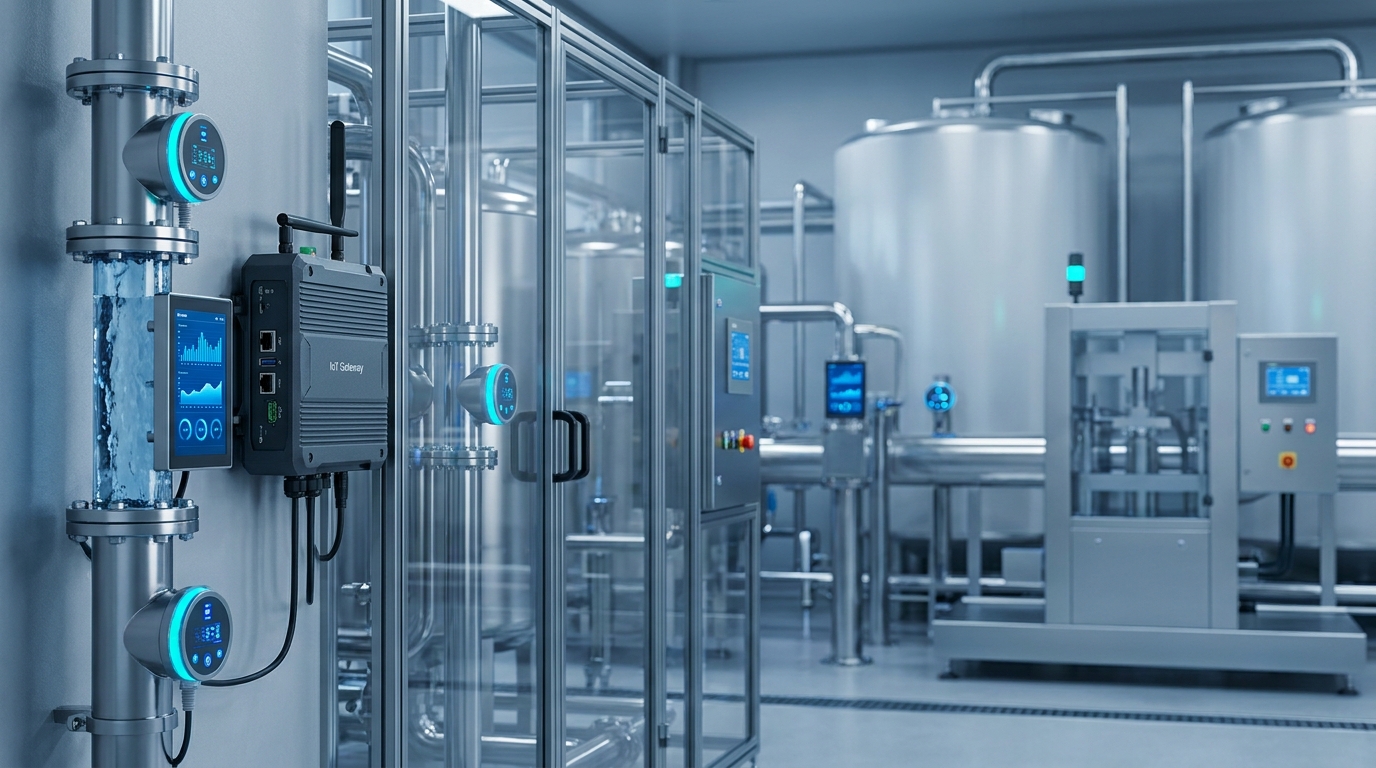
This demands decentralized intelligence: local storage, autonomous control logic, and real-time condition awareness at the point of use—enabled by devices like Ecolor’s HERO V9 RTU, featuring standalone operation, multi-sensor fusion, and cellular/NB-IoT failover.
AI Training Gaps Reveal a Deeper Challenge: Data Quality Over Algorithm Hype
The University of Wisconsin’s specialized AI training program for water professionals highlights a pivotal bottleneck: capability, not just technology. AI adoption hinges on cross-disciplinary fluency among utility managers, OT/IT staff, data scientists, and regulators.
Algorithms trained on sparse, inconsistent, or low-resolution data yield brittle insights. That’s why sensor fidelity matters profoundly—especially for mission-critical AI applications in water infrastructure.
Ecolor 80GHz Visual Fusion Radar Level Sensor
Millimeter-level precision under turbulent, vapor-laden, or foam-covered conditions—delivering clean, deterministic input for trustworthy AI alerts.
Ecolor LGF Electromagnetic Flowmeter
±0.2% accuracy across wide flow ranges and varying conductivity—ensuring billing integrity and feeding robust datasets for hydraulic modeling and anomaly detection.
Closing the Underground Visibility Gap: Subsurface Infrastructure Awareness
True system health requires seeing inside pipes—especially aging, buried mains. Ecolor’s multi-band Doppler flow radar integrates real-time flow velocity profiling with embedded camera inspection—a world-first capability for non-invasive, in-pipe condition assessment.
Unlike traditional CCTV, it operates through existing access points—even under full flow—delivering synchronized video, sediment mapping, and flow stratification analysis.
For utilities facing rising main break rates and tightening regulatory reporting windows, this transforms reactive repair cycles into proactive asset management—directly aligning with Bluefield’s finding that digital spend growth accelerates fastest where data drives capital planning.
A Global Convergence, Not a Regional Trend
Though rooted in North American deployments, the drivers—climate stress, aging infrastructure, regulatory transparency mandates, and citizen expectations for service reliability—are universal.
Chinese water authorities, for instance, are rapidly scaling digital twin pilots in Shenzhen and Chengdu—demanding high-accuracy, low-maintenance field instrumentation compatible with domestic IoT protocols and cloud platforms.
Companies like Ecolor Technology, with deep expertise in electromagnetic, radar, and Doppler physics—and products certified to IP68, EMC Class B, and ISO 4064 standards—are positioned not as exporters of hardware, but as partners in foundational sensing architecture.
Sources
- California Water Service
- Bluefield Research: U.S. and Canada Digital Water Solutions Spend to Double by 2036 as Utilities Scale Up
- Smart Water Box Official Site | Emergency Water Solution Guide
- University of Wisconsin: Artificial Intelligence (AI) in the Water and Wastewater Sector: Comprehensive Training
- Municipal District Services – Water and municipal water district services